On a February morning in 2023, a 34-year-old man from Oaxaca stood in a Florida tomato field at 5:30 a.m., his wrists raw from the previous day's harvesting. His H-2A visa binds him to a single employer. If he complains about the piece rate, the unventilated trailer he shares with seven other men, or the deductions from his paycheck for the ride to the field, he is not just fired. He is deported. The employer who holds his legal status does not need to threaten him directly. The structure of the program does that work. More than 370,000 workers entered the United States on H-2A visas in 2023. Every single one of them became property of a specific capital holder for the duration of their contract. This is not guest work. It is a state-sanctioned system of labor bondage, the direct descendant of the Bracero Program that industrialized the exploitation of Mexican labor from 1942 to 1964.
The H-2A Program Binds Workers to Employers With Legal Force
The defining feature of the H-2A program is not the wage floor or the seasonal limitation. It is the legal mechanism that chains the worker to a single employer. An H-2A worker cannot seek better pay from a different farm. They cannot quit and find a new job in the same industry. If they leave the employer named on their visa, they immediately lose legal status and become subject to deportation. This is not a minor regulatory detail. It is the central structural feature of the program, the one that makes all other forms of exploitation possible. Under the Marxist theory of absolute surplus value, capital extracts more labor by extending the working day or intensifying the work pace. The H-2A program enables this because the worker has no exit option. When a Bracero in 1952 was caught complaining about the pay, the grower simply called the border patrol. When an H-2A worker does the same in 2024, the employer revokes the visa. The mechanism is cleaner, but the result is identical: a workforce that cannot refuse, cannot organize, and cannot flee exploitation. The median wage for H-2A workers was $15.56 per hour in 2023, but this number obscures the real conditions because it does not account for the deductions for housing, transportation, and visa processing fees that employers extract from those wages. In practice, many workers take home far less than the advertised minimum. The Department of Labor conducted audits on less than one percent of H-2A employer applications in 2023. Capital has little to fear from a enforcement apparatus that inspects one out of every one hundred cases.
Employer-Controlled Housing Creates Total Institutional Power
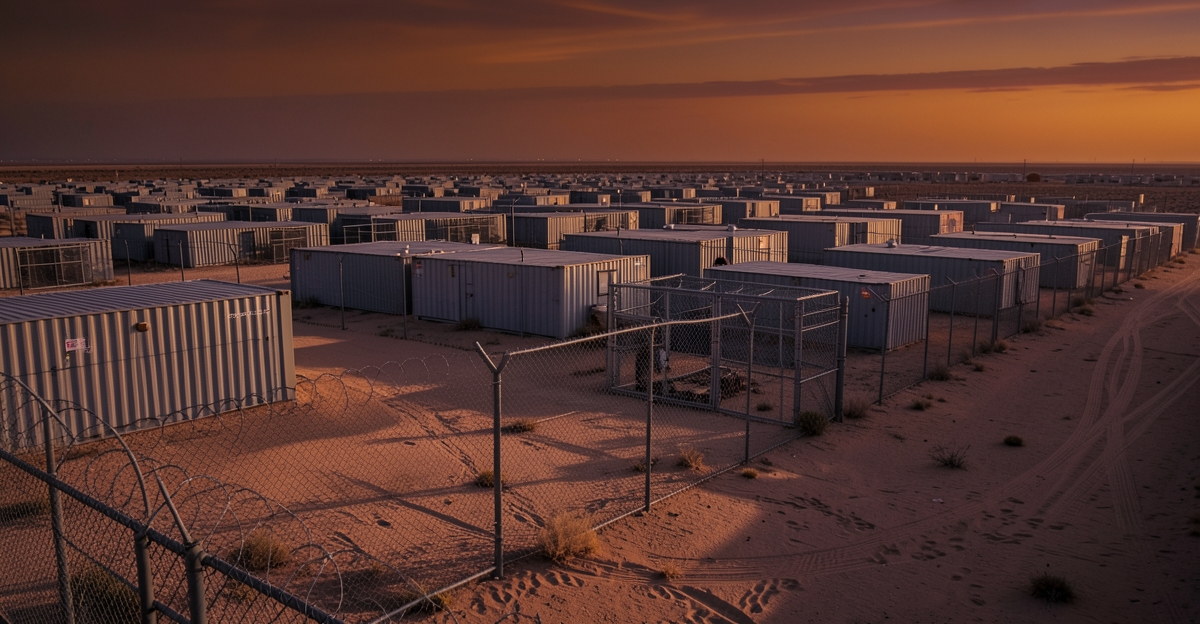
The H-2A program requires employers to provide housing to their workers. This sounds like a protection. In practice, it is a cage. When the employer controls where the worker sleeps, eats, and stores their belongings, the separation between work time and personal time collapses. The Bracero Program operated identical housing arrangements: workers were housed in camps controlled by the growers, often in barracks surrounded by fences, with guards ensuring no one left without authorization. The H-2A version is updated for the twenty-first century — trailers converted into bunkrooms, repurposed shipping containers, motels where the employer holds the keys — but the logic is unchanged. The commodification of migrant labor requires total control over the worker's reproduction. The worker cannot cook their own food if there is no kitchen. They cannot rest properly if eight men share a space designed for four. They cannot seek medical care if they have no transportation. And they cannot organize because any meeting in the employer's housing is subject to employer surveillance. This is institutional power in the classical sociological sense: the employer does not need to use force because the structure of the housing arrangement makes resistance nearly impossible. The H-2A housing provision, sold as a humanitarian measure, actually functions as a mechanism of total control. The worker who steps out of line does not just lose their job. They lose their roof, their bed, and their legal right to be in the country, all in a single motion.
From Bracero to H-2A: The Unbroken Arc of Agricultural Labor Bondage
The Bracero Program, established by bilateral agreement between the United States and Mexico in 1942, processed 4.6 million contracts over its twenty-two-year lifespan. The mechanism was simple: the US government recruited Mexican workers, assigned them to specific agricultural employers, and guaranteed that any worker who violated the contract would be returned to Mexico immediately. Growers controlled housing, food, and transportation. Workers could not bargain, could not strike, and could not leave. The program was formally terminated in 1964 after sustained pressure from labor unions and civil rights organizations, but the demand for cheap, bound agricultural labor did not disappear. It adapted. The H-2A program, created by the Immigration and Nationality Act of 1952 and expanded significantly after the Bracero termination, absorbed the same structural logic into a nominally different legal framework. The numbers prove the continuity. In 1990, the H-2A program certified roughly 15,000 positions. By 2023, that number had grown to over 370,000, with some estimates suggesting that the real figure is higher because of the program's decentralized certification process. The program has expanded every year since 2010, with no sign of contraction. The contradiction here is sharp: the United States ended the Bracero Program precisely because it created conditions of labor bondage that were incompatible with the postwar liberal order. But the demand for super-exploitable agricultural labor never disappeared. Capital simply found a new legal vessel for the same relationship. The Bracero Program ended in name. Its substance lives on in every H-2A contract signed today.
Wage Theft Thrives Because the Legal Structure Makes Workers Unorganizable
Estimates of wage theft in US agriculture run as high as $24 billion per year across all farmworker categories. For H-2A workers specifically, the mechanisms of theft are built into the legal structure. The employer deducts housing costs, transportation fees, and visa processing expenses from wages. The worker has no independent means of verifying whether these deductions are legal or extortionate. The worker cannot file a complaint without risking their visa status. And even if a complaint is filed, the Department of Labor's enforcement rate — measured as the percentage of employers who face any consequence for violations — sits below one percent. This is not due to resource constraints alone. It is a feature of a system designed to make workers unorganizable. The parallel with carceral labor exploitation is instructive: in both cases, the state certifies a category of worker who cannot form a union, cannot strike, and cannot exit. The H-2A worker exists in what Marx called the reserve army of labor — a population of potential workers kept available for capital to draw upon when needed and discard when not. But the H-2A worker is something worse: a member of the reserve army who has been conscripted into active service under conditions that prevent any collective action. The wage theft statistics are not merely evidence of employer bad behavior. They are evidence of a legal structure that makes theft nearly risk-free. When the probability of enforcement against an employer is below one percent, the rational capitalist calculates that cheating is simply good business. The $24 billion in annual farmworker wage theft is not an aberration. It is the system functioning as designed.
The Reserve Army of Bound Labor Suppresses Wages for All Farmworkers
The H-2A program does not just exploit the 370,000 workers who enter on these visas each year. It suppresses wages for the entire agricultural working class. The mechanism is straightforward. When a significant portion of the workforce cannot quit, cannot bargain, and cannot leave the industry, the bargaining power of every other worker in that industry is degraded. Employers can point to the H-2A wage floor — artificially low, artificially enforced — and argue that it represents the "market rate." Farmworkers who are not on H-2A visas, who might otherwise have some leverage through mobility or legal status, find themselves competing with a labor force that has no such options. The presence of bound labor in the agricultural sector functions as a drag on wages for all agricultural workers, documented and undocumented alike. This is a classic Marxist dynamic: capital uses a segmented labor market to drive down the value of labor power across the board. The H-2A worker, stripped of the ability to sell their labor to the highest bidder, becomes the baseline against which all other agricultural wages are measured. The result is wage suppression that benefits the largest growers, the agribusiness corporations that control supply chains, and the retail giants that purchase the produce. The working class as a whole loses, but it loses in a particularly insidious way: the H-2A worker loses everything, the citizen farmworker loses leverage, and the consumer pays for the system through the externalized costs of poor housing, inadequate healthcare, and the ongoing destruction of rural labor communities. This is not a policy failure. It is a class victory for capital, achieved through a legal program that reproduces, under modern conditions, the same bondage that the Bracero Program established eighty years ago. The H-2A program is not a guest worker program. It is a system of waged serfdom, and it functions beautifully for those who profit from it.