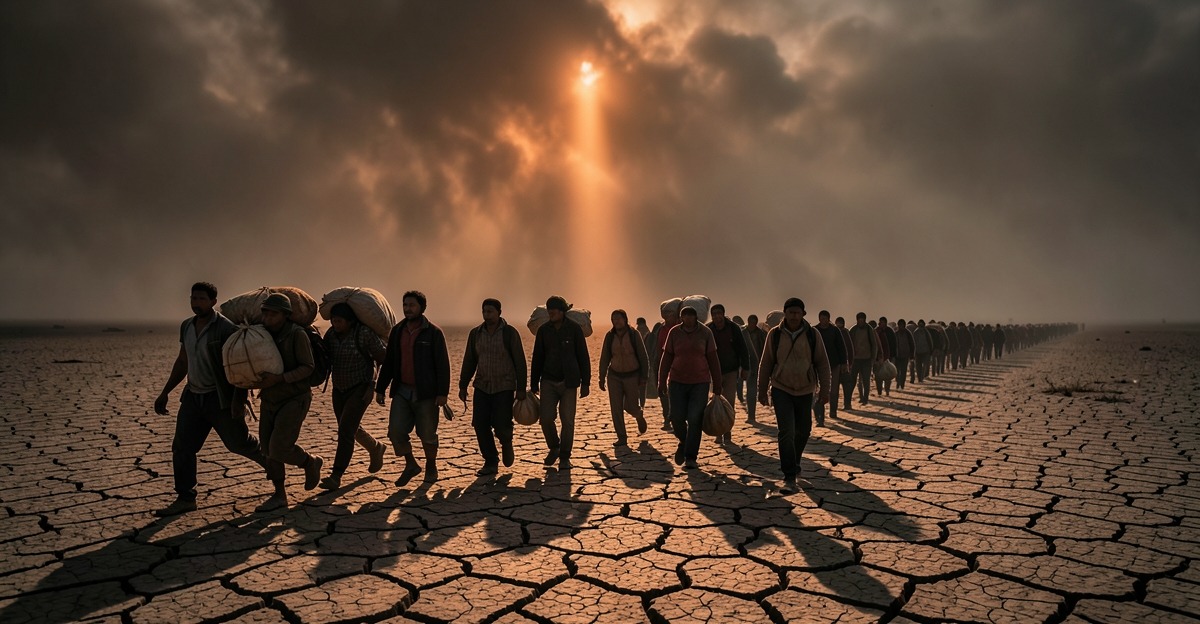
In February 2020, Recep Tayyip Erdoğan announced that Turkey would no longer prevent Syrian refugees from crossing into Europe. Within days, thousands of people massed at the Greek land border, only to be met by Greek border guards firing tear gas and rubber bullets, by pushbacks in the Aegean Sea, and by a European Union that had already paid Turkey €6 billion to make sure this exact scenario never happened. The crisis was manufactured, contained, and then used as proof that the EU-Turkey Deal of March 2016 was not merely a policy arrangement but a prototype for a new mode of imperial governance: the outsourcing of border violence to authoritarian client states.
The EU-Turkey Deal Established the Price of Human Containment
The EU-Turkey Statement, signed on March 18, 2016, was the first comprehensive agreement in which the European Union paid a non-member state to actively prevent refugees from reaching its territory. Under the deal, Turkey agreed to readmit all migrants and refugees who crossed irregularly into Greece, effectively making Turkey Europe's designated buffer zone. In exchange, the EU pledged €6 billion through the Facility for Refugees in Turkey, visa liberalization for Turkish citizens, and the resumption of EU accession talks—a carrot that was never seriously offered.
Between 2016 and 2023, Turkey received the full €6 billion, but the number of Syrian refugees it warehoused remained at approximately 3.6 million. The United Nations High Commissioner for Refugees (UNHCR) has repeatedly criticized the deal for violating the principle of non-refoulement and for creating a "protection gap" where asylum seekers in Turkey lack access to fair procedures. The European Council on Refugees and Exiles reported that the deal effectively dismantled the Greek asylum system, turning the Lesbos hotspot into a detention facility where processing was replaced by deterrence.
The deal was never about sharing responsibility. It was about establishing the price of human containment. The EU calculated that €6 billion was cheaper than processing asylum claims, cheaper than integrating refugees, and cheaper than facing the political backlash of open borders. This calculation revealed the fundamental contradiction at the heart of European migration policy: the working class of Europe is told that borders protect their wages and social services, while capital demands a flexible reserve army of labor drawn from the global periphery. The EU-Turkey Deal resolved this contradiction not by choosing one side but by externalizing the violence of the border to an authoritarian state that could act without European legal constraints.
Turkey's Leverage Reveals the Political Economy of Border Outsourcing
The February 2020 crisis demonstrated that externalization creates its own vulnerabilities. When Erdoğan "opened the gates," he was not acting out of humanitarian concern for the refugees in his country. He was leveraging the 3.6 million people Turkey had been paid to contain as a bargaining chip in the Syrian conflict. The message was clear: if the EU wanted Turkey to continue its role as border guard, it would have to pay more, both in cash and in political concessions.
This threat worked. The EU quickly pledged additional funds and, more importantly, signaled that it would not allow Greece to be overwhelmed—precisely because the entire system of externalization depends on the credible threat that the client state will stop cooperating. When a client state threatens to break the containment system, it forces the imperial core to either absorb the refugees directly (which is politically toxic) or pay more for containment (which is financially manageable). Turkey's leverage was not its military power or economic strength, but its capacity to threaten the EU with the very people the EU had paid it to hide.
The Marxist concept of the reserve army of labor—the pool of unemployed and underemployed workers that capital uses to suppress wages—is essential to understanding why this system persists. Refugees are not simply victims of war; they are potential workers whose labor power is systematically devalued by their legal status. By warehousing 3.6 million Syrians in Turkey, the EU maintains a massive reserve army of labor within easy reach of European employers, but without the political costs of integrating these workers into European welfare states. Turkish capitalists benefit from cheap Syrian labor; European capitalists benefit from the downward pressure this reserve exerts on wages across the continent.
The Template Spread: Libya, Tunisia, Morocco, Egypt
The EU-Turkey Deal was not an isolated arrangement. It became the model for a network of agreements with authoritarian states along Europe's southern periphery. The EU-Libya Memorandum of Understanding, signed in 2017, effectively deputized the Libyan Coast Guard—a militia force implicated in human trafficking, torture, and arbitrary detention—to intercept boats in the Mediterranean and return people to Libyan detention centers. The Italian government, acting as the EU's proxy, provided funding, training, and equipment to a system that the UN has described as "crimes against humanity."
In July 2023, the EU signed a similar deal with Tunisia, providing €150 million for border control equipment and €900 million in macroeconomic assistance in exchange for Tunisia's cooperation in preventing irregular migration. Tunisian President Kais Saied, who had recently consolidated authoritarian rule and launched a racist campaign against sub-Saharan African migrants, was only too happy to accept. The deal replicates the Turkey template: pay a strongman to do the dirty work of border enforcement, then look away when human rights abuses occur.
Morocco and Egypt have signed similar agreements, each tailored to the specific political economy of the client state. Morocco receives EU funding for border surveillance technology and fishing industry support in exchange for preventing departures from its Atlantic coast. Egypt extracts security assistance and development funding for blocking the Eastern Mediterranean route. Each deal reinforces a system where the exploitation of migrants is the foundation of the agreement itself. The construction of Qatar's World Cup infrastructure showed how migrant labor becomes a commodity traded between states; the EU border deals show how the very bodies of migrants become bargaining chips in inter-imperial negotiations.
Externalization Maintains Labor Supply While Eliminating Political Cost
The brilliance of the externalization model from capital's perspective is that it solves two problems simultaneously. First, it ensures a steady supply of cheap, exploitable labor without the political friction of integrating these workers into European society. Second, it displaces the violence of border enforcement onto states that are either authoritarian by nature or have been made authoritarian by the relationship itself. The EU can maintain the appearance of a humane migration policy while funding states that engage in systematic human rights abuses.
The labor supply function is not incidental to externalization; it is its central purpose. European employers in agriculture, construction, logistics, and domestic work depend on migrant labor that exists in a semi-legal limbo—present enough to work, precarious enough to be cheap. The EU-Turkey Deal and its successors maintain this precarity by ensuring that refugees never fully integrate into European labor markets. They remain in Turkey, in Tunisia, in Libya, available as a reserve but not present as a political constituency. This is the direct link between border enforcement and wage suppression: every migrant prevented from crossing is a worker whose labor power is devalued by the threat of deportation.
Consider the numbers. In 2022, the EU received approximately 160,000 asylum applications from Syrians, a tiny fraction of the 3.6 million trapped in Turkey. The same year, German GDP grew by 1.8%, yet real wages fell due to inflation exacerbated by labor shortages in key sectors. The system is designed to maintain this contradiction: capital needs workers, but the political system cannot admit them as equals. Externalization provides the solution by keeping workers close enough to be exploited but distant enough to be denied rights. The super-exploitation of prison labor follows the same logic: barriers are erected not to exclude labor but to make it more profitable.
The Authoritarian Bargain: Human Rights as Negotiating Currency
Every EU externalization deal contains an implicit authoritarian bargain: the EU will overlook human rights violations in exchange for border enforcement. The Libyan Coast Guard returns people to detention centers where they face torture, rape, and forced labor. The Tunisian government deports sub-Saharan Africans to desert border zones with no water or shelter. The Turkish government deports Syrians back to a war zone. In each case, the EU's response is to increase funding.
This is not hypocrisy. It is the logical expression of a system that treats human beings as commodities and their suffering as an acceptable cost of doing business. The Marxism of this analysis lies in recognizing that the liberal discourse of "human rights" is itself a negotiating currency used to extract concessions from authoritarian states while maintaining the exploitative relationship. When the EU "expresses concern" about conditions in Libyan detention centers, it is playing a role in a theater designed to obscure the material reality: the EU funds those detention centers and depends on their continued operation.
The contradiction is productive. It generates exactly the kind of crisis that justifies further securitization. Each scandal about Libyan coast guard abuses is followed by EU proposals for more surveillance, more funding for "coast guard capacity building," and more cooperation with the very forces committing the abuses. The system produces its own justification in a closed loop that serves only the interests of capital accumulation. For the working class—both European and migrant—the result is the same: a world where mobility is a privilege of capital and immobility is a punishment for labor.
The EU-Turkey Deal was not a response to a crisis. It was the creation of a permanent crisis management apparatus designed to ensure that the global reserve army of labor remains available but contained, exploitable but rightsless, present but invisible. As long as the European economy depends on cheap migrant labor, the border will be both a barrier and a filter—stopping the worker from becoming a citizen while ensuring the worker arrives as a commodity.