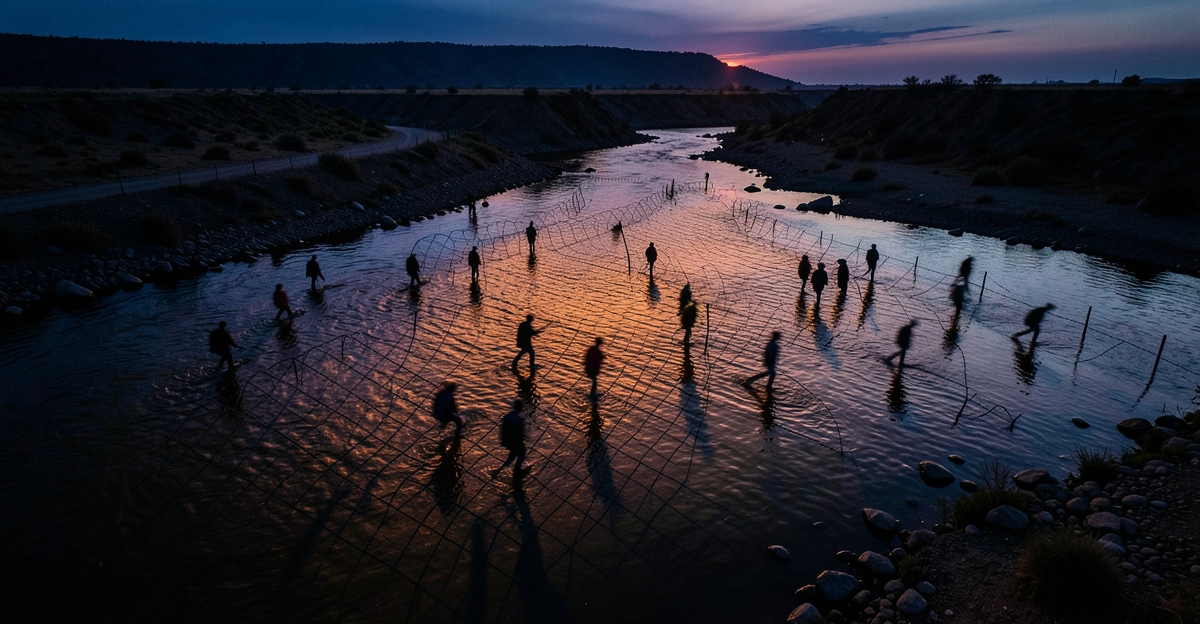
On March 20, 2020, as the novel coronavirus began its deadly march through American working-class communities, the Centers for Disease Control and Prevention issued a little-noticed order under Section 362 of the Public Health Service Act. The ostensible purpose: to prevent the introduction of COVID-19 into land ports of entry and border detention facilities. In practice, the CDC order handed the Department of Homeland Security a legal sledgehammer. Within twelve months, Title 42 would be used to expel over 500,000 migrants without any opportunity to claim asylum. By the time the order was finally terminated in May 2023, that number had exploded to 2.8 million expulsions—more than the total number of removals carried out under all previous Trump-era policies combined. The pandemic had provided the capitalist state with a pretext to implement what immigration hardliners like Stephen Miller had long dreamed of: the suspension of asylum law itself.
Title 42 Converted Public Health into Border Enforcement Infrastructure
The CDC order was drafted in direct consultation with DHS officials and White House immigration hardliners, not epidemiologists. The Public Health Service Act had been designed to quarantine individuals with communicable diseases at ports of entry—a narrow, case-by-case medical intervention. Title 42 repurposed it as a categorical ban on asylum access for anyone arriving at the southern border. The legal alchemy was stunning: a statute intended to stop the spread of smallpox and yellow fever became the mechanism for summarily expelling Honduran families fleeing gang violence, Guatemalan farmers fleeing crop failure driven by climate change, and Mexican workers fleeing cartel terror. This was not bureaucratic error or pandemic panic. This was the calculated deployment of public health authority to accomplish what immigration law could not: the complete suspension of the Refugee Act of 1980 and the United Nations 1951 Refugee Convention. The capitalist state understood that the pandemic created a legal vacuum, and it filled that vacuum with the most aggressive border enforcement apparatus in modern American history.
The expulsion numbers alone tell a story of deliberate policy, not public health necessity. During the two years Title 42 was in full effect, the CDC repeatedly renewed the order despite growing evidence that migrants were no more likely to carry COVID-19 than any other population group. The expulsions were not accompanied by testing, quarantine, or any meaningful health intervention. Migrants were simply apprehended, processed with minimal paperwork, and physically removed—often within hours. Public health was the justification, not the goal. The goal was expulsion without due process, and Title 42 delivered it at industrial scale. Between March 2020 and May 2023, Border Patrol conducted 2.8 million expulsions under the order, many involving the same individuals expelled multiple times. This was not a health policy; it was a deportation machine disguised in CDC livery.
Operation Stonegarden Deputized Local Police as Immigration Agents
If Title 42 was the federal apparatus, Operation Stonegarden was the local enforcement arm that gave border militarization a community-level face. Originally established in 2004 as a modest grant program to reimburse local law enforcement for overtime costs related to border security, Operation Stonegarden has ballooned into a $180 million annual program that funds everything from armored vehicles to helicopter surveillance in communities hundreds of miles from the border. The program is administered not by DHS but by the Federal Emergency Management Agency, a detail that underscores how thoroughly the capitalist state has integrated border policing into its emergency management infrastructure. Immigration enforcement—a civil, not criminal, matter—is funded through the same mechanism that pays for hurricane response and earthquake relief. The crisis frame is not incidental; it is structural.
Under Operation Stonegarden, local police departments in states like Arizona, Texas, and New Mexico receive grants to purchase military-grade equipment, pay overtime for joint patrols with Border Patrol, and establish checkpoints on major highways. The program explicitly requires participating agencies to coordinate with federal immigration enforcement, creating a pipeline that funnels local policing into federal deportation operations. A traffic stop for a broken taillight in a New Mexico county can become the initiating event for an immigration enforcement action that ends with a family separated and a worker expelled. The democratic pretext—that local police are simply "assisting" federal authorities—masks the reality: Operation Stonegarden has transformed municipal law enforcement into an extension of the border security state. Local cops carry out immigration enforcement without the training, oversight, or accountability mechanisms that govern federal border agents. They are border patrol without the badge, the training, or the legal constraints.
The contradiction here is sharp and revealing. Capital requires a reserve army of labor—the Marxist term for the unemployed and underemployed workers whose desperation keeps wages low and discipline tight for those who are employed. Immigrant workers, particularly those without legal status, form a critical segment of this reserve army, providing super-exploitable labor for agricultural, construction, hospitality, and service industries. Operation Stonegarden simultaneously serves two contradictory functions: it terrorizes migrant communities into accepting lower wages and worse conditions, and it periodically expels workers when their labor is no longer immediately necessary. The program is not about "public safety" in any meaningful sense. It is about maintaining a pool of disposable labor that can be activated or deactivated at the whim of capital. When COVID-19 disrupted supply chains and threatened labor-intensive industries, the state did not loosen enforcement to allow migrant workers to fill critical roles; it tightened enforcement to ensure workers remained desperate and compliant.
Pandemic Exception Became Permanent Expansion
The most revealing aspect of the Title 42 period is what happened after the public health emergency officially ended. The Biden administration continued to invoke Title 42 for over a year after vaccines were widely available and after the CDC itself acknowledged that the order was no longer justified on public health grounds. When the policy was finally terminated in May 2023, the administration simultaneously introduced a new regulation that effectively reinstated the Title 42 regime through administrative fiat: the "transit ban," which denies asylum to anyone who passed through another country without first seeking protection there. The exception had become the rule. The crisis had become permanent. The contradiction—the Marxist term for the internal tensions that drive capitalist systems toward crisis—between capital's need for cheap labor and the state's need for political legitimacy was resolved not by choosing one over the other, but by building a system that could oscillate between expulsion and exploitation as conditions demanded.
This permanent emergency structure is not unique to the United States. Across the developed capitalist world, the pandemic provided a template for expanding border enforcement without legislative approval. Australia suspended its refugee program entirely. The European Union effectively outsourced its border enforcement to the Libyan coast guard, which has been documented returning migrants to detention centers where torture and enslavement are routine. Hungary declared a "state of crisis due to mass migration" that has been continuously renewed since 2015. The common thread is the normalization of extra-legal authority: the executive branch, claiming emergency powers, imposes restrictions that would be politically impossible to pass through normal legislative channels. The pandemic did not create this dynamic, but it accelerated it dramatically. The state learned that declaring a public health emergency was a far more efficient way to control borders than passing immigration laws.
The material beneficiaries of this permanent emergency are not the working-class communities that border police claim to protect. As our analysis of migrant labor and wage suppression has shown, the primary function of border enforcement under capitalism is not to stop immigration but to manage it—to ensure that capital has access to cheap, vulnerable labor while maintaining the political fiction of state sovereignty. Title 42 and Operation Stonegarden are two sides of the same coin: one expels workers to discipline the labor force, the other surveils and harasses workers to keep them exploitable. The pandemic simply revealed the underlying logic that has always governed border policy under capitalism: the state will use any available legal tool—public health law, emergency management funding, administrative regulation—to maintain a system that benefits capital at the expense of working people, whether they were born in Guatemala or in Georgia.
Capital Benefited from Both Expulsion and Continued Labor Supply
Title 42 expulsion numbers must be read alongside the reality of continued labor demand. During the very period when 2.8 million migrants were being expelled under the public health order, employers in agriculture, construction, meatpacking, and hospitality were reporting severe labor shortages. The contradiction is only apparent if one assumes that border enforcement is actually about stopping immigration. In fact, the system performed exactly as capital required: it maintained a reserve army of labor by keeping migrants in a permanent state of vulnerability, while selectively allowing entry for those whose labor was most needed. Expulsions under Title 42 were overwhelmingly concentrated among single adults—the most expendable workers from capital's perspective. Families with children and unaccompanied minors were far more likely to be processed and released, because their labor—and the labor of their children as they grew—would eventually be needed.
Consider the specific industries that benefited. American agriculture, which relies on migrant labor for the majority of its harvest workforce, experienced no labor shortage during the pandemic. The USDA reported that agricultural employment actually increased in 2020 and 2021, even as Title 42 expulsions were at their peak. How is this possible? Because the system did not expel workers who were already embedded in the labor market. It expelled those attempting to enter for the first time—the most vulnerable, the easiest to exploit, the least able to demand better wages. The expulsion of the newly arrived did not threaten capital's access to labor; it secured it, by ensuring that no new workers could enter the labor market on terms that might disrupt existing wage structures. The state expelled the surplus population that was not yet integrated into the capitalist labor process, while retaining those whose exploitation was already organized. This is the system working exactly as designed.
The connection to broader patterns of labor exploitation under capitalism is direct and damning. As we have documented in the context of World Cup construction, the treatment of migrant labor is not a deviation from capitalist norms but their purest expression. Migrant workers are super-exploited not despite their legal vulnerability but because of it. They are paid wages below the cost of reproducing their labor power—the Marxist measure of what a worker needs to survive and work another day—because the threat of deportation allows employers to extract surplus value at rates that would be impossible with a fully documented workforce. Operation Stonegarden does not protect workers; it protects this system of super-exploitation by ensuring that any worker who complains, organizes, or demands better conditions can be transformed from an employee into a deportee in a matter of hours.
The parallels to the super-exploitation of prison labor are instructive. In both cases, the state uses legal mechanisms—immigration detention in one instance, criminal incarceration in the other—to create a workforce that cannot organize, cannot demand minimum wage, and cannot quit. Prison labor pays pennies per hour; migrant labor in the fields of California pays wages that would be illegal in any other industry. Both systems are justified through the language of crisis and control: the war on drugs for prisons, the border crisis for detention. In both cases, the actual function is the same: the production of a workforce that can be exploited at rates that violate the normal terms of the wage-labor relationship. The state does not enforce immigration law because it believes in law; it enforces immigration law because enforcement creates the legal vulnerability that allows capital to extract superprofits—the Marxist term for profits derived from exploiting workers beyond the normal rate of exploitation.
The Title 42 era is over, but its architecture remains. The transit ban, the expansion of expedited removal, the militarization of local police through Operation Stonegarden—these are not temporary measures awaiting a future administration to reverse. They are the permanent infrastructure of a border enforcement system that serves capital first, workers never. The pandemic provided the pretext. The state seized the opportunity. And working people, whether migrant or citizen, are left to navigate a system that uses public health law not to save lives but to manage the supply of labor that capital needs to maintain its profit margins. The crisis is not at the border. The crisis is in a system that requires border enforcement to function.