The Spectacle That Ate Its Workers
Between 2010 and 2020, The Guardian documented over 6,500 migrant worker deaths in Qatar — one for every $33 million spent on World Cup infrastructure. Qatari authorities spent $220 billion preparing for a month-long football tournament. FIFA, the sport’s governing body, reported $7.5 billion in revenue for the 2022 cycle. These numbers do not exist in separate columns. They are the same equation: the spectacle required bodies. The commodity demanded flesh.
The World Cup was never a sporting event that happened to exploit workers. It was a capitalist mega-project in which sport functioned as the ideological cover for massive surplus value extraction from migrant labor under conditions of unfree work. To understand the tournament is to understand how modern capitalism uses entertainment as a shield for primitive accumulation.
The Kafala System as Unfree Labor Regime
At the heart of Qatar’s labor regime lies the kafala sponsorship system. Under this legal framework, a migrant worker’s residency and employment are tied to a single sponsor — often the employer themselves. Workers cannot change jobs without the sponsor’s permission. They cannot leave the country without an exit permit. Their passports are frequently confiscated upon arrival. This is not a labor contract. It is a form of bondage.
Marxist analysis distinguishes between free labor — where workers can sell their labor power to any buyer — and unfree labor, where legal coercion replaces market compulsion. The kafala system produces the latter. Migrant workers in Qatar are not free to sell their labor power on an open market. They are legally tethered to a single employer, stripped of bargaining power, and rendered vulnerable to wage theft, unsafe conditions, and deportation if they protest. This is unfreedom by design, not bureaucratic accident.
The International Labour Organization found that 94% of migrant workers in Qatar experienced wage theft. Workers building World Cup stadiums reported working 12-hour shifts in 50°C heat, with no access to shade or water, earning wages promised in contracts but never delivered. When workers struck at a Lusail stadium construction site in 2021, Qatari authorities arrested them and threatened deportation. Striking workers are not workers in capitalism’s self-image. They are insubordinate bodies to be disciplined.
Stadium Construction as Primitive Accumulation
Marx used the term primitive accumulation to describe the original violence that creates the conditions for capitalism: the enclosure of common lands, the dispossession of peasants, the creation of a propertyless class forced to sell its labor power. The World Cup stadiums of Qatar represent a twenty-first-century variant: the accumulation of capital through the super-exploitation of already-dispossessed workers.
Consider the provenance of the workforce. Nepal, India, Bangladesh, Pakistan, the Philippines — the World Cup workforce came from the Global South’s dispossessed peasantries, pushed off land by agribusiness, structural adjustment, and climate collapse. They arrived in Qatar already carrying the debt of their own reproduction. Their families back home needed remittances. Their visas required sponsorship. Their bodies became infrastructure.
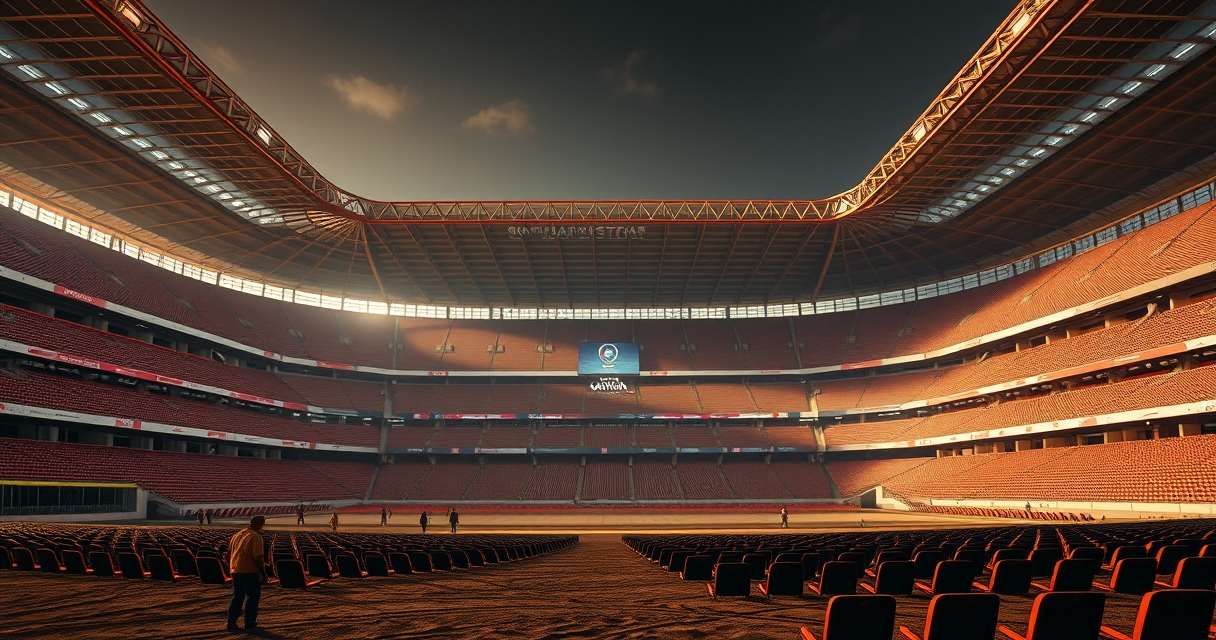
The wage differential tells the story. A Nepali construction worker in Qatar earns approximately $200 per month — roughly one-fiftieth of what a Qatari citizen earns for comparable work. This gap is not market-driven. It is enforced by law. The kafala system ensures that labor power purchased on the world market can be consumed at prices unthinkable in the developed world. Every stadium, every metro line, every air-conditioned fan zone is a monument to surplus value extracted from unfree workers.
Qatar’s development model does not resemble the industrial capitalism of Marx’s era — it is worse. It combines the most advanced construction technology with a labor regime that belongs to the plantation economy. This is what Lenin called the uneven and combined development of capitalism under imperialism: the most modern superstructure resting on the most archaic foundations.
FIFA and the Commodity Spectacle
If the kafala system is the base, the World Cup tournament is the superstructure — the ideological form that mystifies its own material conditions. FIFA’s business model is commodity fetishism in its purest expression. The organization sells not football but the idea of football: national pride, global unity, human achievement. These abstractions become commodities that advertisers purchase at astronomical rates.
For the 2022 cycle, FIFA sold broadcasting rights for $1.2 billion to broadcasters who sold ad slots for $700,000 per thirty seconds during the final match. The product being sold was not a game but an imagined community — the nation as brand. Corporate sponsors like Coca-Cola, Adidas, and Qatar Airways purchased the right to associate their logos with the emotional experience of belonging. The commodity is not the match. The commodity is the feeling of the match.
This is the culture-commodity in its advanced form: the transformation of collective human experience into a purchasable thing. The World Cup requires billions of dollars in infrastructure, millions of hours of labor, and thousands of bodies — all to produce the illusion that a football tournament exists independently of the exploitation that funds it. The more spectacular the event, the more invisible the workers who built it.
FIFA’s response to worker deaths has been instructive. The organization has never accepted legal responsibility for working conditions in host nations. When investigators documented over 6,500 deaths, FIFA president Gianni Infantino said: “I don’t think we have to apologize.” This is not callousness. It is structural. FIFA’s business model depends on denying the material basis of its product. Acknowledging the workers would shatter the fetish.
Sport as Ideological State Apparatus
Louis Althusser described ideological state apparatuses as institutions that reproduce the conditions of capitalist production through ideology rather than force. Schools, churches, media — and sport. The World Cup performs this function with remarkable efficiency. It channels nationalist sentiment into a harmless container. It replaces class solidarity with national identification. It teaches millions of viewers to cheer for their own exploiters.
Consider the experience of watching the World Cup as a migrant worker from Nepal. You build the stadium. You cannot afford a ticket. You watch on a screen in your labor camp, cheering for a national team that does not represent you, while your wages are stolen by the company that built the pitch. This is not distraction. This is alienation — the separation of workers from the product of their labor, from their own humanity, from the very possibility of recognizing their exploitation.
The tournament also functions as ideological cover for Qatar’s ruling class. The Al Thani monarchy spends billions on image management — Western media friendly interviews, human rights reform committees, sustainability pledges — while maintaining a legal regime that treats migrant workers as disposable labor units. The World Cup provides the platform for this performance. The spectacle of “progress” conceals the reality of stagnation.
Counter-Argument: Development or Extraction?
The defense of the World Cup is straightforward: Qatar invested in infrastructure that benefits the country long after the tournament ends. New metro lines, roads, hospitals, airports — this is modernization, not exploitation. Workers chose to come to Qatar. They earned wages they could not earn at home. Their remittances support families across South Asia.
This argument is correct about the empirical facts and wrong about their meaning. Yes, infrastructure was built. Yes, workers received wages. Yes, remittances flowed. But these facts do not describe development. They describe extraction. Development implies the improvement of human capabilities — education, health, political voice, the capacity to shape one’s own life. The kafala system systematically denies every one of these.
A worker who cannot leave their employer is not developing. A worker who dies of heatstroke building a stadium their children will never enter is not receiving benefits. A wage of $200 per month that disappears into debt repayment is not empowerment. The choice between starvation at home and exploitation abroad is not freedom. It is coercion by other means.
What Qatar calls “development” is better understood as imperialist rent — the super-profits extracted from unfree labor under the protection of a sovereign state. The World Cup was not a development project that happened to generate deaths. It was an extraction project that happened to generate football.
The Beautiful Game as Beautiful Lie
Football is a beautiful game. It demands collective effort, tactical intelligence, and physical grace. It produces moments of genuine human solidarity — the roar of a crowd, the embrace of teammates, the recognition that individual achievement depends on social cooperation. But under capitalism, even our most beautiful collective practices are repurposed as instruments of exploitation.
The Qatar World Cup was not an exception to the rule of sport. It was the rule made visible. Every modern mega-event — every Olympics, every World Cup, every Super Bowl — rests on a foundation of displaced people, underpaid labor, and environmental destruction. The spectacle we consume is not separate from the suffering that produces it. The spectacle is the suffering, transformed into a commodity and sold back to us at a profit.
To watch the World Cup with open eyes is to see the contradiction at the heart of capitalism: the most collective, cooperative human activities are organized through the most individualistic, competitive social system ever devised. The beautiful game becomes a beautiful lie — a promise of solidarity that capitalism cannot fulfill.
The workers who died building Qatar’s stadiums will not be remembered in FIFA’s annual reports. Their names will not appear in the broadcast montages. Their families will receive compensation measured in thousands of dollars — the price of a human life in the global market for labor power. But their sacrifice reveals something that the spectacle cannot fully conceal: that every commodity has a cost, and under capitalism, that cost is always paid in flesh.
The struggle against this system is not a struggle against football. It is a struggle for a world where the beautiful game can be played without building monuments to exploitation. Until then, every goal scored in a World Cup stadium is also a goal scored against the class that built it.
Read more: The Border as Wage-Suppression MechanismRead more: Commodity Fetishism is Not a Mistake — It’s a Strategy
Read more: Hegemony in Everyday Life: How Capitalist Common Sense is Made