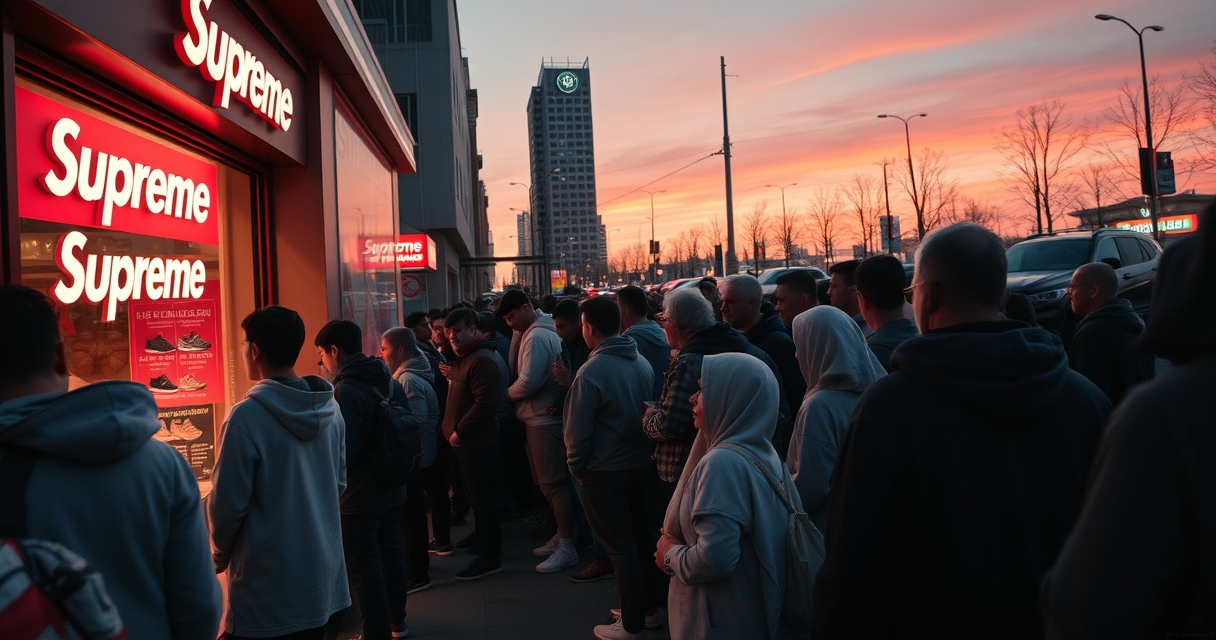
On a Thursday morning, a teenager sleeps in a tent on a Manhattan sidewalk. He is not homeless. He is waiting for a shoe. The Travis Scott x Nike Air Jordan 1 retails for one hundred and seventy-five dollars; by afternoon, it will trade on StockX for over two thousand. Supreme, the brand that perfected this theater, once sold a brick—an actual clay brick—for thirty dollars. It resold for two hundred. Journalists call this a bubble. Economists call it irrational. Marxists call it truth serum. The hype economy does not distort value; it reveals what value has always been: a social relation disguised as a property of a thing.
The sneaker drop is commodity fetishism made visible, a laboratory demonstration of how capital transforms human relationships into relationships between objects. When a sneaker that costs three dollars to manufacture trades for two thousand dollars, the buyer is not paying for leather, rubber, or labor. He is paying for the social hieroglyphic that the sneaker has become—a sign that says: I was there. I got in. I have what you cannot have. This is not a market failure; it is the market working exactly as designed. The value form does not care about use-value. It cares about exchange-value, and exchange-value requires only one thing: that enough people desire something they cannot have.
Artificial scarcity is not a bug in the hype machine; it is the engine. Supreme produces limited quantities not because they cannot produce more—their factories could spin out a million box logos overnight—but because scarcity is the primary input for value production. When a commodity’s availability is constrained, its exchange-value can float freely from its material composition. The sneaker becomes what Marx called a “sensuous supersensible thing”: a physical object that carries a metaphysical aura. The drop is a ritual of exclusion, and every person who fails to cop becomes a source of value for those who succeed. The loser’s desire is the winner’s capital.
The resale market, platforms like StockX and GOAT, complete the circuit by formalizing what was once informal: the commodification of cool. Young people, disproportionately working-class and Black, developed sneaker culture as a genuine expression of style and identity. They queued, traded, and built community around footwear. Capital noticed. Now StockX extracts rent from every transaction, and Nike controls the spigot. The primitive accumulation of cool is underway: the lived culture of the street is stripped of its context, digitized, and sold back as a financial asset. The teenager who camps overnight is not a consumer; he is a laborer producing the aura that Nike will monetize. He works for free and pays for the privilege.
One might object that sneaker culture is authentic community expression, that the lines, the trades, the friendships forged at 4 a.m. are real. This is true. But the commodity form is a parasitic host: it does not destroy what it consumes; it captures, redirects, and metabolizes it. The community is real, but its energy flows upward into brand equity. Supreme does not hate the aftermarket; it needs it. The resale price is the brand’s ideology made concrete: You are what you can obtain.
Consider the brick again. A brick with a logo. Thirty dollars retail, two hundred resale. No use-value whatsoever. And yet people paid. They paid not for the brick but for what the brick represented: the ability to convert money into status, to exchange capital for distinction. The brick is commodity fetishism without apology—a pure specimen of the value form, stripped of all pretense to utility. It is not an anomaly. It is the truth of every commodity, including the ones that pretend to be useful.
The kid still waits on the sidewalk. He will not get the shoe. He will buy the resale. He will never wear it. He will put it in a box, in a closet, and check its market price on his phone. The shoe that costs three dollars to make now stores two thousand dollars of social desire. That is not irrational behavior. It is the value form teaching us, at last, to see what we have always been: relations between things, mediated by money, hallucinating our own freedom in the glow of a logo.