The global wellness industry is valued at five-point-six trillion dollars. Headspace, the meditation application, was valued at over three billion dollars before its most recent restructuring. Corporate mindfulness programs are now standard at Amazon, Google, and Goldman Sachs. Capital does not merely tolerate wellness culture — it requires it. This is not an accident of market growth, nor a benign cultural shift toward self-improvement. It is a logical development of the capitalist mode of production, one that reveals the deep structure of ideological reproduction in late capitalism.
Wellness culture is not a response to the suffering capitalism produces — it is a mechanism for managing that suffering without addressing its material basis. Mindfulness applications, self-care routines, and corporate wellness programs function as ideological apparatuses that redirect class anger inward, transforming structural grievance into individual pathology. The worker who cannot sleep is not suffering from the precarity of gig employment, the erosion of the social wage, or the thirty-percent increase in rent — she is suffering from insufficient breathing technique. The warehouse employee who feels rage at the pace of the assembly line is not experiencing a legitimate political response to exploitation — he is experiencing a failure of emotional regulation. This is the essence of the wellness ideology: the displacement of the social by the psychological.
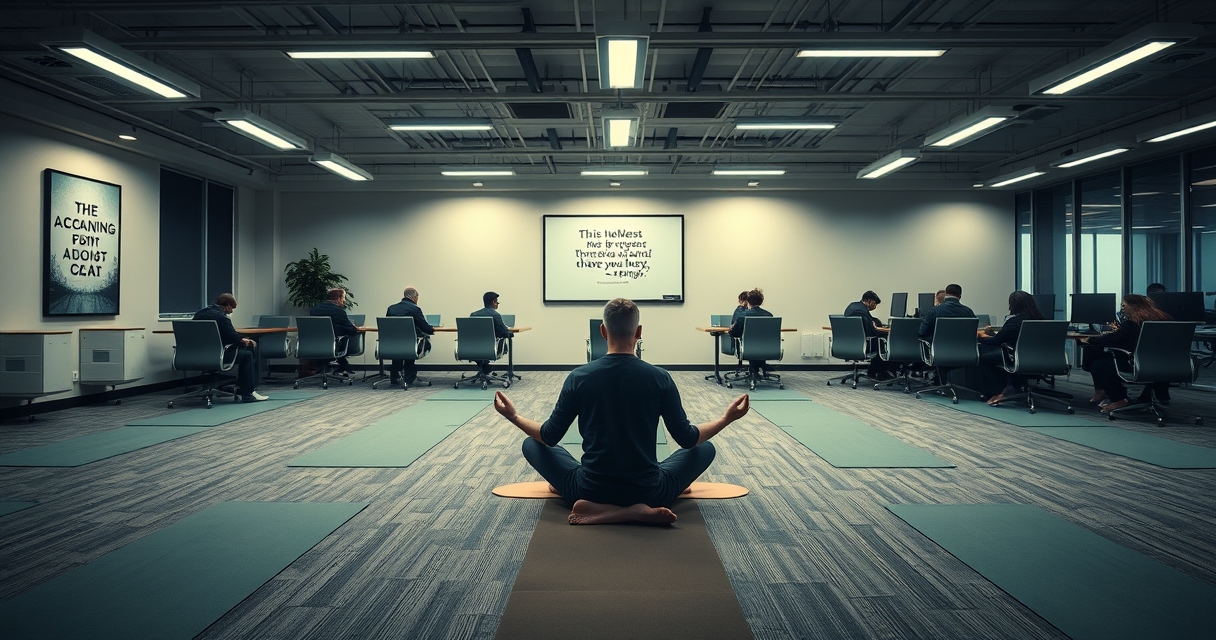
Corporate mindfulness functions as labor discipline. At Amazon, where injury rates exceed industry averages and union-busting is routine, the meditation break is not a concession to worker well-being — it is a technique for increasing productivity without altering the rate of exploitation. The worker who returns to the picking floor with a calmer nervous system is a more efficient worker, not a less exploited one. Mindfulness training in the corporate context standardizes the emotional labor required to tolerate conditions that ought to be met with collective refusal. The app is a tool of affect management, and affect management is a form of labor control.
Self-care as commodity represents a peculiarly perverse moment in the logic of commodification. The wellness industry sells back to workers the relief that decent working conditions, universal healthcare, and collective leisure would provide for free. A yoga class costs thirty dollars; a therapy session costs two hundred; a meditation subscription costs seventy dollars annually. These are not luxuries — they are surrogates for the basic protections that capital has stripped from the working class. The worker pays to tranquilize the effects of a system that could, with different social arrangements, simply cease to produce those effects. This is commodity fetishism operating at the level of bodily experience: the commodity promises to resolve a contradiction it can only manage.
The politics of inner peace constitutes a depoliticization of suffering. If the problem is inside you, then the solution is also inside you — and the system remains untouched. The therapeutic posture of mindfulness culture treats the working class as a collection of individuals with discrete psychological problems rather than as a social force with shared material interests. Class anger, the most politically productive emotion the proletariat possesses, is pathologized as stress. The demand for justice is metabolized into a request for better coping strategies. This is ideology in the Adornian sense: a structure of consciousness that prevents the recognition of one's actual relation to the social totality.
The counter-argument is straightforward: mindfulness genuinely helps people cope. It reduces anxiety, improves focus, and provides moments of peace in otherwise unbearable conditions. This is true, and it is precisely the problem. Coping is not the same as liberation. A better coping mechanism makes the system more bearable, which makes it more durable. The opioid that dulls the pain does not heal the wound — it enables the laborer to continue working through the infection. The wellness industry is the opiate of the precariat, a spiritual analgesic for a social pathology that requires surgery, not sedation.
Consider the concrete image: the Amazon warehouse worker, having walked fourteen miles on the concrete floor during her shift, enters a closet-sized Zen booth during a fifteen-minute break. She opens the Headspace application. A pleasant voice instructs her to notice her breath, to observe her thoughts without judgment. She closes her eyes. The algorithm adjusts the session length to her remaining break time. She is breathing. She is calm. She is still exploited, still underpaid, still surveilled, still replaceable. But she is calm. That is the achievement of wellness culture — not the abolition of suffering, but its aesthetic management. The system does not need to change. The breathing must simply become deeper.