The Metropolitan Museum of Art in New York has an endowment of over 3.6 billion dollars. Its board includes executives from Goldman Sachs, BlackRock, and JPMorgan Chase. The museum charges a recommended admission of 30 dollars. The art belongs to the public; the institution belongs to capital.
The Museum as an Ideological State Apparatus
Museums function as ideological state apparatuses in the Althusserian sense — institutions that reproduce bourgeois hegemony by presenting ruling-class taste as universal culture, corporate philanthropy as public good, and colonial plunder as art history. They are not neutral repositories of human creativity but active sites of class struggle, where the ruling class projects its own particular interests as the general interest of humanity.
The historical development of the public museum traces a direct line from aristocratic cabinets of curiosity to bourgeois cultural institutions. The Louvre, opened during the French Revolution, was not a democratic triumph but a consolidation of bourgeois power — the transfer of royal collections to the "nation" meant the transfer of cultural authority from the monarchy to the bourgeoisie. This pattern repeated across Europe and America: the museum naturalizes class power through aesthetic authority, making the accumulated wealth of a few appear as the collective heritage of all.
How Finance Capital Controls Cultural Institutions
Consider the composition of museum boards. The Metropolitan Museum of Art's board includes the CEOs of BlackRock, Goldman Sachs, and JPMorgan Chase. The Museum of Modern Art's board is dominated by hedge fund managers and private equity partners. This is not incidental — capital requires cultural institutions to legitimize its dominance. When the ruling class controls what is seen, valued, and preserved, it controls the terms on which society understands itself.
Corporate board capture ensures that museum acquisitions serve the interests of capital. Collections are leveraged as tax shelters; exhibitions are curated to avoid offending corporate sponsors; the museum's own labor practices — armies of unpaid interns, underpaid conservators, part-time security guards — mirror the exploitation that characterizes the economy outside its walls. The museum functions as a microcosm of capitalism: a place where the value produced by workers is appropriated by a tiny elite.
Philanthropy as Reputation Laundering
The Sackler galleries, the Koch donations, the art-washing of extractive industries — these are not acts of generosity but investments in legitimacy. Capital accumulates through exploitation; philanthropy allows capital to present itself as civilizing. The Sackler family, responsible for the opioid crisis that killed hundreds of thousands, purchased cultural respectability through museum naming rights. The Koch brothers, funders of climate denial, bought cultural prestige alongside political influence.
This is not corruption but function. The ideological state apparatus requires precisely this kind of laundering: the transformation of blood-soaked wealth into cultural capital. Every museum wing named after a corporate donor is a monument to the ruling class's ability to buy the terms of its own remembrance.
Colonial Collections and Primitive Accumulation
The Elgin Marbles, the Benin Bronzes, the looted antiquities of Iraq and Syria — these represent primitive accumulation in the cultural sphere. Capitalism's origins lie in the violent expropriation of lands and bodies; museums hold the cultural equivalent. Western museums are storehouses of colonial plunder, and the continued refusal to repatriate these objects is not about preservation but about power.
The argument that Western museums "preserve" these objects for humanity assumes that humanity's interest is best served by keeping them in European and American museums. This is the logic of the colonizer dressed in the language of universalism. The objects were taken by force; their retention is the maintenance of that force.
Admission Pricing as Class Gate
The Metropolitan Museum's "recommended" admission of 30 dollars is a class barrier disguised as a suggestion. For a working-class family of four, 120 dollars is prohibitive. The "pay what you wish" policy for New York State residents and students is a concession that proves the rule: access to culture is structured by class. The museum is a public institution in name only; in practice, it is a private club for the bourgeoisie and those who can afford to pass as such.
Admission pricing is not neutral. It determines who enters, whose children are exposed to art, whose imagination is shaped by cultural heritage. The working class is excluded not by law but by price — a more efficient, because less visible, form of gatekeeping.
The Steel-Man Argument
The most serious defense of museums holds that they preserve and democratize access to human cultural heritage. Without museums, argues the liberal curator, works of art and historical objects would be lost, sold to private collectors, or destroyed. Museums are, in this view, a democratic achievement — the public ownership of what was once private.
This argument has merit. Museums do preserve objects that might otherwise be lost. But it mistakes the form for the content. Under capitalism, preservation is selective: what gets preserved reflects ruling-class priorities. The Sackler wings preserve pharmaceutical wealth, not the suffering of addiction victims. The colonial galleries preserve the museum's acquisition history, not the voices of the colonized. The democratic potential of the museum is real, but it is systematically subordinated to the interests of capital.
Class Struggle in the Temple of Civilization
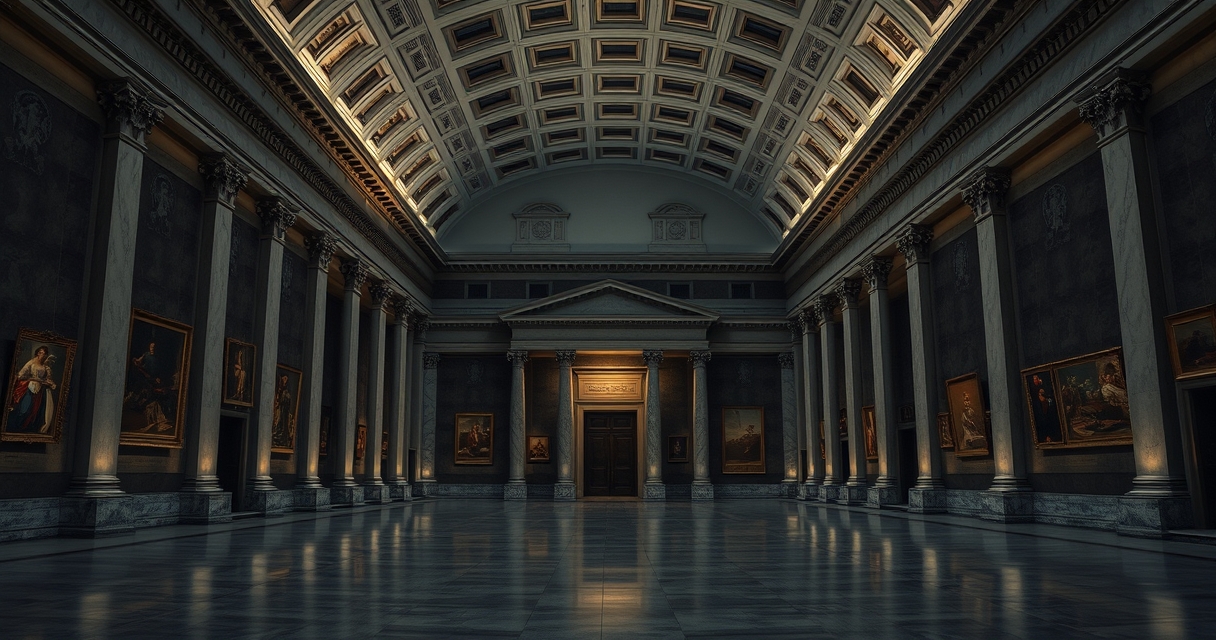
The museum is the temple of a class that needs its power to look like civilization. Every marble column, every climate-controlled gallery, every high-ceilinged atrium is designed to produce awe — not for the art but for the wealth that made the art accessible. The museum visitor is meant to feel gratitude: gratitude to the patrons, the donors, the board members who "generously" share what they have accumulated.
But gratitude is the bourgeois emotion par excellence — the feeling of the beneficiary toward the benefactor, the worker toward the capitalist, the colonized toward the colonizer. The museum channels this emotion into acceptance of class hierarchy. The ruling class does not need to force us to admire its cultural institutions; it has designed them so that we admire them freely.
The task of the revolutionary cultural critic is to break this spell: to see the museum not as a temple but as a battlefield. The fight for repatriation, for free admission, for worker control, for an end to corporate naming rights — these are not reformist tinkering but class struggle in the cultural sphere. Because in the end, the question is not who owns the art but who owns the means of cultural production — and whether that ownership can be anything other than the property of a class.
The art belongs to the public. The institution belongs to capital. The contradiction between these two facts will eventually tear the museum apart.
Read more: Hegemony in Everyday Life: Capitalist Common Sense, Commodity Fetishism Is Not a Mistake, DEI as Ideological Cover: Diversity Programs Under Capitalism