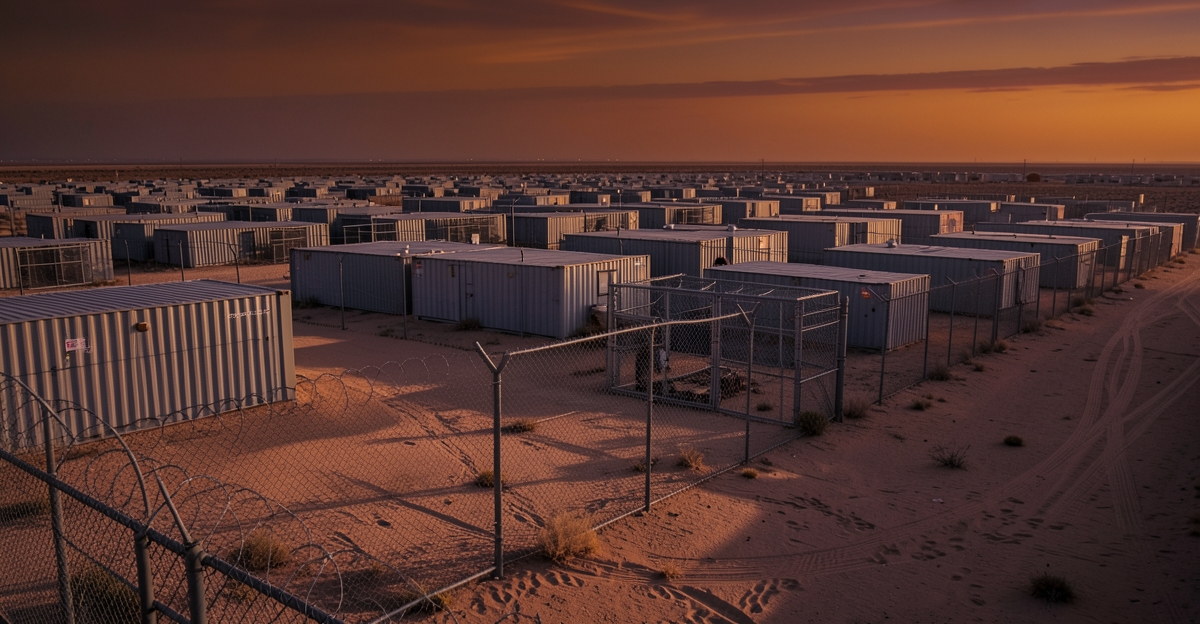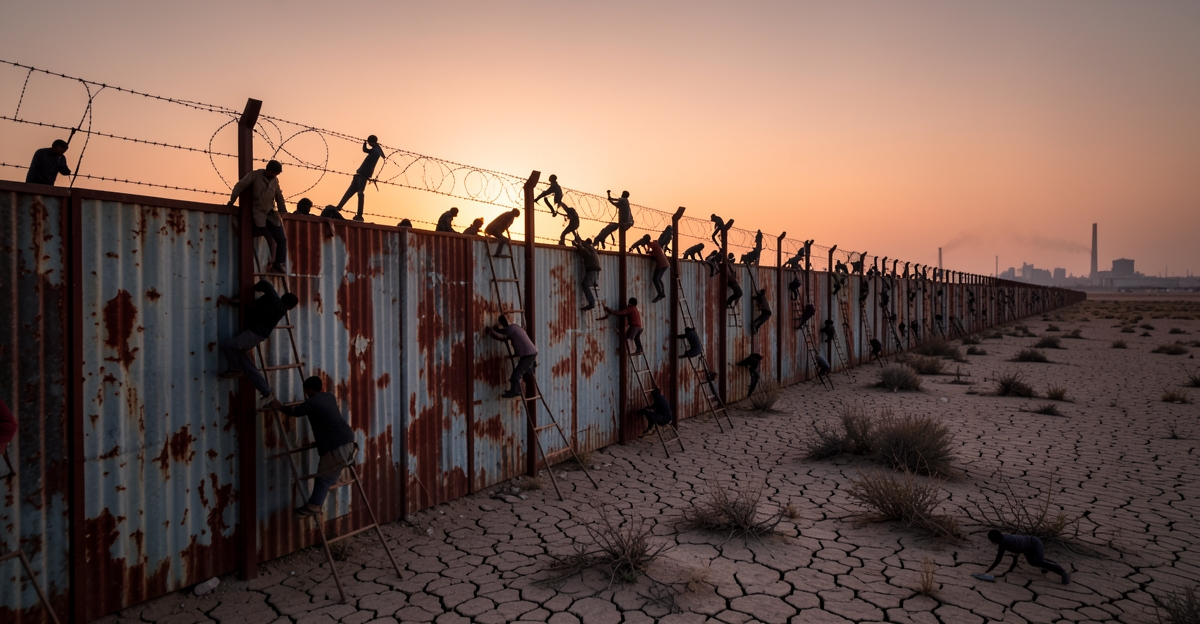
Migration is not a flow to be managed but a mirror: the same global inequalities that capital creates — by chasing cheap labor across borders while maintaining citizenship as a mechanism of wage stratification — produce the 'illegality' that then justifies further exploitation. The border is not a line on a map. It is a labor control device. Its function is not primarily to keep people out. Its function is to ensure that the people who get through arrive without the legal standing to demand the wages and conditions that citizens can demand — and that the threat of removal disciplines those already inside.
This is not a cynical reading. It is what the structure of global migration policy, examined materially, reveals.
How Capital Produces the Migrant
The standard account of migration runs as follows: economic hardship, conflict, or climate disaster in the Global South drives individuals to seek better conditions in the Global North. This account is not false. But it is incomplete in a way that protects the interests of those who benefit from the arrangement.
The economic hardship that drives migration is not simply the absence of wealth in certain regions. It is the active production of poverty through specific policies: structural adjustment programmes that dismantled domestic industry in Mexico, Central America, and Sub-Saharan Africa at the insistence of the IMF and World Bank; free trade agreements that flooded local agricultural markets with subsidized US and European commodities, destroying smallholder farming; the extraction of natural resources under terms that left mineral-rich nations dependent on commodity exports while the value-added processing occurred elsewhere. The inequality that produces migration was engineered — through financial instruments, through trade law, through the conditions attached to debt.
NAFTA is the clearest case study. When the agreement came into force in 1994, Mexican corn farmers — unable to compete with US corn subsidized at below-cost prices — lost their livelihoods. Studies by the Institute for Agriculture and Trade Policy found that US corn was dumped into the Mexican market at prices 19% below the cost of production. The rural displacement that followed contributed directly to the surge in undocumented Mexican migration to the United States in the decade after NAFTA's passage. The same agreement that made Mexican farmers' livelihoods unviable made US employers' access to undocumented labor abundant. This is not coincidence. It is political economy.
The Wage Suppression Function of 'Illegality'
Undocumented status is not a natural category. It is a legal production — a status manufactured by immigration law that transforms a human being with labor power into a worker who cannot organize, cannot complain to a labor inspector, cannot refuse unsafe conditions without risking deportation.
The concept of "border imperialism," developed by scholars including Harsha Walia in Border and Rule (2021), names this function precisely: borders are not neutral administrative tools but instruments of racial capitalism that manage labor supply while maintaining legal asymmetries that keep certain workers permanently precarious. The border does not stop migration. Decades of evidence show that border militarization does not reduce the number of migrants — it increases the danger of the crossing and deepens migrants' dependence on exploitative employers once they arrive.
In the United States, where immigration enforcement has expanded dramatically across administrations of both parties, the undocumented population remained relatively stable at 10–12 million for most of the 2010s despite record deportation numbers under the Obama administration. The labor demand that draws migrants does not disappear because enforcement intensifies. What intensification produces is not fewer migrants but more exploitable ones — workers who have taken greater risks to arrive, who owe more to smugglers, who have fewer legal protections and stronger incentives not to report wage theft, injury, or abuse.
This is the labor market function of the border enforcement apparatus. Agricultural employers, meat processing companies, construction contractors, and domestic service employers in the United States and across the EU benefit directly from the availability of workers who cannot organize without legal jeopardy. The IOM's Missing Migrants Project has recorded over 63,000 migrant deaths on global migration routes since 2014 — a figure that represents only the documented cases. These deaths are not collateral damage from well-intentioned security policy. They are the cost of maintaining the wage differential that makes undocumented labor attractive to employers.
Remittances as Structural Subsidy
The World Bank estimated that remittances to low and middle-income countries reached approximately $669 billion in 2023 — surpassing foreign direct investment flows to those countries. Remittances are now a primary mechanism of income support for millions of families in the Global South. They are celebrated by international institutions as evidence that migration "works."
What this framing conceals is the structural subsidy that remittances represent. When a worker migrates from Guatemala to the United States, the Guatemalan state bore the cost of raising, educating, and maintaining that worker until productive age. The US economy then captures most of that worker's productive output. The remittances that flow back do not compensate for this transfer — they are a fraction of the value produced, returned in a form that relieves the US and Guatemalan states of social obligations they would otherwise bear. It is the world's most efficient aid programme, running entirely on human desperation, and the donors are the migrants themselves.
The EU-Turkey Statement of 2016 — which committed €6 billion to Turkey in exchange for halting migration flows to Greece — illustrates the same logic at the level of international policy. The European Union, facing political pressure from rising far-right parties, paid a neighboring state to warehouse human beings it did not want to process. The refugees in Turkish camps did not cease to exist. They were simply made less visible, at a price that was fiscally manageable compared to the political cost of receiving them.
Solidarity Across the Border
The challenge for left politics is to resist the nationalist frame that the far right imposes on migration — which frames every arriving worker as a threat to citizen workers — without falling into the liberal frame that treats migration as a humanitarian issue disconnected from political economy.
The migrant meatpacking worker and the citizen meatpacking worker share an employer. That employer uses the legal vulnerability of one to suppress the wages of both. The same agricultural corporations that lobby for guest worker programmes that bind workers to specific employers also lobby against labor law enforcement in their facilities. The division between documented and undocumented, between citizen and migrant, is a division that benefits capital and weakens labor. It is the oldest management technique in industrial history, applied to the newest form of the global workforce.
The materialist position on migration is not open borders as an abstract principle — though free movement of labor is a logical corollary of free movement of capital, and the asymmetry between them is worth naming. The materialist position is that the conditions producing forced migration — debt, structural adjustment, war, climate disruption — must be addressed at their source; that migrants already present must have full labor rights regardless of status; and that the enforcement apparatus that manufactures "illegality" serves capital interests, not the interests of working-class people on either side of any border.
The border divides workers. Capital crosses it freely. That fact alone tells us where the analysis should begin.