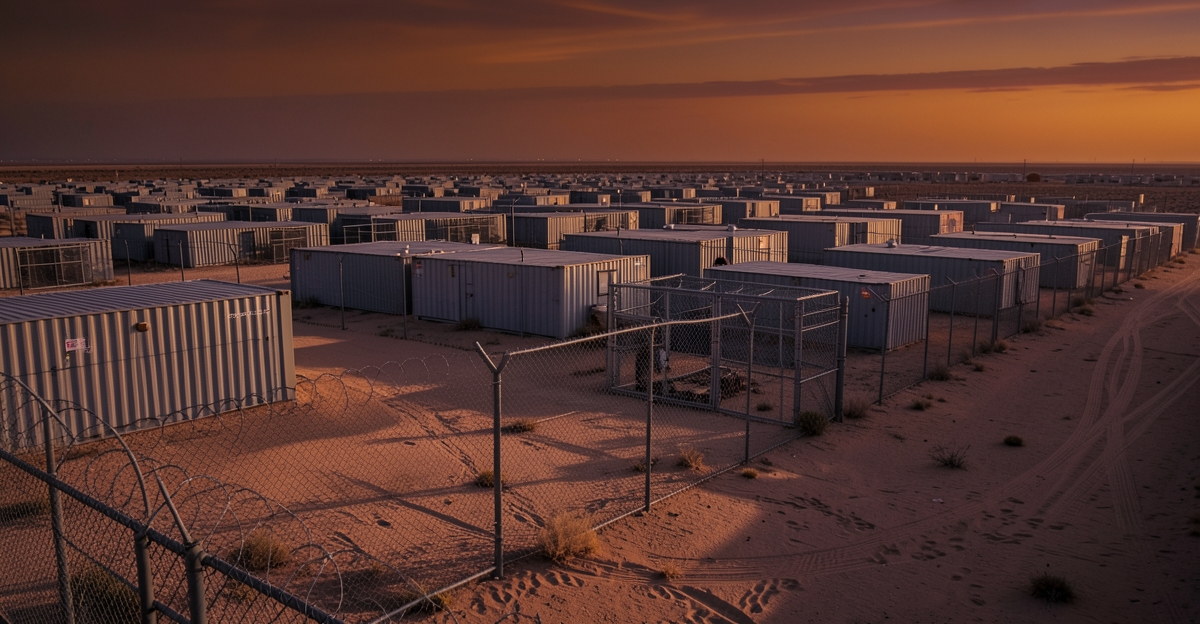
On any given day in the United States, more than 34,000 human beings are held in Immigration and Customs Enforcement custody. They are not prisoners in any criminal sense — they have been accused of civil immigration violations. Yet they are locked in concrete-and-steel facilities operated by the two largest private prison corporations in the world: CoreCivic and GEO Group. In 2023, CoreCivic reported USD 1.9 billion in revenue; GEO Group reported USD 2.4 billion. Their combined market capitalization exceeds USD 6 billion. The detention camp is not security infrastructure. It is a site of primitive accumulation — the violent process by which capital seizes human bodies and turns them into instruments of profit.
Private Prison Corporations Built an Industry on Captive Migrant Bodies
CoreCivic and GEO Group operate the majority of ICE detention beds in the United States. These are not government-run facilities leased to private contractors; they are wholly private enterprises in which the state subcontracts its coercive power. The companies own the buildings, control the labor regimes, and answer to shareholders — not to the public. Of ICE’s approximately 34,000 detention beds, roughly 70 percent are operated by these two corporations. That market concentration is not accidental. It is the result of three decades of systematic lobbying, deregulation, and the cultivation of a captive population from which to extract surplus value.
Surplus value, in Marxist terms, is the difference between the value a worker produces and the wage they receive. In standard capitalism, the working class sells labor power voluntarily. In the detention camp, consent is abolished. The migrant is held under threat of indefinite confinement and deportation. They do not choose to work — they are compelled by the structure of the camp itself. The private prison corporation, acting as the direct agent of capital, appropriates the entire product of that labor. The state provides the raw material — the detained body — and the corporation processes it into profit.
The USD 1/Day Wage Reveals Detention as Super-Exploitation
ICE’s Voluntary Work Program pays detainees USD 1 per day for four hours of labor. For eight-hour shifts, the rate rises to USD 3 per day. These wages are not merely low — they are a form of super-exploitation that goes beyond what Marx described as the extraction of absolute surplus value. In normal capitalist relations, wages must at minimum reproduce the worker’s labor power: food, shelter, clothing. In the detention camp, the state already provides these necessities at the lowest possible cost. The wage of USD 1 per day is thus pure surplus value — it does not even pretend to compensate labor.
Detainees clean cells, cook meals, do laundry, maintain grounds, and perform clerical work. Without this unpaid or near-unpaid workforce, the per-diem rates CoreCivic and GEO Group charge ICE would be much higher. And those rates are already enormous: between USD 140 and USD 300 per bed per day. At USD 200 per bed, a facility with 1,000 beds generates USD 73 million annually. The labor of detainees reduces operating costs, inflates profit margins, and transforms the camp into a factory that produces nothing but the conditions of its own reproduction. This is the contradiction at the heart of the detention system: capital demands cheap labor, but that labor can only be secured through state violence.
The wage suppression effect extends beyond the camp walls. When migrant workers in the broader economy hear that detention labor is compensated at USD 1 per day, the threat becomes a disciplinary tool. The border functions as a wage-control mechanism, depressing labor costs for capital across entire sectors. The camp is not an exception to the labor market — it is its brutal foundation.
Guaranteed Minimum Contracts Turn Empty Beds into Profit
Private prison corporations do not merely profit from filled beds. They profit from empty ones too. ICE contracts include guaranteed minimum quotas: the government promises to fill a certain number of beds or pay for them anyway. This is not a bug in the contract system — it is its fundamental logic. When CoreCivic and GEO Group sign agreements to operate detention centers, they demand that the state assume the risk of low occupancy. The corporation cannot lose money on unused capacity because the taxpayer covers it.
In 2019, ICE paid CoreCivic for approximately 16,000 empty beds — beds that were never used, never staffed, never fed a single detainee. This is primitive accumulation in its purest form: capital collects rent without providing any use-value. The guaranteed minimum contract turns the detention camp into a fixed capital investment that yields returns regardless of actual production. The corporation’s profit is decoupled from any genuine service. The state, acting as the executive committee of the bourgeoisie, ensures that capital’s revenue stream is uninterrupted.
This arrangement creates a perverse incentive. If ICE reduces detention numbers, the corporation still gets paid. But the corporation has every reason to lobby for more detention — empty beds generate profit, but filled beds generate more. The guaranteed minimum is a floor, not a ceiling. Every additional detainee beyond the quota is pure margin. The corporation has a structural interest in expanding the carceral system, which brings us to the third contradiction: the companies that profit from detention also manufacture the political demand for it.
ICE Lobbying Creates the Demand It Claims to Serve
Since 2000, CoreCivic and GEO Group have spent more than USD 25 million on federal lobbying and political contributions. They have funded anti-immigrant legislation, backed candidates who promise mass deportations, and crafted model bills for state and local governments that mandate cooperation with ICE. They have also spent millions on advertising campaigns that present detention as a public safety necessity. This is not advocacy — this is market creation. The corporations create the fear, then promise to sell the solution.
Consider the 2012 scandal in which GEO Group was found to have hidden a tracking device in a donated teddy bear given to an immigrant child. The company was attempting to use the family as bait to detain the father. When exposed, the incident revealed the cold logic of accumulation: every detained body is a revenue unit. The child’s trauma was an externality. The profit motive required more detainees, and GEO Group was willing to use any means to generate them. This is not a moral failing of individual executives. It is the structural imperative of capital in a sector where profit depends on incarceration volume.
Private prison corporations have also pushed for the expansion of mandatory detention — laws that require ICE to hold certain categories of migrants without the possibility of bond. Mandatory detention eliminates judicial discretion, guaranteeing a steady supply of bodies to fill beds. The corporations lobby for the laws, then bid for the contracts to implement them. They create the problem and sell the solution in a closed loop. The same dynamic drives the exploitation of migrant workers in mega-events like the World Cup: capital manufactures conditions of precarity, then extracts value from those caught in the system.
Deportation and Detention Form a Cycle of Accumulation
Detention and deportation are not two separate functions of immigration enforcement. They are two phases of a single cycle of accumulation. Detention generates immediate profit through per-diem payments and captive labor. Deportation regenerates the pool of potential detainees by ensuring that those removed can attempt re-entry — and if they succeed, they enter the system again, generating another round of profit. Capital requires a renewable supply of bodies. The deportation machine produces that supply by maintaining the conditions that drive migration and by criminalizing re-entry.
The criminalization of re-entry is particularly instructive. Under US law, a migrant who returns after deportation commits a felony punishable by up to 20 years in prison. Each re-entry case generates multiple points of profit: the detention center earns per-diem revenue during the pre-trial hold, the private probation or monitoring company earns fees during supervision, and the deportation process itself is contracted out to private transport companies. The same person can be processed multiple times, each cycle generating new revenue streams. This is not a bug. It is the business model.
Marx wrote that primitive accumulation is the historical process of divorcing the producer from the means of production. In the modern detention camp, that divorce is literal: the migrant is separated from family, community, and any ability to sell labor power on their own terms. They are incorporated into capital not as wage workers but as something worse — as captive laborers whose entire product is appropriated, whose wage is a fiction, and whose freedom is contingent on the profit calculations of a corporation with a stock ticker and a quarterly earnings report.
The contradiction is unsustainable. As the immigrant detention industry grows, the reserve army of labor swells with people who have experienced the camp firsthand. They return to their home countries or enter the underground economy as deportees, their labor power further devalued by the threat of re-detention. The carceral system and the wage system are not opposites — they are complementary. One disciplines the other. The camp does not sit outside the capitalist economy. It is its most concentrated expression: the state using violence to ensure that capital can extract value from bodies that have no other option.
The abolition of immigrant detention is not a humanitarian demand. It is a demand of the working class — a demand that the state stop subsidizing primitive accumulation with human flesh. Every dollar paid to CoreCivic and GEO Group is a dollar stolen from the possibility of a world in which migration is free, labor is dignified, and no person is reduced to a revenue unit. The detention camp is not inevitable. It is a political choice made on behalf of capital. And what capital builds, the working class can dismantle.