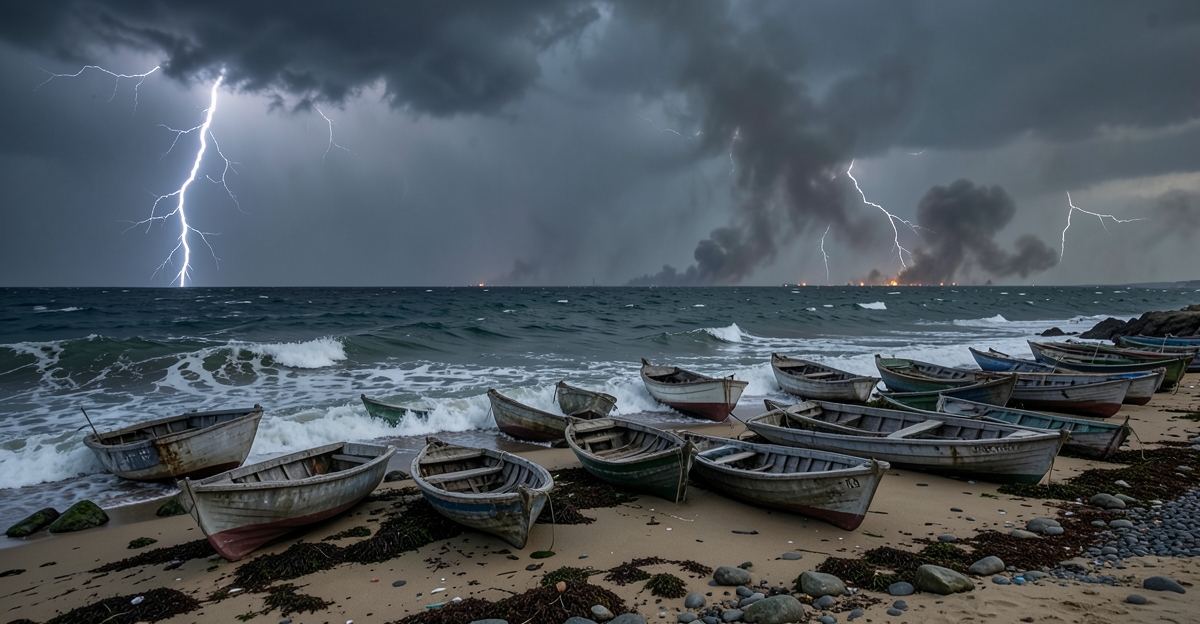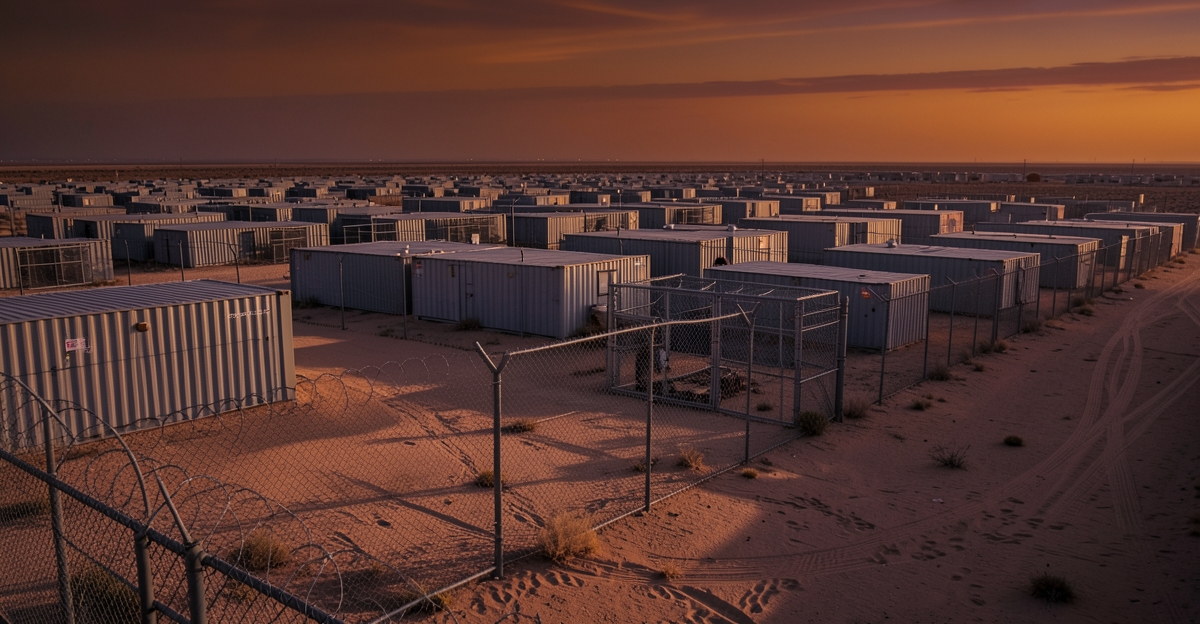
On March 6, 2021, Governor Greg Abbott stood before a camera in Austin and launched Operation Lone Star, a state-level border security initiative that would deploy 10,000 Texas National Guard troops and Department of Public Safety officers to the Rio Grande Valley. The stated target: migrants crossing the US-Mexico border. The unstated target: a working class displaced by ecological collapse that Texas itself helped manufacture through oil and gas extraction. Two years and eleven billion dollars later, the result is not security but a militarized barrier that criminalizes the very population whom US carbon emissions have rendered homeless.
Operation Lone Star Militarizes the Border at USD 11 Billion and Counting
Operation Lone Star represents the largest state-level military deployment along the US-Mexico border since the Mexican-American War. At a cost exceeding USD 11 billion as of early 2024, the program has purchased 30-foot razor wire barriers, constructed a floating buoy wall in the Rio Grande, and authorized National Guard troops to make arrests—a power traditionally reserved for federal immigration enforcement. The Texas legislature has allocated over USD 5.4 billion in a single budget cycle to sustain the operation, a sum larger than the entire annual budget of the Texas Commission on Environmental Quality.
This expenditure does not represent security spending in any rational sense. Border crossings at the Texas-Mexico frontier have fluctuated with economic conditions in Central America, climate disasters, and US labor demand. The USD 11 billion could have funded the restoration of the state's coastal wetlands, provided drought relief to the Rio Grande Valley's agricultural workers, or financed public housing for the very same populations who now face arrest and deportation. That capital instead flows to private prison contractors, razor wire manufacturers, and military equipment suppliers reveals the operation's true function: not protecting Texans, but disciplining a displaced working class.
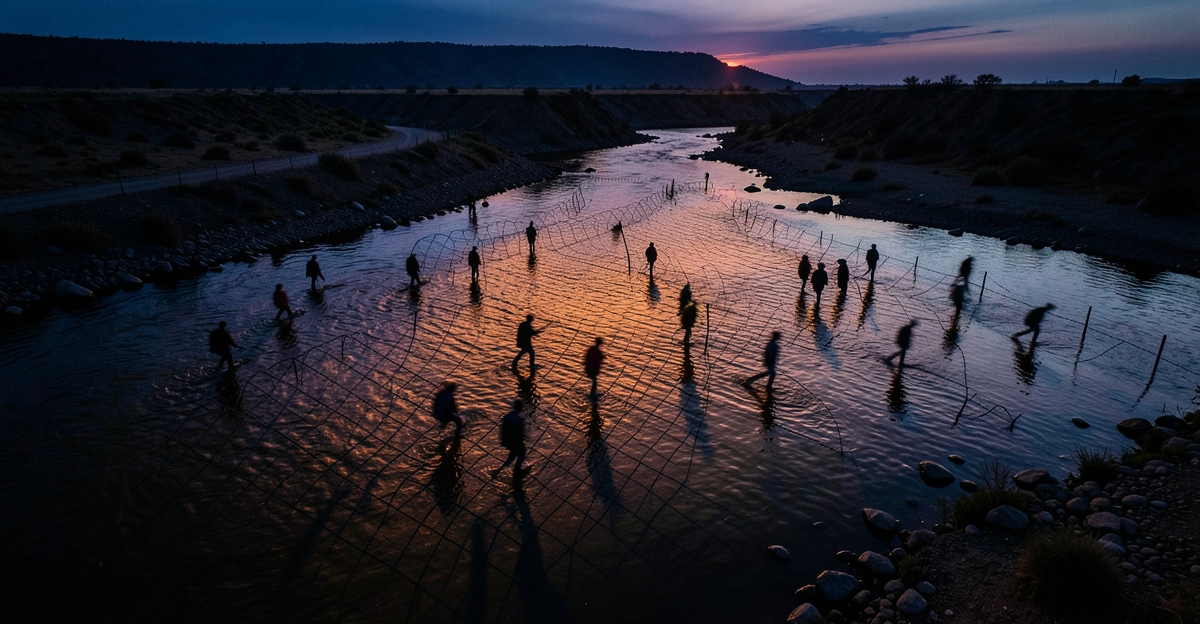
Eagle Pass, Texas—a city of 28,000—became the symbolic epicenter of this militarization. The state strung concertina wire along the riverbanks, installed shipping containers as makeshift walls, and deployed troop patrols that effectively sealed off the only crossing point for miles. The result: migrants forced into more dangerous crossing routes, more drownings, more deaths. The Texas Department of Public Safety reported over 1,200 migrant deaths in the Rio Grande sector during the operation's first two years, a figure that undercounts bodies never recovered.
Climate Displacement Produces the Migrants Texas Criminalizes
To understand who the razor wire catches, one must examine what drives migration from Central America's Northern Triangle: Guatemala, Honduras, and El Salvador. The Central American Dry Corridor, a strip of land running through these countries, has experienced the most severe drought in 700 years, according to tree-ring analysis published by the University of Cambridge. Prolonged dry spells, alternating with catastrophic hurricanes like Eta and Iota in 2020, have destroyed subsistence farming across the region. The United Nations Food and Agriculture Organization estimates that over 3.5 million people in the Dry Corridor faced acute food insecurity by 2022.
These are not economic migrants in the neoliberal sense of workers seeking better wages, though that framing serves capital's need to individualize structural crisis. These are climate-displaced persons fleeing conditions produced by industrial capitalism's carbon emissions. The United States bears 25 percent of cumulative global carbon emissions since 1850—more than any other nation. Texas alone, as the largest oil and gas producer in the United States, has contributed more greenhouse gases than most entire countries. The drought that destroys a Guatemalan maize farmer's harvest originates in the refineries of Houston and the fracking fields of the Permian Basin.
Marxist analysis understands this as the contradiction between capital's drive to expand production and the ecological conditions of production itself. Capital treats nature as a free gift—an atmospheric sink for emissions, a water source for extraction—until the costs of that exploitation return as crises that capital cannot easily manage. The migrant arriving at Eagle Pass is not a stranger to be repelled. They are the physical embodiment of those costs returning to their source. Operation Lone Star responds by criminalizing the messenger rather than addressing the message.
The migrants who attempt crossing are disproportionately rural working-class families who lost land, not job-seekers abandoning stable livelihoods. The Guatemalan National Institute of Statistics reports that 80 percent of rural households in the Dry Corridor depend on rain-fed agriculture. When rain fails for three consecutive seasons, those households have no surplus to sell, no credit to borrow, no safety net to catch them. Migration becomes not a choice but the only remaining survival strategy. Texas law, under Operation Lone Star, reclassifies this survival as a criminal offense—trespassing, criminal trespass, smuggling of persons—carrying penalties of up to 20 years imprisonment.
The Rio Grande Barrier Is Capital's Ecological Externality Made Physical
The floating buoy barrier installed by Texas in the Rio Grande near Eagle Pass in July 2023 crystallizes the operation's logic in physical form. Composed of orange, four-foot-wide spherical buoys connected by steel cables and anchored to the riverbed, the barrier stretches 1,000 feet across the water. The stated purpose: to prevent migrants from crossing. The actual effect: to turn a shared river—a water source, an ecosystem, a lifeline for communities on both sides—into a weapon against the displaced.
The barrier sits on the Rio Grande, a river whose flow has declined by 50 percent since the 1990s due to overextraction for agriculture and municipal use, compounded by drought intensified by climate change. The same drought that dries the Dry Corridor also reduces river flow, making the barrier more effective at blocking crossing but also more dangerous. Migrants attempt to swim around it or cross through deeper water downstream, where stronger currents and submerged debris increase drowning risk. The US Department of Justice filed a lawsuit against Texas in July 2023 arguing that the barrier violates the Rivers and Harbors Act of 1899, which prohibits unauthorized obstructions to navigable waters. The case reveals a contradiction: federal law blocks Texas from blocking the river, but Texas blocks it anyway, exercising state power on behalf of capital's interest in controlling labor mobility.
The barrier is not merely a physical object; it is an ecological externality made visible. Capital's extraction of fossil fuels generates emissions that destabilize climate systems, which displace millions, who then move across borders that capital has also shaped through centuries of imperialism. Operation Lone Star attempts to manage the consequences of this chain by turning the natural environment—the river, the desert, the heat—into enforcement agents. The razor wire cuts; the river drowns; the desert dehydrates. Texas pays for the wire; capital avoids paying for the displacement.
"The Rio Grande barrier is not a solution to migration. It is a solution to capital's need to extract fossil fuels without paying the costs of that extraction." — Analysis by the Texas Climate Justice Coalition
The blockquote above correctly identifies the function but understates its scope. Capital not only avoids paying extraction costs through the barrier; it actively profits from the crisis. Private prison companies like GEO Group and CoreCivic have seen stock increases correlated with Operation Lone Star expansion. The contractors building the barrier—including Coastal Bend Construction and others—report million-dollar contracts. Meanwhile, the migrants criminalized by the barrier enter the reserve army of labor, a pool of workers whose precarious legal status suppresses wages for all working-class people in Texas. The buoy barrier transforms ecological debt into surplus value extraction.
State-Level Border Enforcement Serves Federal Capital Interests
Operation Lone Star appears to represent a conflict between state and federal authority—Texas versus Washington over immigration enforcement. This surface-level reading serves capital's interest in obscuring the deeper unity of purpose. Both state and federal governments ultimately serve the same capitalist class, which requires both labor mobility and labor control, regulation and deregulation, depending on the conjuncture. The conflict between Abbott and the Biden administration over border policy conceals the underlying agreement: both seek to manage migration in ways that serve capital accumulation.
The federal government has historically controlled immigration enforcement through the Immigration and Nationality Act and the Department of Homeland Security. Texas's assertion of state power through Operation Lone Star does not challenge federal authority so much as supplement it with harsher measures that the federal government cannot legally apply. Federal law prohibits indefinite detention, sets caps on detention periods, and requires due process for deportation proceedings. Texas avoids these constraints by using state criminal charges—trespassing, smuggling—that carry longer sentences and exclude migrants from federal immigration protections. The result is a carceral regime that federal law prohibits but state law enables, and federal courts have largely allowed to continue.
This division of labor between state and federal enforcement reflects capital's need for what Marx called the super-exploitation of the incarcerated. Texas's criminalization of migration produces a population subject to prison labor at wages far below the legal minimum—sometimes as low as USD 0.16 per hour. Prison labor in Texas produces everything from office furniture to road signs to slaughterhouse services, generating surplus value extracted from incarcerated workers who have no union, no bargaining power, and no exit. Operation Lone Star feeds this system by generating a steady supply of workers convicted of border-related felonies.
The fiscal cost of USD 11 billion is borne by Texas taxpayers—disproportionately the Texas working class—while the benefits flow to capital. Private prison contractors, surveillance technology firms, construction companies, and oil and gas interests all profit from the operation. The Texas oil and gas industry, which contributed USD 26.3 billion in state and local taxes and royalties in 2022, pays none of the costs of the climate displacement its emissions produce. Instead, those costs are socialized through state taxes, and the displaced population is criminalized. This is the essence of the capitalist state under ecological crisis: capital profits from extraction, the state pays for enforcement, and the working class—both displaced migrants and Texas residents—pays with taxes, lower wages, and deaths at the border.
Operation Lone Star's commodification of migrant labor extends beyond immediate arrest and detention. Migrants who survive the crossing, avoid arrest, and find work in Texas enter a labor market structured by their precarity. Undocumented status prevents unionization, enables wage theft, and suppresses wages across industries from construction to hospitality to agriculture. Texas law SB 4, passed in 2017, criminalizes sanctuary cities and empowers local police to enforce immigration law, further entrenching this precarity. Operation Lone Star intensifies the same dynamic at the state level: the more migrants it arrests and deports, the more it signals to employers that remaining undocumented workers can be super-exploited without consequence.
The contradiction at the heart of Operation Lone Star is that capital simultaneously needs migrant labor and must police it. The US economy depends on immigrant workers: agriculture, meatpacking, construction, hospitality, and elder care all rely on labor that US-born workers cannot or will not provide at prevailing wages. Texas agriculture alone employs over 200,000 farmworkers, the majority of whom are immigrants. Deporting this workforce would collapse the industry. Yet capital also needs to maintain the legal barriers that keep these workers precarious, deportable, and cheap. Operation Lone Star serves this contradictory function: it performs border enforcement to maintain the ideological fiction of sovereignty while ensuring enough migrants cross to replenish the reserve army of labor that suppresses wages.
Operation Lone Star is not a border policy. It is a class policy. It manages the ecological costs of fossil capital by criminalizing their human embodiment. It extracts surplus value from a displaced working class while taxing the settled working class to pay for the enforcement. It turns the Rio Grande into a weapon and the desert into a wall. And it operates in the service of capital's fundamental drive: to accumulate without limit, regardless of the human and ecological destruction left behind. The migrants at Eagle Pass are not the problem. They are the proof.