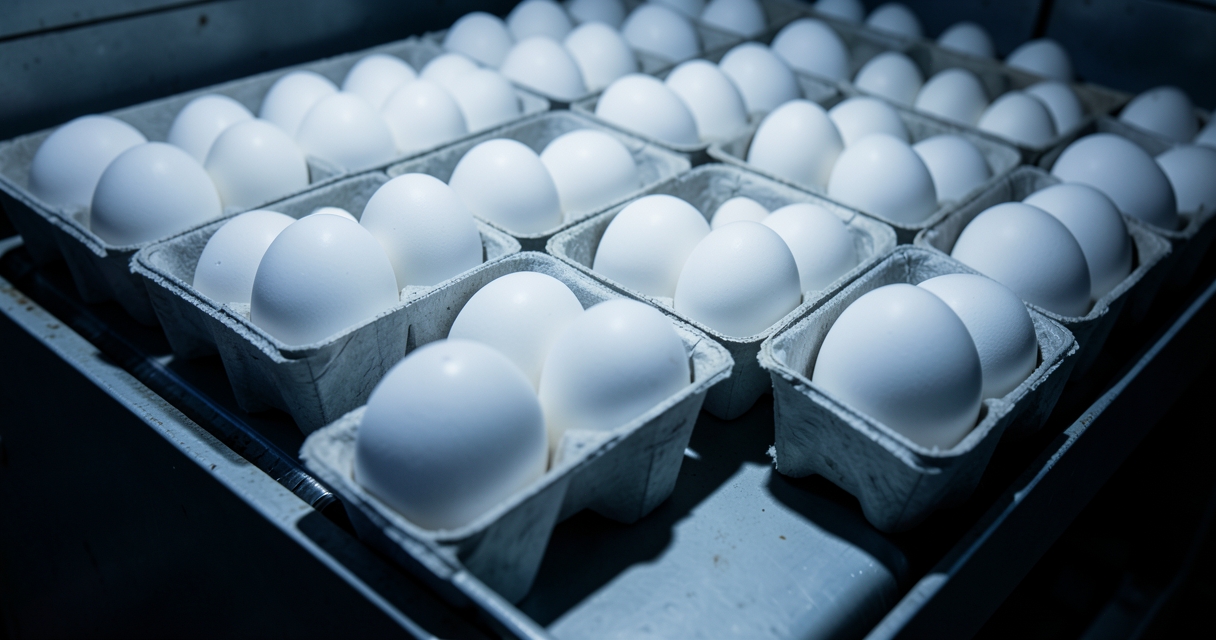
A dozen large eggs, grade A, sells for roughly fifty cents in the United States. This price, inscribed on a cardboard carton at the supermarket, presents itself as neutral information — the natural outcome of supply and demand interacting in a transparent market. Yet this single number conceals an entire world of production relations, biological extraction, and systematic violence. The price contains no information about the living hen whose oviduct produced each egg, no trace of the feed converted into albumen, no record of the twenty-three hours per day she spends confined in a space smaller than a sheet of printer paper. The egg, in its most reified form, is capitalism’s most perfect commodity fetish — a product whose material history has been so thoroughly scrubbed from its appearance that the consumer encounters only an abstract quantity of value, completely severed from the concrete labor and life that brought it into being.
The commodity fetish, as Marx described in Capital, is the process by which social relations between people take on the fantastic form of relations between things. In the egg, this fetishism reaches its apex. The hen herself — the direct producer of the egg — is not a worker in any conventional sense. She receives no wage, enters into no contract, and exercises no agency over the means of her production. She is living fixed capital, a biological machine whose body has been subordinated to the metabolic requirements of capital accumulation. Cal-Maine Foods, the largest egg producer in the United States, operates a system designed to ensure that the consumer never encounters this reality. The egg arrives clean, uniform, and anonymous, packaged in Styrofoam or pulp, stamped with a sell-by date, and priced as though it simply appeared on the shelf through the spontaneous generation of value.
The Battery Cage as Fixed Capital
The battery cage system represents a qualitative leap in the subordination of biological processes to the logic of fixed capital. Unlike earlier forms of poultry husbandry, where hens ranged across fields and required minimal infrastructure, the battery cage transforms the hen’s body into an appendage of machinery. The cages themselves — wire mesh enclosures stacked in tiers, typically housing four to eight hens per unit — function as components of a larger production apparatus designed to maximize the conversion of feed into eggs while minimizing labor costs. The hen’s reproductive system is forced into an accelerated cycle of ovulation, laying roughly three hundred eggs per year compared to the fifteen to twenty her wild ancestor would produce. This is not natural productivity enhanced by human care; it is the systematic intensification of biological exploitation through the application of fixed capital to a living organism.
Cal-Maine’s production facilities are not farms in any meaningful sense of the word. They are egg factories, designed according to principles of industrial efficiency that treat the hen as a machine with replaceable parts. The cages, the automated feeding and watering systems, the conveyor belts that collect eggs, and the climate control infrastructure constitute fixed capital valued in the hundreds of millions of dollars. The hen, reduced to a mere element within this fixed capital, experiences what Marx called the “real subsumption of labor under capital” — except here the labor is biological reproduction itself. Her body becomes a site of valorization, her metabolic processes synchronized with the rhythms of the production line. The battery cage is not merely a technology of confinement; it is a technology of value extraction, designed to discipline the hen’s biological existence into conformity with the profit requirements of the enterprise.
The use-value of the hen, from capital’s perspective, is exhausted in her egg-laying capacity. When her productivity declines — typically after seventy to eighty weeks — she is slaughtered for rendering into animal feed or low-grade meat products. This is not cruelty incidental to production; it is the logical conclusion of treating a living being as fixed capital. The hen’s body is depreciated, not honored. Her death is an accounting event, not a biological one. The battery cage system thus reveals the fundamental contradiction at the heart of capitalist agriculture: the living labor of the hen must be exploited as thoroughly as possible, but the hen herself must be prevented from living a life that would interfere with this exploitation.
Cal-Maine’s Monopoly and the Consolidation of Egg Production
Cal-Maine Foods controls approximately 20 percent of the United States’ egg market, producing over one billion eggs annually. The company’s market power, however, extends far beyond its direct market share. Through vertical integration, contract production, and strategic acquisitions, Cal-Maine exercises disproportionate influence over the structure of the entire egg industry. The company owns its own feed mills, hatcheries, processing plants, and distribution networks, eliminating the need for independent suppliers at every stage of production. This vertical concentration is not a natural outcome of market efficiency; it is the deliberate construction of monopoly power through the accumulation of productive assets and the systematic elimination of competition.
The consolidation of egg production under Cal-Maine’s dominance has transformed the material conditions of egg production across the United States. Independent family farms, which once supplied eggs to local markets through diversified agricultural operations, have been largely replaced by industrial facilities housing millions of hens in controlled environments. This transformation was not technologically inevitable; it was driven by the logic of capital accumulation, which demands ever-larger scales of production to reduce unit costs and increase market share. Cal-Maine’s annual reports reveal the company’s explicit strategy: acquire competitors, consolidate production into fewer, larger facilities, and use market power to control prices across the industry. The result is a system in which the consumer faces a choice between Cal-Maine eggs and eggs produced under Cal-Maine’s pricing umbrella — a choice that is no choice at all.
This monopoly power manifests most visibly in the company’s pricing practices. Cal-Maine has been the subject of multiple antitrust investigations and class-action lawsuits alleging price-fixing and market manipulation. In 2023, the company paid $100 million to settle claims that it conspired with other producers to restrict supply and inflate prices. Yet these legal actions address only the most overt forms of market manipulation. The deeper reality is that Cal-Maine’s monopoly power is structural, embedded in the concentration of ownership over the means of egg production. The price of a dozen eggs is not determined by the free play of market forces; it is administered by a handful of corporate actors whose control over production allows them to set prices that maximize profit extraction from both consumers and the hens whose bodies constitute the productive apparatus.
Forced Molting and the Extraction of Maximum Use-Value from the Hen’s Body
Perhaps no practice reveals the logic of biological extraction more starkly than forced molting. In nature, hens undergo a seasonal molt — a period of feather loss and reproductive rest — lasting several weeks. During this time, the hen’s body recovers from the stresses of egg production, and her reproductive system regenerates. Forced molting, as practiced in the egg industry, accelerates and intensifies this natural process by withholding feed for periods of ten to fourteen days, often combined with reduced lighting to induce physiological stress. The hen’s body, deprived of nutrients, enters a state of metabolic emergency, breaking down its own tissues to survive. When feed is restored, the hen resumes egg production at a higher rate, as if her body has been reset by the trauma.
Cal-Maine’s use of forced molting is not a marginal practice applied to a few flocks; it is a standard technique for extending the productive life of hens beyond what their bodies would naturally sustain. The logic is straightforward: the hen represents a significant investment of fixed capital in the form of feed, housing, and veterinary care consumed before she begins laying. Maximizing the return on this investment requires extracting as many eggs from her body as possible before her reproductive system fails. Forced molting allows capital to wring a second, third, or even fourth cycle of production from the same biological machine, deferring the cost of replacement and increasing the total output extracted from each hen over her lifetime.
The practice exposes the fundamental lie of the commodity fetish. The price of the egg, cleansed of all reference to the conditions of its production, contains no information about the starvation endured by the hen whose body produced it. The consumer who purchases Cal-Maine eggs is not buying a product of nature or of human labor alone; they are buying the metabolized suffering of a living being whose body has been converted into a means of value extraction. Forced molting, battery cages, and the systematic denial of the hen’s biological needs are not unfortunate side effects of egg production; they are essential conditions of production under the capitalist mode of agriculture. The egg cannot be produced cheaply without this cruelty because the cheapness is the cruelty, externalized through the intensity of exploitation.
“The hen must be made to produce beyond her natural capacity, and when she cannot, she must be induced or compelled to produce more through techniques that would be recognized as torture if applied to any animal not classified as livestock.” — Peter Singer, Animal Liberation
Singer’s observation, while ethically acute, does not go far enough. The issue is not merely the cruelty inflicted upon individual hens; it is the structural imperative that drives capital to maximize extraction regardless of the cost to living beings. Forced molting is not an aberration within the system of industrial egg production; it is the system operating according to its own internal logic. The hen’s suffering is not an externality that can be corrected through better welfare standards; it is a necessary condition for the production of eggs at the price and volume demanded by the market. Any attempt to reduce suffering without transforming the underlying relations of production will inevitably be subordinated to the profit imperative that makes forced molting rational from capital’s perspective.
The Price Tag as Ideological Screen
The price tag on a carton of Cal-Maine eggs performs ideological work far beyond its function as a numerical indicator of exchange value. It naturalizes the entire system of production that brought the egg to the shelf. The price appears as a simple fact, a quantitative expression of what the egg is worth in the market. But this appearance is systematically deceptive. The price conceals the unpaid labor of the hen, whose reproductive capacity is appropriated without compensation. It conceals the capital investment in battery cages, feed mills, and distribution networks that structure the production process. Most importantly, it conceals the class relations — or more precisely, the species relations — that determine the allocation of resources between those who control the means of production and those whose bodies are the means of production.
The consumer who stands before the egg case at the grocery store faces a choice governed entirely by price. Organic, cage-free, pasture-raised, conventional — each category carries a price premium that transforms ethical considerations into consumption decisions. The consumer who chooses conventional eggs saves money, and this saving appears as a rational economic choice. The consumer who chooses cage-free eggs pays a premium for the appearance of ethical production, but this too is a choice mediated by price, not by any direct relationship with the conditions of production. In both cases, the price tag mediates the consumer’s relationship to the hen, converting a question of exploitation and suffering into a question of personal preference and budget allocation.
This is the ideological screen in its most effective form. The price tag transforms systemic violence into individual consumer choice. The consumer becomes responsible for the conditions of production through the act of purchase, while the producer — Cal-Maine — retreats behind the veil of market responsiveness. “We produce what consumers demand,” the industry claims, conveniently forgetting that demand is itself manufactured through the very prices and product differentiation that the industry controls. The price tag thus serves as a mechanism of ideological mystification, converting the objective conditions of exploitation into subjective consumer preferences and deflecting responsibility from those who own and control the means of production onto those who have no choice but to consume the products of exploitation.
This dynamic operates with particular force in the egg market because the commodity itself is so thoroughly standardized. One Grade A large egg is nearly identical to another, regardless of the conditions of its production. The shell, yolk, and albumen bear no trace of the battery cage, the forced molt, or the premature death of the layer. The commodity form has achieved its most perfect expression: a product whose material history has been entirely erased, whose origins in the body of a living being have been replaced by a USDA grade and a sell-by date. The consumer who cracks an egg into a pan encounters not a fragment of a life but an ingredient, indistinguishable from any other egg produced anywhere in the industrial system. The fetish is complete.
The cage-free and pasture-raised alternatives, while representing marginal improvements in the conditions of production, do not fundamentally challenge this structure. These production systems operate under the same imperative of profit maximization, seeking to capture price premiums from consumers willing to pay for the appearance of ethical production. The hen in a cage-free facility still faces a life of induction laying, early mortality, and premature slaughter. The price premium for cage-free eggs is not a payment for the hen’s wellbeing; it is a rent extracted from consumer guilt, a market segmentation strategy that allows capital to profit from the very ethical concerns raised by its own practices.
The Egg Reveals the Commodity Form’s Capacity to Erase Living Beings
The egg is not exceptional in its capacity to conceal the conditions of its production. All commodities under capitalism perform this mystification to some degree. But the egg perfects the form because its origin in a living being is so intimate, so directly tied to the reproductive processes of another creature, that its erasure requires a level of ideological production that other commodities do not demand. A steel beam does not raise questions about the suffering of its production in the way that an egg does, precisely because the steel beam’s origin in ore and furnace is obviously inhuman. The egg’s origin in the body of a hen whose existence has been reduced to an egg-laying machine is a truth that the commodity form must work overtime to suppress.
Cal-Maine’s egg production system represents the logical endpoint of treating living beings as means of production rather than ends in themselves. The battery cage, forced molting, uniform packaging, and administered pricing are not separate features of the industry; they are integrated components of a single system designed to produce the most perfect commodity possible — a product whose very existence denies the life from which it came. The price tag, the Grade A stamp, the clean white shell — these are not neutral descriptors. They are ideological weapons in a war against the knowledge of what capitalist production requires.
To see the egg clearly is to see through the commodity form to the social and biological relations that constitute it. The egg is not a thing; it is a frozen moment in a process of extraction that begins with the hen’s birth in a hatchery and ends with her death in a rendering plant. It is a fragment of her metabolism, converted into a commodity through the application of capital to her living body. The price does not tell us what the egg is worth; it tells us how thoroughly capital has succeeded in erasing the conditions of its own production. The egg, in the end, is not a food. It is a document of exploitation, written in the only language capital can speak — the price tag that says nothing about the life it cost to produce.
For further reading, see our analysis of commodity fetishism in industrial agriculture and the treatment of animal bodies as fixed capital. The egg industry does not operate in isolation; it is one node in a global system of biological extraction whose logic extends from the henhouse to the slaughterhouse to the dinner plate.