The Forty-Two Day Body
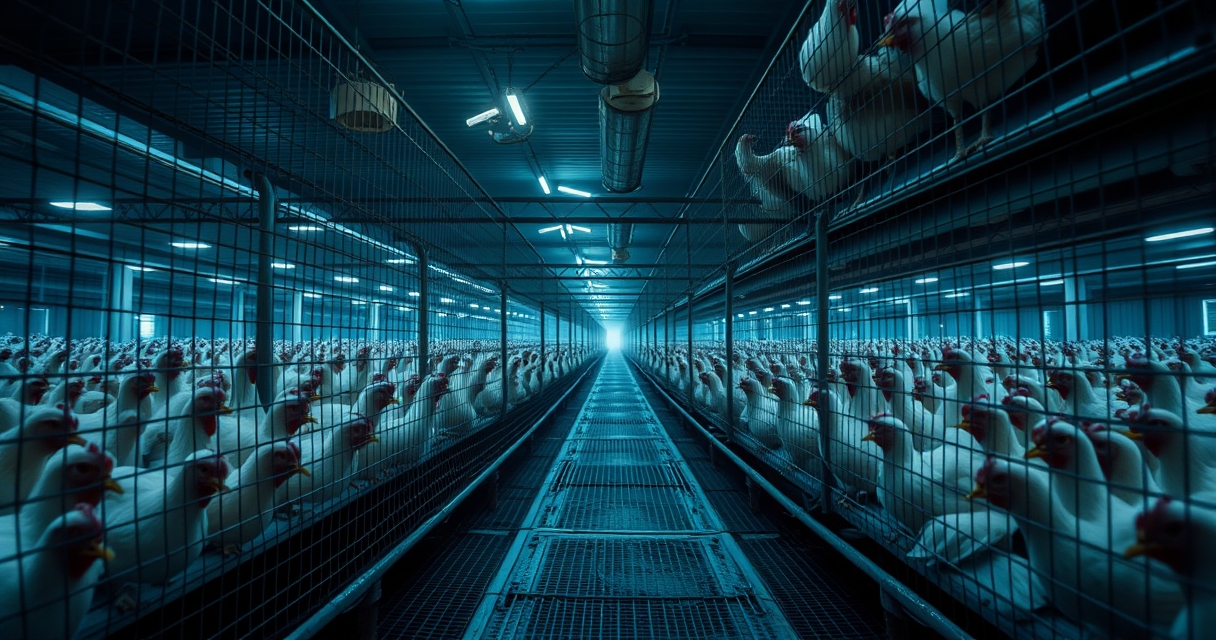
At a Tyson Foods grow-out house in eastern Arkansas, a broiler chicken reaches its scheduled slaughter weight at precisely forty-two days old. Its breast muscle is so overdeveloped that the bird cannot stand, its legs having been reshaped by selective breeding into load-bearing struts ill-suited for the chassis they support. The animal does not walk to its feed; the feed comes to it, delivered by automated lines. The chicken does not reproduce; the hatchery supplies it. The chicken does not choose when to sleep, when to eat, or when to die. Its entire existence is a production cycle, compressed into six weeks by a century of genetic optimization that treated the organism as a substrate for protein synthesis. This is not a biological being living in the world. This is living capital.
The scene is not metaphorical. The broiler chicken, as genetically engineered by multinational breeding corporations, is an organism whose form, metabolic rate, reproductive capacity, and even its capacity for pain have been subordinated to the accumulation of exchange-value. Capital has not merely purchased the animal's labor—it has redesigned the animal's very substance.
From Formal to Real Subsumption of Animal Life
Marx's distinction between formal and real subsumption provides the diagnostic framework for understanding what industrial animal agriculture represents. Under formal subsumption, capital takes over an existing labor process without fundamentally altering it. The craftsperson becomes a wage worker but still works with the same tools, the same materials, the same skills. Formal subsumption describes the early capitalist farm: the farmer still raised chickens as chickens had always been raised, but now did so for a landlord or a merchant who extracted surplus from their labor.
Real subsumption, by contrast, transforms the labor process itself. Capital reorganizes production from the ground up, designing machinery, workflows, and—crucially—biological inputs that are optimized for value extraction. In the case of animal agriculture, real subsumption does not stop at the barn door. It reaches deep into the genome. The animal as a naturally occurring species is abolished. In its place stands a population of protein-conversion units, each one tailored to a specific node in the value chain: the broiler for breast meat, the layer for maximum egg output, the sow for piglet production per square foot.
This is the material basis for the claim that industrial animal agriculture constitutes a distinct stage in the capital-labor relation—one in which the living organism itself becomes a fixed capital investment, designed and redesigned to meet the demands of accumulation.
Selective Breeding as Capital's Redesign of the Living Organism
The modern broiler chicken shares a common ancestor with the red junglefowl, but the two are as different as a hand sickle and a combine harvester. Since the mid-twentieth century, breeding programs—concentrated in a handful of global firms that control the genetic stock for virtually all industrial poultry—have selected for traits that serve accumulation: rapid growth rate, feed conversion efficiency, breast meat yield, and uniformity. The unintended consequences—cardiovascular collapse, skeletal failure, ascites—are managed not by redesigning the bird but by redesigning the environment that keeps it alive just long enough to reach slaughter weight.
This is not evolution by natural selection. It is evolution by capital selection. The criterion is not fitness for survival in an ecological niche but fitness for accumulation in a market niche. The animal is literally rebuilt to serve as a conduit for the conversion of corn and soy into profit. In Marx's terms, the animal's biological processes are subsumed as a productive force. Its metabolism, its growth rate, even its susceptibility to disease are treated as variables to be optimized, not as features of a living being with its own intrinsic ends.
Tyson does not merely raise chickens. Tyson produces chickens—chickens whose very genetic code is a proprietary asset, protected by intellectual property law and enforced through contracts that prohibit farmers from saving breeding stock. The animal has become intellectual property, a form of constant capital that walks, eats, and excretes until the day it is turned into frozen products.
The Confinement Architecture Is the Factory Floor
The confined animal feeding operation—the CAFO—is not a barn in any traditional sense. It is a factory floor designed around the biological requirements of the animals it contains, but only insofar as those requirements serve the production schedule. Lighting cycles are manipulated to maximize feed intake. Floor space is calculated to the square inch to minimize energy expenditure while maintaining the legal minimum required to avoid prosecution under animal cruelty statutes. Ventilation systems, waste disposal, automated feeding lines—the entire built environment is a fixed capital investment whose form is dictated by the imperative to convert grain into flesh at the lowest possible unit cost.
The animals are not workers in the sense of conscious labor-power, but they are living productive forces whose biological activity—growth, reproduction, lactation—constitutes the central productive process of the industry. Capital does not hire them; it builds them. It does not pay them a wage; it supplies them with feed formulated to the precise nutritional profile that maximizes accumulation. Their "labor" is their life process itself, and that life process has been entirely subsumed by the circuit of capital.
This is why the concept of real subsumption applies with such force. The animal is not an external input that capital purchases and processes. The animal is produced within the circuit of capital, from the genetically selected grandparent stock through the hatchery through the grow-out house to the slaughter line. The entire biological trajectory of the animal is a moment in the valorization process.
Tyson's Vertical Integration Completes the Circuit of Subsumption
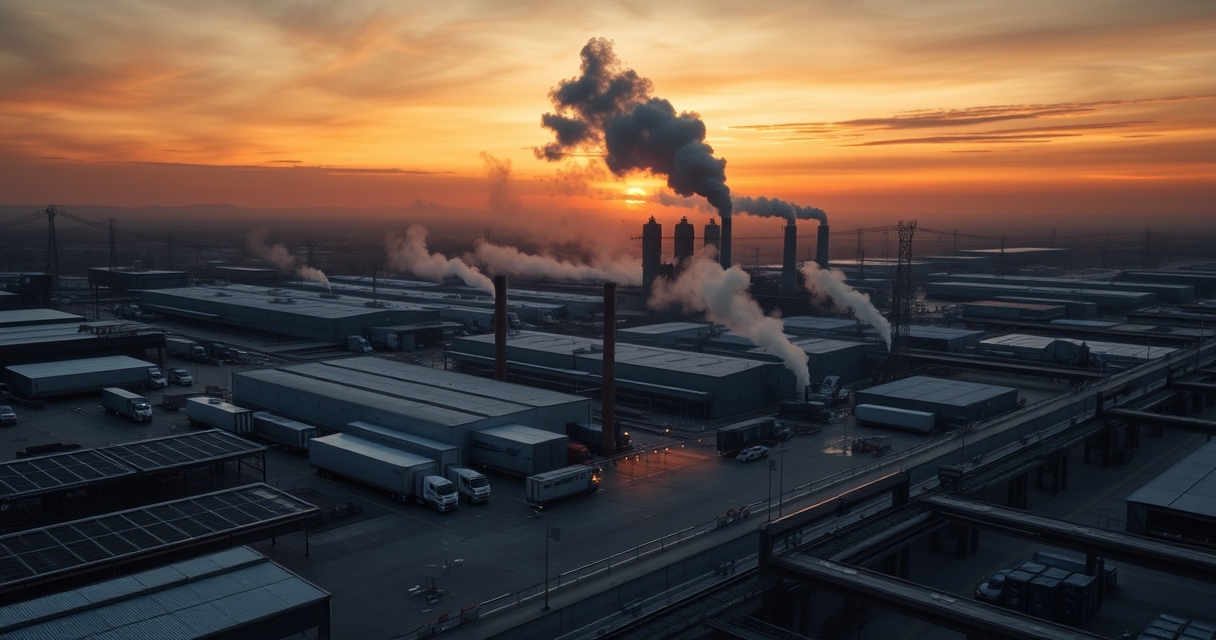
Tyson Foods is the largest processor of chicken, beef, and pork in the United States, with annual revenues exceeding fifty billion dollars. Its business model is built on a structure of vertical integration that extends from the genetic stock to the retail shelf. Tyson controls the breeding stock, the feed mills, the hatcheries, the contract grow-out operations, the slaughterhouses, the processing plants, and the distribution networks. Every node in the chain is owned or controlled through contracts that leave the independent farmer as a debt-serviced appendage to the corporate machine.
This vertical integration is not merely a logistical convenience. It is the organizational form that real subsumption takes in the animal industry. By controlling every stage of production, Tyson can treat the animal as a continuous flow of value, from the moment of conception to the moment of consumption. The farmer who raises the birds owns the building and the debt, but Tyson owns the birds, the feed, the genetics, and the market. The farmer is a custodian of a production process they do not control, tending living capital that belongs to someone else.
The slaughterhouse is the terminal point of this circuit. It is where the animal—now a fully realized piece of fixed capital—is converted into commodities. But the slaughterhouse is also where the contradiction of real subsumption becomes visible. The animal, unlike a machine, resists its own commodification. It feels pain. It struggles. It dies. The slaughterhouse is a site of immense and systematic violence, not because capital is cruel but because violence is the necessary technical condition for realizing the value embodied in the animal's flesh. The blood on the kill floor is not an accident of production. It is the physical manifestation of the subsumption of a living organism into the valorization process.
Synthesis: The Animal Body as Accumulation Strategy
Real subsumption in the Tyson slaughterhouse is not a metaphor. It is a material process in which the biological, genetic, and ecological dimensions of animal life are systematically reorganized to serve the accumulation of capital. The forty-two-day broiler chicken is the end product of this process: a living organism whose every feature—growth rate, body composition, disease resistance, even its capacity for suffering—has been optimized not for survival or flourishing but for profit.
The implications extend beyond animal welfare, though the ethical horror is undeniable. What industrial animal agriculture reveals is that capital's drive to subsume all productive forces does not stop at the boundary of the human. It reaches into the genome, into the reproductive system, into the metabolic pathways of entire species. The animal under industrial capital is not a partner, not a resource, not even a victim in the traditional sense. It is a manufactured input, a piece of living constant capital that is produced, maintained, and liquidated according to the requirements of accumulation.
For Marxism, this analysis demands a rethinking of what constitutes the working class, the productive forces, and the boundary between nature and capital. The animal body, in the era of real subsumption, is no longer external to the capitalist mode of production. It is internal to it, produced by it, and consumed by it. The broiler chicken at the Tyson plant is not merely killed. It is a product that was always already a commodity, from the moment its genetic code was written in a corporate breeding program. Capital does not find animals. Capital makes them. And then it kills them.