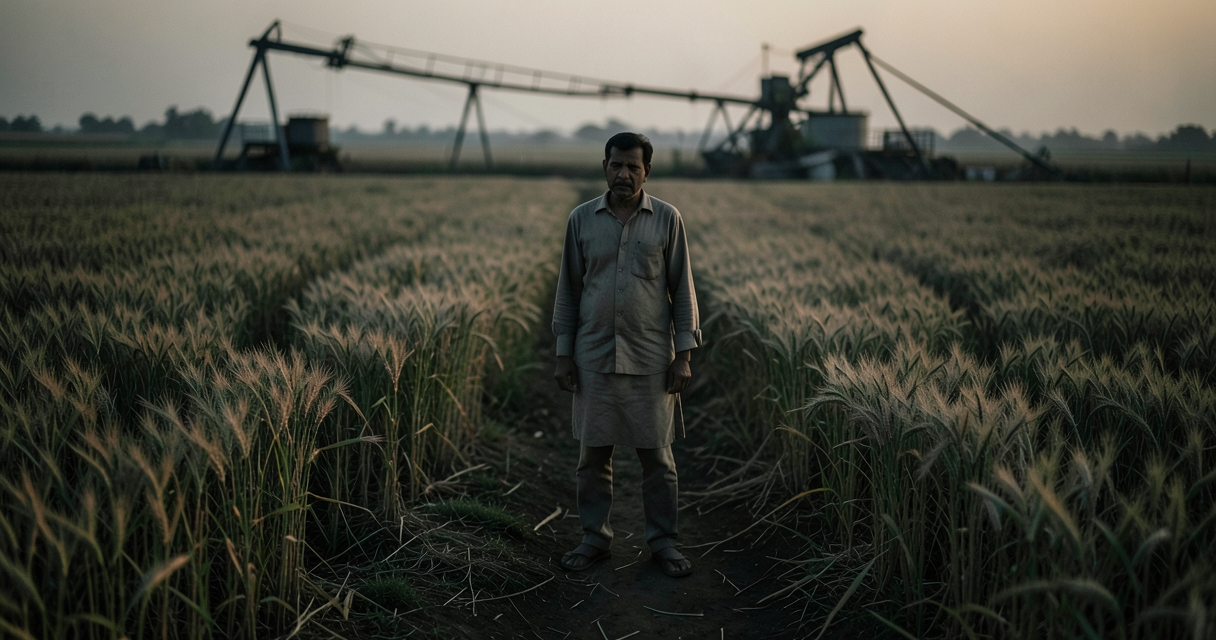
Since 1995, over 300,000 farmers in Punjab, India have taken their own lives. The official narrative blames monsoon failure or personal folly. The material reality traces a direct line from the debt incurred for Syngenta and Monsanto seeds to the noose. This is not a tragedy of errors. It is the logical outcome of a Green Revolution that transformed the Indian peasantry into a colony of global capital — a dispossession executed not by enclosure but by license and loan.
1. The Green Revolution as Primitive Accumulation
The Green Revolution in Punjab was never about feeding the hungry. It was a geopolitical project to prevent agrarian insurgency by integrating the Indian countryside into the world market. Beginning in the 1960s, the Indian state, advised by the Ford Foundation and the Rockefeller Foundation, pushed high-yielding variety (HYV) seeds — the precursors to today's patented GM seeds from Syngenta and Monsanto (now Bayer). These seeds required chemical fertilizers, pesticides, and assured irrigation. The state subsidized the inputs, but only for those who could take credit. The smallholder was not liberated; he was hooked.
This was primitive accumulation by other means. Marx described primitive accumulation as the historical process of divorcing the producer from the means of production. In Punjab, the land was not taken — but the conditions of its cultivation were. The HYV seeds demanded capital. The peasant who once saved seed from harvest now had to buy it each season. The soil that once regenerated through polyculture now required synthetic nitrogen. The farmer who once owed nothing now owed the bank, the seed merchant, the pesticide dealer. The circuit was closed: capital advanced, nature transformed, debt accumulated.
2. Seed Patents and Peasant Debt
The real transformation came with the Trade-Related Aspects of Intellectual Property Rights (TRIPS) agreement in 1995 and the Indian Patents Act (2005). Monsanto and Syngenta could now patent seeds. The terminator gene — which makes seeds sterile — was the crowning achievement of capitalist biology. It ensured that the peasant could not replant. Every season, a new purchase. Every purchase, a new debt. Syngenta’s seed-chemical package is not a product; it is a rent-seeking mechanism that turns the peasant into a perpetual debtor.
Data from the National Crime Records Bureau (NCRB) shows that over 80% of farmer suicides in Punjab are directly linked to debt — most of it informal, from local moneylenders who charge 24-36% annual interest. The average debt of a suicide victim is ₹1.2 lakh (about $1,500). A small sum in global finance; a death sentence in rural India. The same logic of disposability that governs animal life in factory farms governs the peasant: both are reduced to inputs in a metabolic circuit that discards them when they cannot be made productive.
3. The Metabolic Rift in Punjab Soil
The debt is not the only destruction. The soil itself is dying. Marx’s concept of the metabolic rift — the rupture in the natural cycle of soil nutrients caused by capitalist agriculture — is on full display in Punjab. The Green Revolution replaced crop rotation and organic manure with continuous monocropping of wheat and rice (the latter heavily subsidized for export). Chemical fertilizers temporarily boost yield but deplete micronutrients. Pesticides kill soil biota. Over 30 years, soil organic carbon in Punjab has fallen by 50%. Water tables are dropping by a meter per year. The water that remains is increasingly contaminated by pesticides — Syngenta’s Atrazine and Monsanto’s Glyphosate are detected in over 60% of wells tested by Punjab Agricultural University.
This is not an accident. It is the necessary consequence of a system that treats land as a factory floor. Capital cannot wait for nature to regenerate. The biological time of the soil conflicts with the accumulation time of the corporation. Syngenta makes profit selling the inputs that destroy the soil, and then sells the inputs to "fix" the problems it created — a classic double movement of capital. The peasant bears the cost of both: the debt for the seed, and the debt for the micronutrients needed because the seed destroyed the soil. The same mechanism of artificial scarcity that drives wage suppression along borders drives soil depletion in Punjab: a structural coercion disguised as market choice.
4. Farmer Resistance and the Limits of Reform
The peasantry is not a passive victim. The 2020-2021 farmer protests against the Modi government's farm laws — supported by Syngenta and its allies in the agrochemical lobby — brought millions to the borders of Delhi. That movement won a tactical victory: the laws were repealed. But the material conditions that produced the crisis remain untouched. The protest demanded Minimum Support Prices (MSP) and debt relief. These are reforms within the system; they do not challenge the seed monopoly, the patent regime, or the metabolic rift itself.
The limits of reform are the limits of capital. MSP can delay the fall but cannot reverse the dispossession. Debt relief without seed sovereignty is a temporary fix: the next season, the debt returns. The farmer who cannot save seed is never free. The struggle must move beyond the state to the very form of property that makes seed patentable. This means a politics that reclaims the commons of the genome — the right to save, exchange, and breed seed without license. It means decommodifying agriculture. The peasant in Punjab and the worker in a Tyson chicken plant share the same enemy: a system that treats life as a cost to be minimized. The question is not whether capitalism can reform agriculture, but whether agriculture can survive capitalism.
The soil will not wait. Every season of debt accumulation is another year of metabolic depletion. The 300,000 suicides are not an anomaly; they are the statistical expression of a system that requires the periodic destruction of its weakest links. The vanishing smallholder is not disappearing into history. He is being actively liquidated — by a patent, a loan, a seed that cannot be saved. The only answer is not a better seed, a better loan, or a better price. It is the collective refusal of the conditions that make debt, depletion, and death the condition of life.