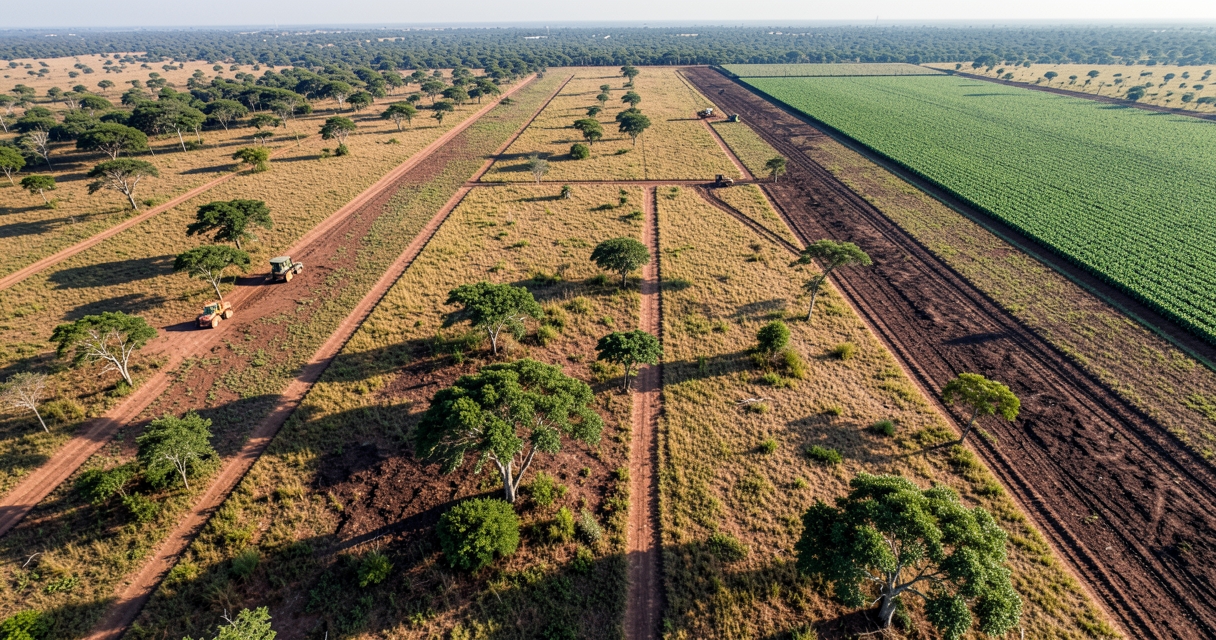
The Brazilian Cerrado is not a forest. It is a savanna — one of the most biodiverse on Earth, with 4,800 species of plants and vertebrates found nowhere else. It stores more carbon below ground than the Amazon forest above. It feeds rivers that sustain 40% of Brazil's freshwater. It has, over the past fifty years, been systematically eviscerated. Nearly 50% of its native vegetation is gone, replaced by a single crop: Glycine max, the soybean. The commodity that lubricates European livestock feed, Chinese pig herds, and the global agro-industrial complex.
The agents of this destruction are not anonymous market forces. They are specific, concentrated, integrated. BASF provides the genetically modified seeds and the glyphosate-based herbicides that poison the soil and the workers. Cargill controls the grain elevators, the rail networks, the crushing plants, the export terminals at Santos and Paranaguá. Between them, they own the soy life-cycle: from the patent-protected germplasm to the cargo ship bound for Rotterdam. This is not agricultural development. It is imperial extraction — the transformation of a living biome into a dead zone of exchange-value, a sacrifice zone for Northern accumulation.
1. The Cerrado as Sacrifice Zone
The concept of the sacrifice zone names a territory whose destruction is accepted as the cost of reproducing capital elsewhere. The Cerrado is the archetype. Unlike the Amazon, which draws global headlines and NGO campaigns, the Cerrado has been quietly liquidated — a "side-show" to the rainforest narrative, as if its extinction were a lesser tragedy. The data show otherwise: between 2000 and 2020, the Cerrado lost 460,000 km² of native cover. The rate of clearing now exceeds that of the Amazon. At current trends, the Cerrado will lose its ecological integrity within two decades.
The soy frontier is the direct cause. Brazil exports over 80 million tons of soy annually, more than any country on Earth. The vast majority — over 70% — is destined for animal feed in China and Europe. The Cerrado is thus not being "developed" for Brazilians. It is being dismantled to produce protein for industrial livestock systems that belong to the imperial core. The soil nutrients, the water cycles, the biodiversity — all are sacrificed so that a German pig or a Dutch chicken can be fed more cheaply. The Cerrado is a colony, not a countryside.
See also: Congo Cobalt, EV Revolution and Green Capitalism — sacrifice zone dynamics in the mineral-extraction complex.
2. BASF—Cargill Vertical Integration as Imperial Mechanism
Capital does not simply extract—it organizes. The soy commodity chain is structured by two monopolistic nodes. BASF, after its acquisition of Bayer's agricultural division (2023), controls over 30% of the global seed and pesticide market. Its Intacta RR2 Pro soybean — engineered for glyphosate resistance and insecticidal Bt toxicity — is the genetic standard for the Cerrado. Farmers do not buy these seeds; they license them, agreeing to proprietary terms that forbid saving seed, that mandate chemical regimes, that extract rent from every generation.
Cargill operates at the other end. It is the largest privately held corporation in the United States, and in Brazil it controls approximately 20% of all grain origination. Its logistics network — 30 grain terminals, 12 crushing plants, dedicated rail corridors — means that a soy farmer in Mato Grosso has exactly one buyer with realistic transport access. The price is set by Cargill's trading desk in Minneapolis, not by any local market. The farmer is a price-taker. The surplus from the land — ecological, economic, metabolic — flows upward into the balance sheets of the integrated oligopoly.
This vertical structure is the concrete form of imperialism in the 21st century. Not territorial occupation, but supply-chain capture. The seed-to-export pipeline is a pipeline of value: from Cerrado soil to European livestock, from peasant labor to shareholder dividends. Every link is owned. Every transaction is a transfer of wealth from the Global South to the Global North.
3. Peasant Dispossession and Proletarianization
The soy frontier is not empty. The Cerrado is home to 12 million people, including 87 indigenous groups and hundreds of thousands of campesino and quilombola communities. Their land tenure is typically informal, collective, undocumented. Under Brazilian law, this makes them vulnerable to grilagem — the systematic forging of land titles — which large soy operations use to "legalize" expropriation. Between 2010 and 2020, over 300,000 families were displaced from rural areas in the Cerrado biome.
Dispossession does not simply remove people from land. It transforms them into wage-laborers. The displaced peasant moves to the soy frontier's cidades-dormitório — dormitory towns like Sorriso or Sapezal — where they work as temporary harvest hands, pesticide applicators, or truck drivers. Their labor is seasonal, dangerous, and poorly paid. BASF's herbicides are sprayed from aircraft over fields that once were their gardens. Formerly autonomous producers become proletarians — and in Brazil, this proletariat is overwhelmingly Black and Indigenous, the racialized body of primitive accumulation.
This is not a "social cost" of progress. It is a deliberate class project. The destruction of the Cerrado is inseparable from the destruction of the peasantry. Capital requires cheap land and cheap labor. The Cerrado provides both — at the price of social and ecological life.
4. Monoculture as Metabolic Rift
Marx's concept of metabolic rift — the rupture of the natural cycles of soil fertility under capitalism — finds its purest contemporary expression in the soy monoculture. A natural Cerrado system is characterized by deep-rooted grasses and shrubs that recycle nutrients, fix nitrogen, and maintain soil structure. The soy system destroys this entirely. The soil is left bare between seasons, exposed to equatorial sun and rain. Erosion rates on soy fields in the Cerrado exceed 15 tons per hectare per year — 10 times the natural rate.
Chemical inputs do not close the rift; they widen it. Nitrogen fertilizers volatilize into N₂O, a greenhouse gas 300 times more potent than CO₂. Phosphorus runoff from the Cerrado flows into the Pantanal — the world's largest tropical wetland — causing algal blooms that suffocate fish and poison water. BASF's herbicides, especially dicamba and 2,4-D, drift beyond field boundaries, killing non-target vegetation and insects. The Cerrado's pollinators — bees, wasps, butterflies — are collapsing. The soy plant itself is sterile, engineered not to reproduce, requiring annual reseeding. The metabolism of the land is broken.
Read also: The CFA Franc and Neocolonial Extraction in West Africa — a parallel analysis of imperial mechanisms in the monetary sphere.
The metabolic rift is not a technical problem. It cannot be fixed with "precision agriculture" or "regenerative soy" — labels that Cargill markets to European consumers while the Cerrado burns. The rift is the necessary form of capital's relation to nature. Soy is not grown to feed people, but to accumulate value. As long as the seed-to-export pipeline is privately owned, the land will be exhausted. The contradiction is not between soy and forest; it is between use-value and exchange-value, between ecological reproduction and capital accumulation.
The Cerrado is dying. BASF and Cargill will move on — to the Argentine Chaco, to the Mozambican savanna — when the soil gives out. The peasantry will have been scattered, the Indigenous territories fragmented, the rivers silted. This is not development. It is primitive accumulation on a planetary scale, the voracious metabolism of capital consuming its own conditions. The only resolution is not a different soy, but a different mode of production — a society in which the land, the seed, and the labor belong to those who work it, and in which the Cerrado is allowed to be itself: a living biome, not a corpse of commodities.