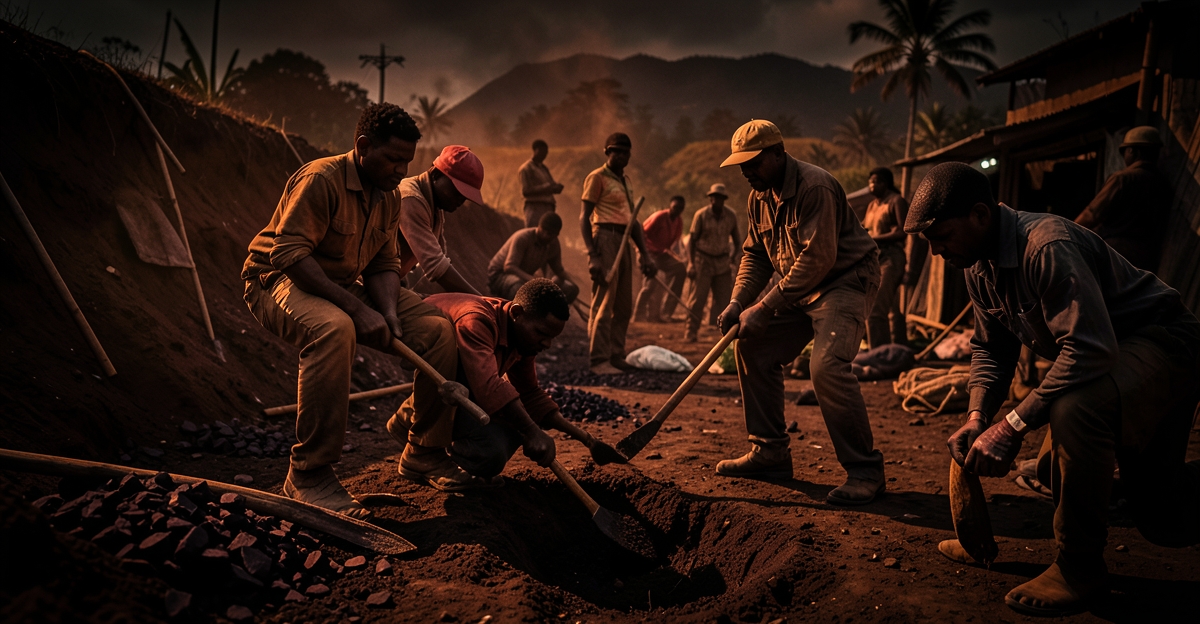
In Kolwezi, Democratic Republic of Congo, a nine-year-old boy swings a hammer against cobalt-bearing rocks under a July sun. His hands are calloused, his lungs clogging with dust. A hundred yards away, a white Land Cruiser belonging to Glencore's logistics division idles past—air-conditioned, armored, locking its doors. Meanwhile, in Kinshasa's wealthier neighborhoods, fewer than a thousand electric vehicles navigate potholed roads across a country of 100 million people. One of them is a Cybertruck, shipped from Texas to sit in a diplomat's garage. This is the material reality of the "green transition."
The global push for electric vehicles is capitalism's latest bid for ecological legitimacy—a narrative in which Tesla, BMW, and Volvo promise salvation through consumption. But beneath every lithium-ion battery lies a deeper history of extraction. The thesis is this: Green capitalism does not transcend imperialism; it perfects it, externalizing the ecological costs of transition onto the Global South while rebranding super-exploitation as sustainability. The electric vehicle revolution is not a rupture with extractive capitalism but its most advanced form—one in which "decarbonization" serves as ideological cover for the reproduction of imperialist relations.
The EV Supply Chain Begins in a Colonial Extraction Zone
The Congo supplies over 70 percent of global cobalt, concentrated in the southern Katanga Copperbelt—a region first violently integrated into global capital under Belgian King Leopold II's rubber and ivory extraction regime (1885–1908). That regime killed an estimated 10 million Congolese through forced labor, mutilation, and starvation. The structural logic did not end with independence in 1960; it merely changed corporate flags. Today, cobalt extraction occurs through two parallel systems: industrial mining dominated by Glencore's Mutanda mine (which alone produces roughly 40 percent of global supply) and artisanal mining, where an estimated 110,000 to 200,000 informal laborers—including children as young as seven—excavate ore by hand without protective equipment.
The material conditions remain structurally identical to the Congo Free State: foreign ownership of mineral rights, state-compelled labor, and the wholesale repatriation of value to imperial centers in Switzerland, China, and the United Kingdom. Glencore reported $34 billion in revenue in 2022 from operations that include the Mutanda and KCC mines, while the average artisanal miner in Kolwezi earned between $1 and $3 per day. This is not market failure; it is a functioning imperialist extraction regime.
"Green" Certification Schemes Obscure, Not Resolve, Imperialist Extraction
In response to mounting scrutiny, corporations have embraced voluntary certification regimes such as the Fair Cobalt Alliance and the Responsible Minerals Initiative. These schemes audit only formal-sector mines, yet an estimated 15 to 30 percent of Congolese cobalt originates from artisanal sites where no certification reaches. The regimes function primarily as ideological cover, allowing Tesla—which used conflict minerals in roughly 85 percent of its supply chain as of 2020—and Apple to claim ethical sourcing without altering the fundamental extraction relation: the miner's subordination to capital.
History demonstrates the pattern. The Dodd-Frank Wall Street Reform Act's Section 1502 (2010), which required companies to disclose the use of "conflict minerals" from the Congo, produced a perverse outcome. Formal buyers withdrew from the region, artisanal miners were pushed into illegal circuits, and armed groups found new revenue streams. Certification regimes in the Congo tend to formalize extraction at the expense of the poorest, legitimizing corporate control while rendering the most vulnerable invisible to the law.
The Price of Cobalt Is Determined Not by "Supply and Demand" but by State Violence
Between 2010 and 2018, cobalt prices fluctuated between $12 and $40 per pound on the London Metal Exchange. Yet miners' daily wages in Kolwezi never exceeded $1 to $3 per day. This disparity reveals a fundamental Marxist truth: the "market price" of a commodity does not reflect its scarcity but the cost of suppressing labor power—specifically, the cost of maintaining what Marx called the reserve army of labor, a surplus population whose desperation drives wages below subsistence.
The Congolese state, under both Joseph Kabila (2001–2019) and current President Félix Tshisekedi, annually contracts foreign security firms—including GardaWorld, whose CEO is a former British intelligence officer—to pacify mining regions. In 2022, security forces massacred 49 artisanal miners at Kashobwe, a town in Kasai province, after a dispute over tunnel access. The real subsidy to the EV industry is not tax breaks or R&D credits; it is the Congolese state's willingness to deploy lethal force to maintain a reserve army of super-exploited labor. This is a subsidy that the International Monetary Fund's $4.6 billion Extended Credit Facility (2021) directly underwrites by imposing fiscal austerity that forces the state to seek alternative revenue streams from mineral extraction.
Imperialist Ecology Demands a Socialist Alternative, Not "Greener" Capitalism
The same corporations celebrated for electrifying transport—Glencore, Tesla, BMW—lobbied against the 2022 United Nations Human Rights Council resolution to investigate cobalt mining conditions in the Congo. This is not hypocrisy; it is the logical expression of green accumulation. Capital cannot afford the truth of its own supply chain because the margins of the energy transition depend on the opacity of extraction.
The counter-argument must be steel-manned. The strongest position from the other side: Cobalt mining in the Congo, while historically violent, is the only economic option for a country whose colonial legacy left it without diversified industry. EV manufacturers are not colonial villains but rational actors responding to consumer demand for cheaper batteries. Voluntary certification and gradual technological substitution—such as lithium-iron-phosphate (LFP) batteries that use no cobalt and are already adopted by Tesla in its standard-range vehicles—will phase out artisanal mining organically. The real obstacle to reform is not capitalism but Congo's endemic corruption, which would persist under any system. Imposing labor standards, the argument concludes, would simply push mining to unregulated sites or to other mineral regimes.
This argument is defensible in its facts but false in its conclusions. The pivot to LFP batteries does not resolve the crisis; it merely shifts extraction pressure to lithium in Chile and Bolivia and phosphate in Morocco and Western Sahara—each site with its own history of imperialist extraction. Corruption in the Congo is not a cultural pathology but the political form of a state whose fiscal base depends on foreign capital. As Mahmood Mamdani has argued, the post-colonial state in Africa is defined not by its autonomy from capital but by its mediation of competing imperialist interests. The corruption is not separate from capitalism; it is capitalism's local expression.
The only exit from this contradiction is not reform but rupture. A genuine ecological transition must break with the imperialist division of labor. Congo cannot remain the sacrifice zone for Europe and North America's decarbonization. The demand is not "ethical cobalt"—a concept that functions as a commodity fetish—but the structural transfer of processing capacity and industrial power to the Congo. This includes the nationalization of mining under workers' control as a condition for any global energy transition. The working class of the Congo must have the right not only to extract but to define the terms of extraction, including a planned phase-out of cobalt dependency through rapid investment in public transportation, renewable energy cooperatives, and industrial diversification—all financed by the corporations that have extracted $500 billion in mineral wealth from the Congo since 1960.
The electric vehicle revolution is a battle within capitalism, not against it. The real choice is not between green capitalism and no transition; it is between imperialist ecology and socialist ecology. The former offers carbon-neutral inequality; the latter demands that those who have been stripped of their land and labor for 140 years become the architects of a genuinely post-carbon world. Anything less is not a transition. It is a colonial repetition dressed in silicon.
Sources: Amnesty International, "The Cost of Cobalt" (2021); Congo Research Group, "Cobalt Mining in the DRC" (2023); IMF Press Release 21/217 (July 2021)