On October 20, 2019, Evo Morales won the first-round presidential election in Bolivia with 47.08% of the vote, a 10.57-point lead over runner-up Carlos Mesa. Within three weeks, Morales—who had overseen the country’s most significant period of Indigenous-led socialist governance since the 1952 National Revolution—was in exile in Mexico, and a far-right regime had seized power. This was not a democratic correction. This was a coup animated by imperial extraction interests, racial animus, and a concerted attack on what Marxists call the social relations of production—the class and property structures through which a society organizes labor, surplus, and power.
The Lithium Triangle and Imperial Interest Are Inseparable from the Coup
Bolivia sits atop the so-called “Lithium Triangle,” a salt-flat region holding roughly 70% of the world’s known lithium reserves—a mineral essential to the global transition to electric vehicles and grid storage. By 2019, Morales’ state-led industrialization model, pursued through the state-owned lithium company YLB (Yacimientos de Litio Bolivianos), had already inked a $350 million joint venture with German firm ACI Systems, retaining majority state ownership. This directly challenged the imperial preference for extractivist privatization, in which transnational corporations—primarily American, Canadian, and Australian—extract raw materials at minimal cost to themselves and maximal profit for shareholders. The Washington Consensus, a neoliberal policy framework enforced by the IMF and World Bank since the 1980s, demands that developing nations open strategic resources to foreign capital. Morales had refused. The coup removed that obstacle.
The OAS Electoral Fraud Narrative Was Itself Fraudulent
The immediate pretext for the coup was the Organization of American States (OAS) preliminary report, released November 10, 2019, which alleged “clear manipulation” of the vote count, claiming a “statistical impossibility” in Morales’ margin of victory. The OAS methodology was later subjected to independent scrutiny by researchers at the Massachusetts Institute of Technology and the Center for Economic and Policy Research (CEPR). Their analysis found no evidence of fraud; the supposed anomalies were artifacts of the OAS’s own flawed sampling and a failure to understand Bolivia’s vote-transmission system. The OAS’s own internal audit (published in 2020, but suppressed) reportedly found no systematic irregularities. The narrative of fraud was itself fraudulent—a coup by spreadsheet, as some analysts termed it.
Yet this false narrative was mechanically reproduced by Western corporate media—El País, The New York Times, the BBC—which amplified the OAS claims without critical interrogation. The speed with which the fraud allegation was converted into a geopolitical fact demonstrates Gramsci’s concept of hegemony: the capacity of ruling-class institutions to define what counts as “credible” truth, even when that truth contradicts available evidence. By the time CEPR’s rebuttal was published, Morales was already gone.
Morales’ Economic Record Threatened the Neoliberal Consensus Itself
Opponents of the coup rarely emphasize the material conditions that made it necessary—not just for Bolivia’s oligarchy, but for the global capitalist order. Under Morales (2006–2019), Bolivia experienced the most sustained pro-poor economic transformation in Latin America. Poverty fell from 60.6% to 37.2%; extreme poverty from 38.2% to 15.2%; the Gini coefficient (a measure of inequality) dropped by 15 points—the largest reduction in the region. Bolivia’s GDP grew at an average of 4.9% annually, while public debt as a percentage of GDP remained among the lowest in South America.
These were not accidental outcomes. The Morales government pursued what Marxists call primitive socialist accumulation: the use of state power to redirect surplus from extractive industries (particularly natural gas, nationalized in 2006) into social programs, infrastructure, and industrialization. This model relied on high commodity prices—a vulnerability—but it also built a domestic market, increased the organic composition of labor (more skilled workers, better wages), and reduced dependency on imperial finance. This trajectory threatened the neoliberal consensus not by rhetoric but by demonstration: it showed that an alternative to the Washington Consensus was materially possible.
The Racial Character of the Coup Was Central, Not Incidental
Any analysis that frames the 2019 coup as merely a “political conflict” or an “institutional crisis” commits a category error. The coup was white supremacist in form and content. Bolivia’s elite has historically been fair-skinned, Spanish-descended, concentrated in the eastern lowlands (the media luna crescent) and the city of Santa Cruz. They have never accepted the 2009 Constitution, which re-founded Bolivia as a plurinational state—a state recognizing multiple Indigenous nations as co-sovereign, with collective land rights, autonomous governance, and official language status for 36 Indigenous languages.
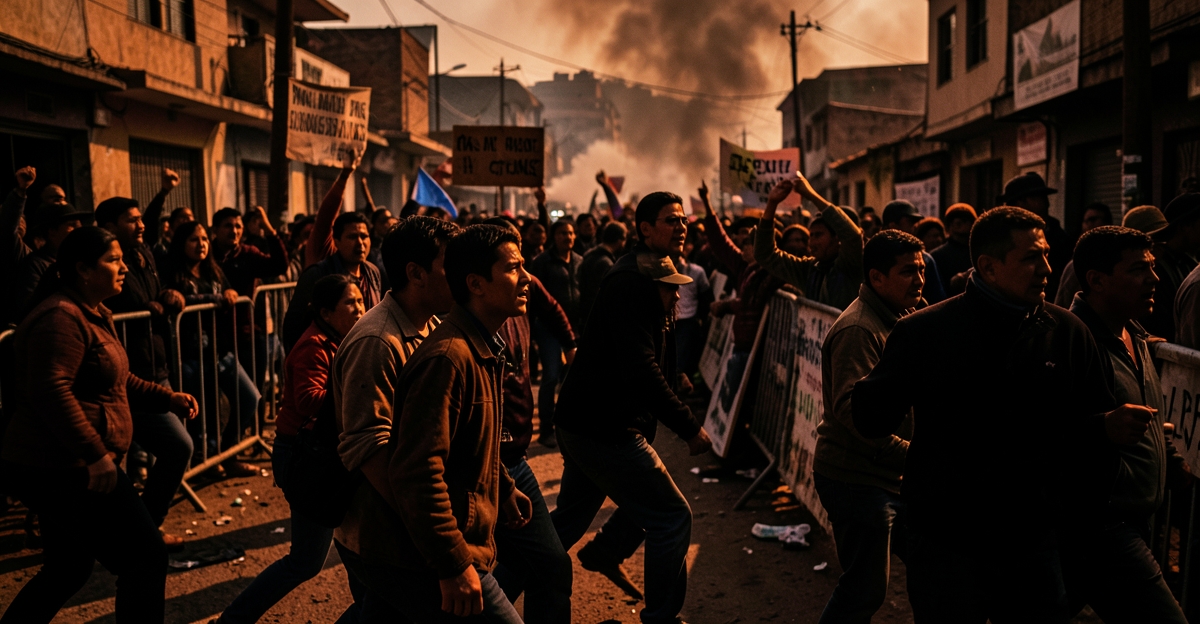
During the three weeks of post-election violence preceding the coup, racist attacks against Indigenous people intensified in La Paz and El Alto. Aymara women in pollera skirts were spat upon, had their braids cut, and were called “cholos” (a racial slur for Indigenous people) by protesters. The far-right leadership of the coup—including Luis Fernando Camacho, who carried a Bible and explicitly framed his campaign as a “Christian” redemption against “pagan” Indigenous governance—did not attempt to hide its racial animus. When Camacho entered the Palacio Quemado on November 12, 2019, he publicly insulted the wiphala, the rainbow Indigenous flag, ordering it removed from the government palace. This was not a disagreement over electoral procedure. It was a racialized class assault on Indigenous political self-determination.
The Return and Its Limits: What the Left Must Learn
In October 2020, amid the catastrophic mismanagement of the COVID-19 pandemic by the de facto regime of Jeanine Áñez (whose health policy was described by The Lancet as a “public health emergency in its own right”), the Movimiento al Socialismo (MAS) returned to power, winning 55.1% of the vote under Luis Arce, Morales’ former finance minister. This was a democratic vindication. But it was not a revolutionary restoration. Arce’s government has been more cautious on nationalization and more conciliatory toward business elites than Morales’ first two terms. Extraction rents remain the economic base, and lithium development has stalled.
The lesson for the Marxist left is not that Morales was insufficiently radical or that Arce is a sellout; these judgments are too cheap. The lesson is structural: imperialism will tolerate socialist reform only so long as it does not threaten the core logics of capital accumulation within its strategic periphery. Once Bolivia’s lithium policy posed a material threat to imperial industrial strategy—and once the racialized order of white-mestizo supremacy was challenged at the level of the state—a coup became a rational response for capital, executed through a fraudulent narrative that would have been laughable but for its consequences. The return of the MAS proves the strength of Bolivia’s popular movements. Its limits prove the breadth and depth of the enemy.
To steel-man the counter-argument: one might argue that Morales’ decision to seek a fourth term, despite a 2016 referendum rejecting term-limit changes, created a democratic vulnerability that the OAS exploited. This is true, but it mistakes a tactical error for a structural cause. The coup did not happen because Morales overreached. It happened because Bolivia’s bourgeoisie—backed by U.S. state apparatuses and an inter-imperialist organization (the OAS)—saw an opportunity to reverse a decade of Indigenous socialism and seize control of the world’s most strategic mineral reserve. The fraudulent electoral narrative was the crowbar, not the motive.
The coup of 2019 was a brutal, clarifying event. It revealed that Bolivia’s plurinational project was always a threat—to white supremacy, to neoliberal extraction, to the idea that a small Andean nation could chart a course outside the orbit of imperial capital. The task ahead is not simply to defend the remains of the Morales era, but to understand why it could be overthrown so quickly, and what would need to be different—economically, politically, and militarily—for the next effort to endure.