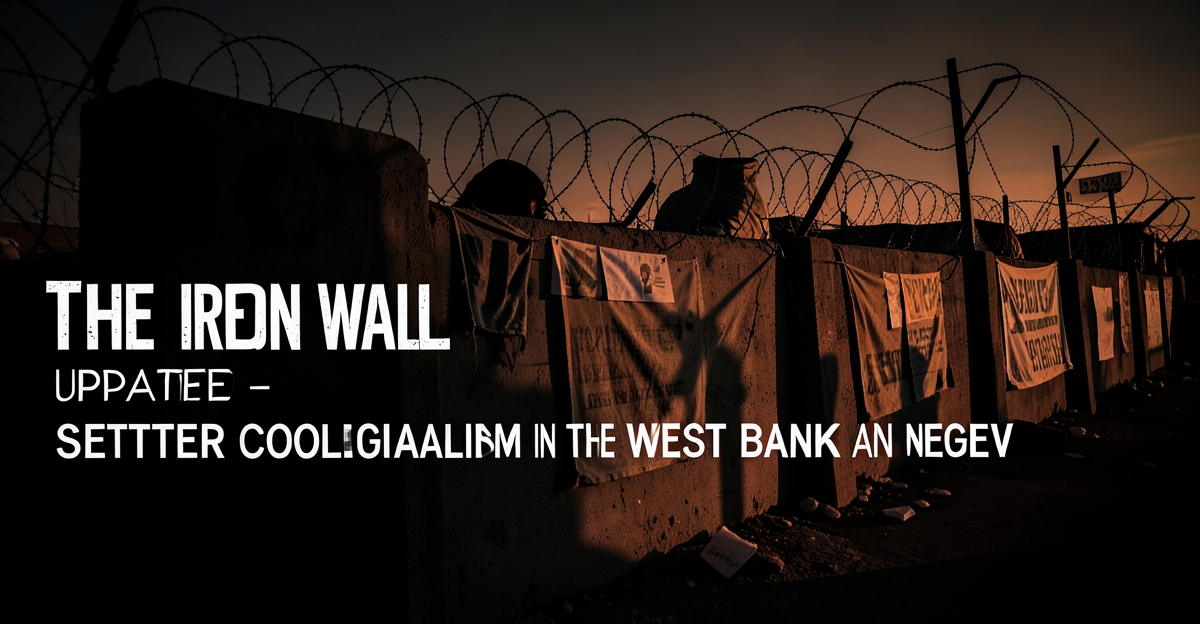
The Iron Wall today is not made of concrete and barbed wire, but of Excel spreadsheets, permit quotas, and zoning maps. The occupation's most brutal violence is now bureaucratic, administered by civilian clerks with laptop computers. This shift from overt military domination to administrative strangulation marks the third phase of Zionist settler colonialism—a phase that does not replace but absorbs and supersedes the 1948 Nakba and the 1967 occupation. The thesis is this: the current apparatus of colonial rule in Palestine is not a temporary security measure but a permanent infrastructure of primitive accumulation, designed to extract maximum surplus value from a super-exploited indigenous labor reserve while annexing territory through differential legal regimes. This is the "Iron Wall Updated," and it represents capitalism's spatial solution to its own internal crises of accumulation and legitimation.
The Iron Wall 2.0: From Military Deterrence to Bureaucratic Enclosure
Vladimir Jabotinsky's 1923 essay "The Iron Wall" argued that no voluntary agreement between Jews and Arabs was possible; only "an iron wall of bayonets" could create conditions for eventual Zionist consolidation. For a century, this doctrine justified overwhelming military force. Yet the fourth decade of occupation has witnessed a qualitative transformation: the bayonets remain, but they now enforce a bureaucratic enclosure system more efficient than any checkpoint. The 2018 Nation-State Law formally codifies Jewish supremacy as a constitutional principle, while the 2020 Trump "Peace to Prosperity" plan provides the juridical blueprint for permanent annexation disguised as autonomy. The Palestinian Authority survives not as a proto-state but as a subcontractor of colonial labor control—a de facto gendarmerie quelling resistance in exchange for the scraps of customs revenue and international legitimacy.
The material evidence is staggering. Between 2021 and 2023, the Israeli state legalized 24 previously "unauthorized" outposts retroactively, bringing the total settlement count to over 300 across the West Bank. The bureaucratic apparatus operates through a web of overlapping jurisdictions: the Civil Administration, the Nature and Parks Authority, the Custodian of Absentee Property, and the Planning Council—all working in concert to produce what the UN Office for the Coordination of Humanitarian Affairs (OCHA) documented as a 50% increase in demolition orders in Area C during 2023 alone. This is not random violence but calculated enclosure: every demolished home, every revoked building permit, every designated "firing zone" or "nature reserve" serves to shrink Palestinian space while expanding settlement grid. The permits, zoning categories, and "green zones" are the slow-motion expulsion mechanism—a violence administered by civilians with clipboards and laptops, but violence nonetheless.
The Negev as Internal Colony: Bedouin Dispossession Under the Prawer-Begin Framework
This bureaucratic enclosure is not limited to the occupied territories proper. Inside the Green Line, the Israeli state subjects its Bedouin citizens to a parallel regime of dispossession—a fact that reveals the unified logic of settler colonialism as accumulation through displacement. The 2011 Prawer Plan, codified as the Prawer-Begin law in 2013, targets 30,000 to 40,000 Bedouin citizens for forced relocation from 35 "unrecognized villages" into state-planned townships like Hura and Rahat. The state's stated rationale is "development" and "rule of law," but the material reality is textbook primitive accumulation: the expropriation of 800,000 dunams (80,000 hectares) of ancestral land for transfer to Jewish-only agricultural settlements, industrial zones, and military training grounds. The Bedouin lose not just land but the very basis of their economic existence—pastoralism, agriculture, and community reproduction—all criminalized through a parade of legislation.
The 2018 "Kaminitz Law" (Amendment No. 116 to the Planning and Building Law) raised fines to hundreds of thousands of shekels and imposed prison sentences for building without permits—permits that are never granted to unrecognized villages by definition. From 2022 to 2024, the Negev witnessed over 1,500 structures demolished annually, according to the Association for Civil Rights in Israel. The state wraps this violence in ecological rhetoric: "nature reserves" are declared over Bedouin lands, and pastoralism is framed as environmental degradation. This is not a land dispute between equal parties; it is a class-driven program of accumulation that dispossesses indigenous citizens to enrich Jewish settlers and state-linked agricultural corporations. The Bedouin are not "Arabs of the land" in the state's narrative but internal enemies whose existence must be erased through zoning codes.
Differential Incorporation: The West Bank as a Super-Exploited Labor Reserve
If the Negev represents dispossession through exclusion, the West Bank exemplifies dispossession through differential inclusion. Between 150,000 and 200,000 Palestinian workers cross into Israel daily under the "permit system"—a regime that is not labor migration but labor extraction in its purest capitalist form. These workers earn wages 60% lower than their Israeli counterparts for identical work in construction, agriculture, and service industries. They enjoy no union rights, no social benefits, no job security. The permit system ties legal presence to a specific employer, recreating conditions of indentured labor: switch jobs, lose the permit. So deep is the extraction that many workers are forced to sleep illegally in Israel, hiding from police night patrols, because checkpoint time limits make daily return to the West Bank physically impossible within the 5 a.m. to 5 p.m. work window.
The 2023-2024 war on Gaza has paradoxically accelerated this dynamic. While the Israeli state tightened movement restrictions across the West Bank—more checkpoints, longer queues, more arbitrary closures—it simultaneously increased the selective issuance of labor permits as a mechanism of political pacification. The Palestinian Authority receives a cut of permit fees and customs revenues, creating a material stake in maintaining the flow of cheap labor. What emerges is a triangular relation of exploitation: the Israeli capitalist extracts surplus value from Palestinian labor; the PA extracts its own legitimacy from managing the flow; and both collaborate to suppress any class-wide organization. This is not merely occupation as security policy but occupation as a labor regime—a permanent reserve army of super-exploited workers that disciplines both Palestinian and Jewish working classes through wage depression and spatial fragmentation.
The Settler Class and the State: An Uneasy Alliance of Primitive Accumulation
None of this functions without a class of beneficiaries with vested interests in the colonial apparatus. The 500,000 settlers in the West Bank (excluding East Jerusalem) are not spontaneous "pioneers" but a parasitic class sustained by massive state investment. Settlements receive ten times the per-capita state funding of Israeli municipalities, according to the Jerusalem Institute for Policy Research (2022). This subsidy creates a material dependency on continued land theft and military protection. Yet within the settler class, tensions exist between "market-oriented" settlers (who operate tech parks, wineries, and industrial zones needing cheap Palestinian labor) and "ideological" settlers (who advocate maximal territorial annexation and periodic violence against Palestinians).
These fractions, however, share a common material base: both require the apparatus of dispossession to survive. The recent surge in settler violence—over 900 incidents documented by UN OCHA in 2022-2023, with less than 1% of cases leading to indictment (Yesh Din, 2023)—is not state weakness but state strategy. The Israeli state under the current coalition (2023-) has elevated settlers to actual law enforcement roles, embedding them in Civil Administration planning committees and border police units. The "hilltop youth" who attack Palestinian farmers and their international solidarity escorts operate with functional impunity, while the state prosecutes Palestinian stone-throwers with military courts and indefinite administrative detention. This is the Iron Wall's final logic: the colonial state need not administer violence directly when it can deputize the settler class to do so.
The Counter-Argument: Security, Rejectionism, and the Two-State Illusion
The strongest opposing position must be steel-manned, not straw-manned. Its advocates argue that the occupation is a tragic but temporary security necessity arising from the 1948-1967 wars and ongoing Palestinian rejectionism. Israel, they claim, repeatedly offered land-for-peace—Camp David 2000, the Olmert proposal of 2008—and was met with either refusal or (in the case of Hamas) active terrorism. The current reality is a holding pattern until a negotiated two-state solution can be realized. Settler violence is a fringe phenomenon condemned by the Israeli state, which prosecutes perpetrators when evidence allows. The Negev Bedouin issue is fundamentally a matter of development and rule of law: Israel, like any sovereign state, must enforce zoning regulations for all citizens, and the relocation to townships offers modern infrastructure that unrecognized villages lack.
The immanent critique of this position lies in its own contradictions. If the occupation were a temporary security measure, why has Israel built permanent civilian infrastructure—highways, industrial parks, university campuses—inside the West Bank? If the state condemns settler violence, why does it fail to prosecute 99% of cases? If Bedouin relocation is about development, why are Bedouin citizens excluded from the basic water and electricity grids that Jewish towns enjoy? The two-state solution fails not because of Palestinian intransigence but because the material reality of settlement expansion has made territorial partition impossible. The "peace process" was not a failure of good-faith negotiation but a mechanism to facilitate continued land theft under a diplomatic cover. The security argument cannot explain why a "defensive" state would build infrastructure designed to make occupation permanent—because it is not defensive. It is accumulative.
Synthesis: The Unified Apparatus of Accumulation Through Dispossession
The West Bank and the Negev are not two separate problems—one "external" occupation, one "internal" discrimination—but a single system of settler colonial capitalism. In the West Bank, the state annexes territory while differentially incorporating Palestinian labor as a super-exploited reserve army. In the Negev, the state dispossesses Bedouin citizens to transfer land to Jewish settlers and state-linked capital. Both operate through the same bureaucratic infrastructure: permits, zones, demolitions, legal differentials. Both serve the same material function: primitive accumulation for the settler class, wage depression for the Jewish working class, and racialized super-exploitation for Palestinians.
The "Iron Wall Updated" is capitalism's spatial fix for three simultaneous crises: the military overstretch of the occupying state, the demographic competition between Jewish and Palestinian populations, and the neoliberal austerity that has hollowed out the Israeli welfare state. By maintaining a permanent colonial reserve army and annexing territory without formal responsibility for its indigenous population, the settler state resolves these crises through dispossession rather than redistribution. The only resolution, consequently, is not reform of the occupation or revival of the two-state illusion but dissolution of the colonial infrastructure itself. This requires something the current framework structurally prohibits: a united struggle of Palestinian workers, Bedouin communities, and Jewish anti-Zionist forces against the settler-colonial state and its imperial sponsors. The Iron Wall's third phase has perfected the art of bureaucratic violence, but it has also concentrated the contradictions into a single target: the apparatus of accumulation through dispossession.