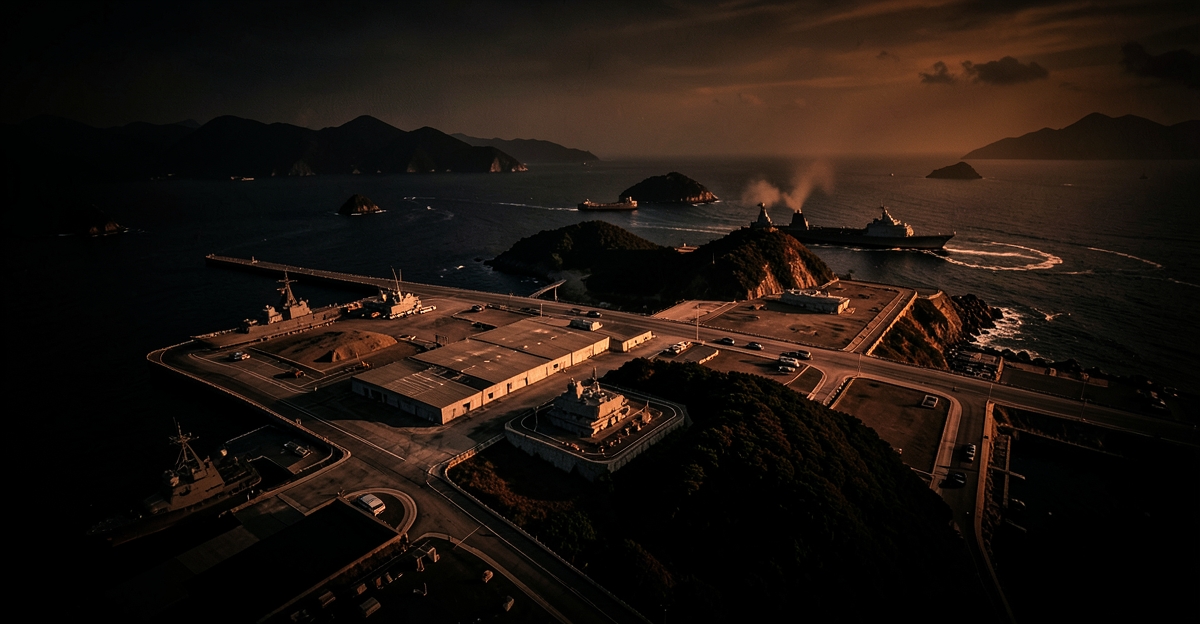
On April 25, 1945, as the Battle of Okinawa raged, the New York Times reported that U.S. forces had already secured the Kadena airfield—a strip of coral that would, within two decades, become the linchpin of America’s Pacific forward-deployment system. That 82-day campaign killed over 12,000 Americans and perhaps 150,000 Okinawans, but for the Pentagon, the real prize was geography: Okinawa sits just 400 miles from Taiwan and 800 from mainland China, a firing position no missile can erase. Today, that same geography has been rebranded as the First Island Chain, a concept that wraps imperial basing in the language of liberal security. But the chain is not a defensive perimeter. It is a lattice of occupied territory, designed to project American power into Asian markets and to suppress the emergence of any competing economic bloc—particularly one centered on Beijing.
The Island Chain Strategy Serves Capital Not Security
The First Island Chain—running from Japan’s Ryukyu Islands down through Taiwan, the Philippines, and Indonesia—is often presented as a Cold War relic, a cordon sanitaire against communism. In Marxist terms, this is a classic example of military Keynesianism: the use of state military expenditure to stabilize capitalist accumulation, often under the guise of national defense. The actual threat to U.S. capital has never been invasion, but exclusion from Asian supply chains and consumer markets. By 2023, East Asia accounted for over 60% of global container throughput and roughly 40% of the world’s GDP growth. Washington’s “rebalance to Asia,” announced by President Obama in 2011, was always a market-access project first and a military posture second. The chain’s forward bases—Andersen Air Force Base on Guam, Kadena on Okinawa, and the sprawling logistics hub at Diego Garcia—do not protect the American homeland. They protect the conditions for capital accumulation: the free flow of seaborne trade, the suppression of sovereign industrial policy, and the maintenance of dollar-denominated finance. When the Pentagon speaks of “deterrence,” it means forcing rivals to calculate whether challenging U.S. hegemony is worth the cost of their own coastal infrastructure.
Okinawa Bears the Military Cost While Tokyo Reaps the Political Benefit
Okinawa Prefecture comprises just 0.6% of Japan’s landmass, yet it hosts roughly 70% of U.S. military facilities in the country—some 32,000 troops, concentrated on an island of 1.5 million people. The burden is not incidental; it is structural. Under the 1960 U.S.-Japan Status of Forces Agreement, Washington enjoys extraterritorial jurisdiction over its personnel, exempting them from Japanese criminal law and environmental regulation. Okinawans have suffered decades of noise pollution, aircraft crashes—at least 16 since 1972—and a rate of sexual assault by U.S. servicemembers that the prefectural government compiles in annual reports. In 1995, the rape of a 12-year-old girl by three U.S. servicemen sparked the largest protests in Okinawa’s postwar history. Yet Tokyo, which reaps the geopolitical legitimacy of hosting American forces, has consistently deferred to Washington. The 1996 Special Action Committee on Okinawa promised to consolidate bases; 28 years later, the Futenma air station remains open, its replacement—a massive runway on the Henoko coast atop endangered coral reefs—entered construction in 2020. For Japan’s ruling Liberal Democratic Party, Okinawa is a convenient sacrifice zone: the political costs of the alliance are concentrated on a peripheral region with an ethnic minority population (the Ryukyuan people), while the benefits—protection of shipping lanes and a seat at the G7 table—accrue to Tokyo’s capitalist state.
Guam Build-Up and the Chamorros Erasure
As Okinawa’s political temperature has risen, the Pentagon has shifted some capacity to Guam, a U.S. territory 1,600 miles southeast. The 2010 Guam International Agreement between the U.S. and Japan outlined a transfer of roughly 5,000 Marines from Okinawa to a new base on the island’s northern tip. What the public-relations materials omitted was that Guam is not empty space; it is the homeland of the Chamorro people, an indigenous population that has been under American colonial administration since 1898. The buildup, which includes a missile defense battery, a nuclear submarine berth, and expanded aircraft parking, will occupy land the U.S. military already controls—much of it seized from Chamorro families under eminent domain during World War II and never returned. In 2019, the Pentagon acknowledged that the buildup would require the permanent stationing of 13,000 additional personnel and their dependents, increasing Guam’s population by nearly 20%. No referendum was offered to the Chamorro electorate, which has no voting representation in Congress. This is not oversight; it is a consistent pattern of colonial extraction, wherein the capitalist state treats indigenous territory as a strategic resource to be consumed without compensation. The Chamorro erasure mirrors the history of the Okinawan land struggles: both are ethnic minorities whose lands were annexed and militarized to serve the accumulation needs of metropolitan capital.
The Pacific Pivot as Market Access Project
The militarization of the Pacific island chain cannot be understood apart from the Trans-Pacific Partnership (TPP), the 12-nation trade bloc negotiated between 2008 and 2016. In Marxist analysis, trade blocs and military basing are not separate spheres; they are two arms of the same imperial state, which uses coercion to open and maintain markets for monopoly capital. The TPP’s intellectual property provisions—Chapter 18 of the agreement, in particular—would have extended U.S. patent law across the Pacific, locking in drug prices and preventing Asian states from manufacturing generic alternatives. The basing network along the island chain was the military insurance policy for that liberal order: if a signatory attempted to exit, renegotiate, or pursue industrial sovereignty, Washington retained the capacity to interdict its maritime trade or stage a show of force. Though the United States withdrew from the TPP in 2017, the architecture remains. The 2021 AUKUS pact, which will supply Australia with nuclear-powered submarines, extends the same logic to the Indian Ocean. The island chain thus functions as a militarized trade corridor, ensuring that the circuits of capital—from Japanese auto parts to Taiwanese semiconductors to Indonesian nickel—flow under American currency and under American guns.
Anti-Base Movements as Class Struggle
The resistance to the island-chain strategy is not merely anti-war sentiment; it is class struggle expressed in territorial form. In Marxist theory, class struggle occurs wherever the extraction of surplus value meets organized refusal—including when that refusal targets the military apparatus that enforces the extraction. On Okinawa, the anti-base movement has sustained mass protests for over 25 years, peaking in 2019 with a referendum in which 72% of voters opposed new base construction. The movement is led by the Okinawa Social Mass Party (Shaminren), which explicitly links base burdens to economic inequality: Okinawa’s per-capita income is the lowest of any Japanese prefecture, while land rents paid by the U.S. military flow to a small landlord class, not the general population. On Guam, the organization Famoksaiyan—a mutual aid network named after the Chamorro word for “rising”—has combined base opposition with food sovereignty projects and indigenous language revival, treating demilitarization as inseparable from decolonization. In the Philippines, the 2014 Enhanced Defense Cooperation Agreement, which granted the U.S. access to five bases, was met with street protests that forced President Rodrigo Duterte to briefly threaten termination of the deal in 2020. These movements are not naive; they recognize that the island chain is not a security architecture but a class architecture, one that concentrates violence on peripheral communities so capital can circulate without friction. The struggle against the bases is a struggle against the entire mode of production that requires them.
The synthesis is uncomfortable but unavoidable: the Pacific island chain is not a fortress of freedom but a series of sacrifice zones, maintained by a colonial state that treats indigenous and ethnic-minority lands as disposable. The Marxian critique does not demand that these bases be dismantled overnight; it does insist that we name what they really are. Until the movement for Pacific demilitarization is recognized as a workers’ movement—fighting not just for peace, but for sovereignty over land, labor, and life—the chain will remain exactly where capital needs it: around the throats of those who live beneath it.