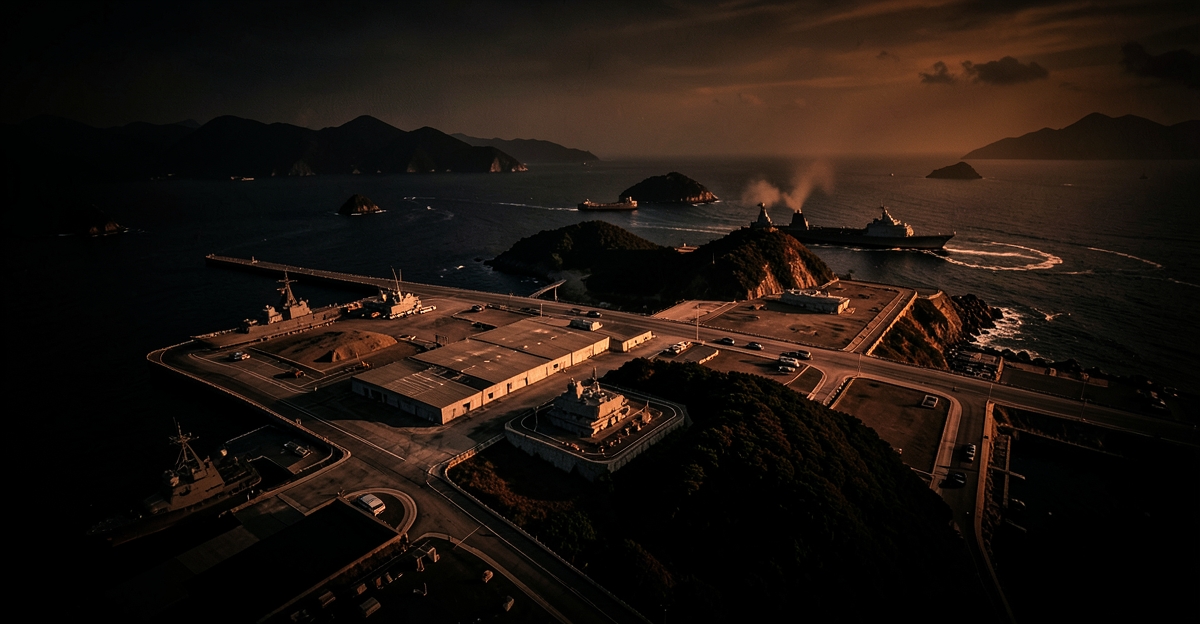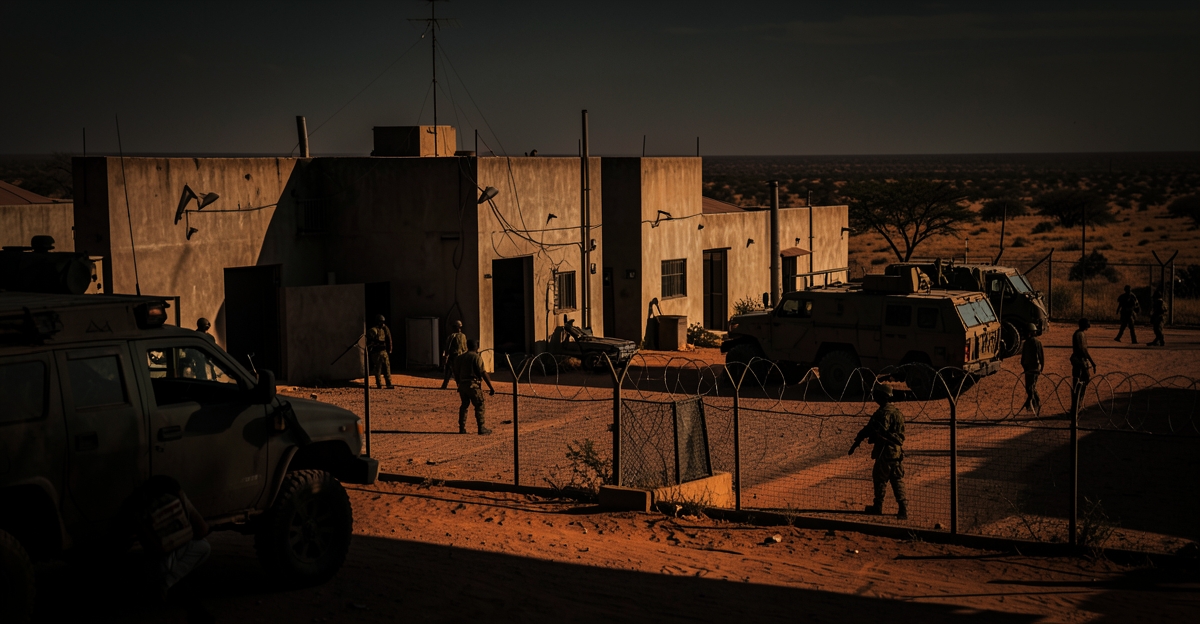
The United States' largest permanent military base in Africa sits in a nation smaller than Massachusetts, a barren patch of volcanic rock and sand at the mouth of the Red Sea. Camp Lemonnier houses 4,000 to 5,000 American personnel plus thousands of contractors, launches drone strikes across eleven African countries, and costs the Pentagon over $300 million annually to operate. Yet Djibouti itself has never been the target of any terrorist organization operating in the Horn of Africa. The base's official mission—counterterrorism—cannot explain its existence in a country with zero terrorist activity. The actual logic becomes visible only when we move past official justifications and examine the political economy of military basing under late capitalism: Camp Lemonnier functions not as a shield against terrorism but as a forward logistics node for US imperial competition over African resources and containment of Chinese capital expansion. Djibouti's ruling class extracts substantial rents from this arrangement while the working class bears the full weight of its social costs—inflation, land dispossession, and super-exploitation—locking the country into a dependency that benefits only the comprador bourgeoisie at the top.
Camp Lemonnier Is the Point of the Spear for US Resource Extraction in Africa
US Africa Command (AFRICOM) uses Djibouti as its primary launchpad for operations targeting regions rich in oil, uranium, coltan, and rare earth minerals. Drone strikes in Niger protect uranium mines operated by French state-owned Orano. Special forces deployments to the Democratic Republic of Congo shadow Chinese-owned cobalt concessions in Katanga. Training missions in South Sudan orbit the oilfields that China's National Petroleum Corporation controls. The Pentagon's 2022 Africa Strategy makes explicit what the counterterrorism cover story obscures: it identifies "competition with China and Russia for access to African resources and markets" as the command's primary mission. The document mentions terrorism as a secondary concern. Camp Lemonnier's infrastructure—runways capable of handling C-17 cargo planes, fuel storage facilities, drone hangars, barracks for expeditionary forces—is built for sustained power projection, not sporadic counterterrorism raids. The base's annual operating cost of $300 million exceeds the entire US foreign aid budget to sub-Saharan Africa outside health programs. This is not an economy of counterterrorism; it is an economy of imperial logistics.
The Rentier State: How Djibouti's Ruling Class Profits from Military Basing
Djibouti receives approximately $150 million annually from the United States in base rent, infrastructure aid, and training funds—representing roughly 20 percent of the country's GDP. In Marxist terms, this is economic rent: income derived from control over a scarce geographical asset (the strategic location at the Bab el-Mandeb strait) rather than from productive economic activity. President Ismail Omar Guelleh, who has ruled since 1999, has positioned his family to control major logistics contracts servicing the foreign bases—fuel supply, food provisioning, construction services. This is the classic structure of a comprador bourgeoisie: a local capitalist class that mediates between foreign imperialism and the domestic economy, extracting wealth from its role as intermediary rather than from independent industrial development. The rent economy generates zero forward linkages. No technology transfers occur. No domestic industrial upgrading happens. The service sector grows only to the extent that foreign military personnel require hotels, restaurants, and entertainment—an economy dependent entirely on the continued presence of armed forces that answer to Washington, Beijing, Paris, and Tokyo.
The Social Costs: Inflation, Land Grabs, and the Super-Exploitation of Djiboutian Labor
The working class pays for this rentier arrangement in three currencies: housing, land, and wages. Camp Lemonnier's presence has driven housing costs in Djibouti City 300 to 500 percent above inland areas. UN-Habitat data from 2022 ranks Djibouti among the highest urban rent-to-income ratios in Africa—meaning workers spend the vast majority of their wages simply to sleep indoors. In 2001 and 2002, the government forcibly relocated 20,000 Djiboutians from the Balbala neighborhood to expand Camp Lemonnier, paying below-market compensation and never completing the promised resettlement. Amnesty International documented the abuses in 2003; as of 2023, the displaced residents have received neither adequate housing nor compensation. On the base itself, wage differentials enforce a system of super-exploitation: Djiboutian workers earn $200 to $400 per month performing the same labor for which US contractors receive $3,000 to $5,000. These disparities are codified in "local hire" classifications that prevent unionization and block access to US labor protections. Multiple complaints filed with the US Department of Labor since 2019 have produced no structural changes. The working class does not share in the rent; it is a cost to be minimized.
The China Factor: Why US Bases Respond to the Belt and Road, Not Terrorism
China opened its first overseas military base in Djibouti in 2017, located directly adjacent to Camp Lemonnier. The Chinese base exists explicitly to protect Beijing's $15 billion in African infrastructure investments under the Belt and Road Initiative. US military aid to Djibouti tripled between 2015 and 2020—a timeline that correlates perfectly with Chinese base construction, not with any measurable increase in terrorist activity in the Horn of Africa. This is inter-imperialist rivalry expressed through basing competition. Djibouti's foreign debt profile reveals the strategic tension: roughly 60 percent of the country's external debt is owed to Chinese state banks, according to International Monetary Fund data from 2023. The Guelleh regime thus finds itself indebted to one imperial power while hosting military forces for three others (the United States, France, and Japan, with Italy maintaining a smaller presence). This arrangement creates what analysts call a "strategic squeeze": the country is vulnerable to pressure from Beijing through debt leverage even as Washington uses the base to project force against Chinese interests elsewhere on the continent. Only the local elite benefits from this contradiction, collecting rents from all sides while the population bears the strategic risk.
The Contradiction: Djibouti's Weak Bargaining Power in an Era of Inter-Imperialist Rivalry
Counter-argument: Djibouti has successfully played multiple imperial powers against each other to extract rising rents, monetizing its geography more effectively than most resource-exporting African nations monetize their minerals. The presence of US, Chinese, French, Japanese, and Italian bases creates a balance of power preventing any single country from establishing neo-colonial control. The bases provide over 10,000 formal jobs in a country with 40 percent unemployment, and US military contracts have financed roads, a port, and water infrastructure that benefit the general population. Djibouti has used great-power competition to extract development aid that would never flow to such a small, resource-poor nation under normal circumstances. This is not exploitation; it is rational sovereignty-maximization.
The immanent critique of this position: sovereignty-maximization assumes the Djiboutian state acts in the national interest, when in fact the Guelleh regime acts in the class interest of the comprador bourgeoisie. The rent revenue does not flow to the working class; it flows to contractor profits, presidential patronage networks, and debt service to Chinese banks. The "jobs" argument collapses under scrutiny: formal employment on foreign bases amounts to roughly 2 percent of the labor force, and these positions depend entirely on the continued presence of armed forces over which Djibouti exercises zero democratic control. When Red Sea shipping disruptions in 2024 required exclusive access arrangements, each imperial power demanded priority over the others—revealing the fragility of the "balance of powers" argument. Any threat by Djibouti to expel US forces would require replacing $150 million in annual revenue, an impossibility given that the elite has deliberately avoided economic diversification because rent extraction requires no industrial policy and threatens no established patronage networks. The country has no independent trade union movement, no legal left party, and elections that Freedom House rates as "Not Free." The working class has no vehicle to challenge this arrangement.
The Djiboutian situation is not exceptional; it is paradigmatic of how late imperialism integrates peripheral states. Military rentierism offers immediate rewards to local elites while foreclosing developmental futures for the working class. The country's strategic geography becomes a trap rather than an asset because it encourages a political class to extract value from foreign military presence rather than build productive capacity. The resolution cannot come from choosing between US and Chinese empire—both operate through the same logic of basing, resource extraction, and comprador mediation. It can only come from the Djiboutian working class developing autonomous organization capable of demanding democratic control over the country's geopolitical position. Until that organizational capacity exists, Camp Lemonnier will remain what it has always been: not a base defending Djibouti, but a launching pad for imperial competition across a continent whose resources are not destined for its own people.