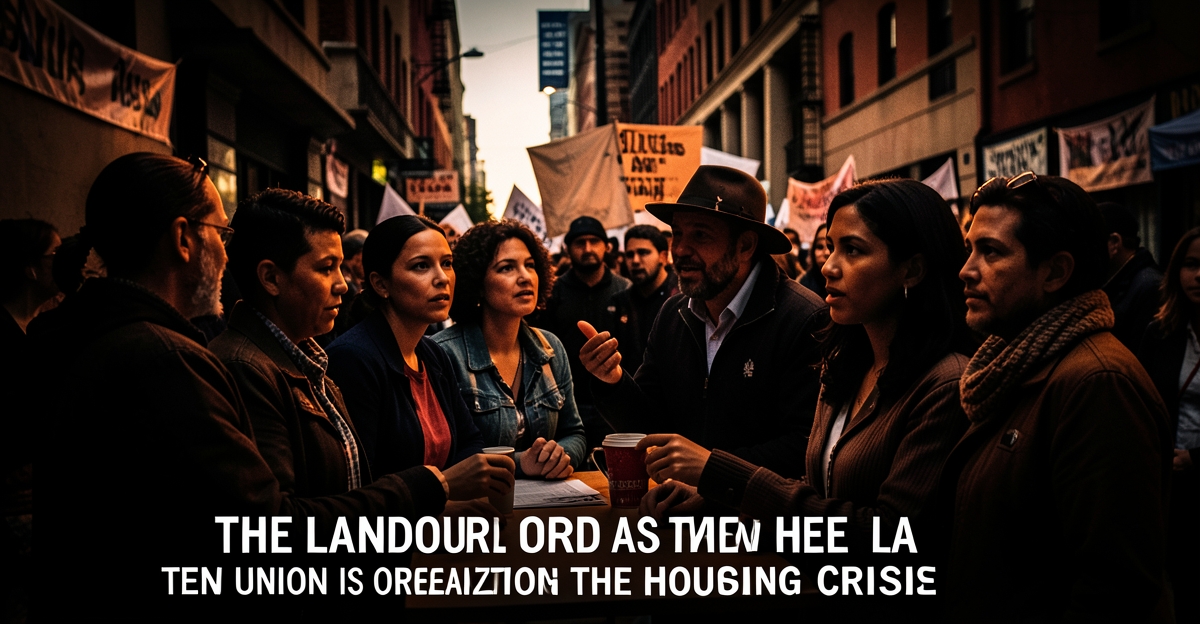
In the spring of 2023, tenants at a 32-unit building in Koreatown, Los Angeles, did something that would terrify any landlord: they stopped paying rent. Not because they couldn't afford it—though many could barely scrape by—but because their building's owner had let the property decay into a hazard. Raw sewage backed into first-floor units. Black mold crept up bedroom walls. The elevator, a lifeline for elderly residents, had been out of service for six months. When the tenants approached the landlord with a formal list of demands, they were met with silence. So they organized. With the support of the Los Angeles Tenants Union (LATU), they formed a building-level union, voted to withhold all rent, and placed the funds into an escrow account. Within six weeks, the landlord sold the building to a tenant-owned cooperative. This was not an isolated incident. In neighborhoods across LA—from Boyle Heights to Van Nuys—LATU is waging a quiet war against the landlord class, one building at a time.
Rent as Exploitation: The Class Character of Housing
The Los Angeles Tenants Union is not a typical tenant advocacy group. It does not primarily lobby city council members or file amicus briefs. Instead, it organizes tenants as a class, building by building, using the weapons of collective action: rent strikes, repair withholding, and direct confrontation with landlords. This approach is grounded in a fundamental Marxist insight: the rent relation is an exploitative class relation. When a landlord extracts rent from a tenant, they are appropriating a portion of the tenant's wages—surplus value that could otherwise be used for food, education, healthcare, or savings. In Los Angeles, where over 60% of residents rent and the median rent consumes more than 40% of the median income, this extraction is not incidental; it is central to the city's political economy.
LATU's innovation is to recognize that housing is not merely a commodity to be regulated, but a site of class struggle. Just as workers at a factory organize against the boss who expropriates their labor, tenants organize against the landlord who expropriates their wages. The union model applies the logic of the shop floor to the apartment building. A building's tenants are, in effect, a workforce producing the landlord's profit through their monthly payments. The landlord, like any capitalist, seeks to maximize revenue while minimizing costs—ignoring repairs, raising rents, exploiting turnover. LATU's organizing breaks this cycle by building collective power at the point of extraction: the building itself.
From the Shop Floor to the Front Door: Organizing the Sphere of Reproduction
The significance of LATU's model extends beyond housing. It represents the extension of class struggle from the point of production to the point of reproduction. Marxism has long recognized that capitalism exploits workers not only at the factory gate but also in the home, where the cost of reproducing labor power (housing, food, childcare) is socialized under capitalism. The double duty of the dinner table—the invisible labor of social reproduction—falls disproportionately on women and the working class. When landlords extract rents that consume half or more of a household's income, they are squeezing the very resources needed to sustain the workforce.
LATU's building-level organizing recovers a crucial insight: the apartment building is a workplace in its own right. The rent strike is the equivalent of the strike on the shop floor. Repair withholding—where tenants legally withhold rent until landlords fix hazardous conditions—is the equivalent of a work stoppage over unsafe conditions. And when LATU confronts landlords directly, organizing pickets outside management offices or occupying vacant units, they are engaging in the direct action that has always been the backbone of labor militancy. This is not reformism; it is class warfare, waged in the hallway, the courtyard, and the rent roll.
The union's approach also avoids the pitfalls of liberal tenant advocacy, which often focuses on individual legal remedies or policy reforms like rent control. While rent control can mitigate the worst excesses of the housing market, it does not fundamentally challenge the landlord-tenant relation. A rent-controlled building with a predatory landlord is still a site of exploitation. LATU, by contrast, organizes for collective ownership—cooperatives, community land trusts, and, ultimately, the decommodification of housing entirely. This is a vision of mutual aid as prefigurative politics: building the new world within the shell of the old, one building at a time.
Beyond the Legal Framework: Why "Working Within the System" Fails Tenants
The most serious counter-argument to LATU's approach is that tenants should work within existing legal frameworks. Critics argue that rent strikes invite eviction, that direct confrontation escalates conflict, and that the better path is to lobby for stronger tenant protections, enforce building codes, and use the courts. This is a steel-man position: it assumes good faith and acknowledges the risks of militancy. But it fundamentally misunderstands the nature of class power in the housing market.
The legal framework is itself a product of class struggle—one that landlords have largely won. In California, the 2019 Tenant Protection Act (AB 1482) capped annual rent increases at 5% plus inflation, but this "cap" still allows landlords to raise rents faster than wages grow. Eviction protections are riddled with loopholes: owner move-in evictions, Ellis Act evictions, and no-fault evictions that displace tenants with legal impunity. The court system, meanwhile, processes evictions at industrial speed—Los Angeles County saw over 60,000 eviction filings in 2023 alone. Legal aid organizations are overwhelmed, with a single attorney handling hundreds of cases. The law, in short, is a weapon available to both sides, but landlords hold the heavier artillery: capital, lawyers, and a legal system built to protect property rights.
Moreover, the housing crisis is not a bug but a feature of capitalism. Algorithmic rent-setting platforms like RealPage now coordinate pricing across thousands of units, effectively cartelizing the rental market. This is not a market failure; it is the market working as designed—for capital. The problem is not that landlords have too much power within the rules, but that the rules themselves are designed to facilitate extraction. LATU's response is not to ask for better rules, but to organize outside them, building the power to break them. The rent strike is not a legal tactic; it is a political one. It says: we will not be exploited, even if the law permits it.
Synthesis: The Union as a Classroom for Class Consciousness
The LA Tenants Union teaches an essential lesson: that the working class must organize not only where it produces but where it lives. The building is the new factory floor. The landlord is the new boss. The rent strike is the new strike. In this, LATU points the way toward a broader recomposition of the working class, one that recognizes the unity of production and reproduction under capitalism. When a tenant learns to organize their building, they learn the same skills needed to organize their workplace: collective decision-making, democratic accountability, direct action. They learn that their enemy is not a bad landlord but the landlord class. They learn that solidarity is not a sentiment but a strategy.
The housing crisis will not be solved by better policies or more affordable housing units within a capitalist market. It will be solved when tenants, organized as a class, seize control of the buildings they live in and the neighborhoods they build. That is the horizon LATU organizes toward. It is not a reformist demand but a revolutionary one: housing as a right, not a commodity. And in every building that wins a rent strike, every cooperative that takes ownership, every tenant who refuses to pay for mold and sewage, that horizon comes a little closer.
The struggle is not to find a better landlord. The struggle is to abolish the landlord. That is the lesson of the LA Tenants Union.