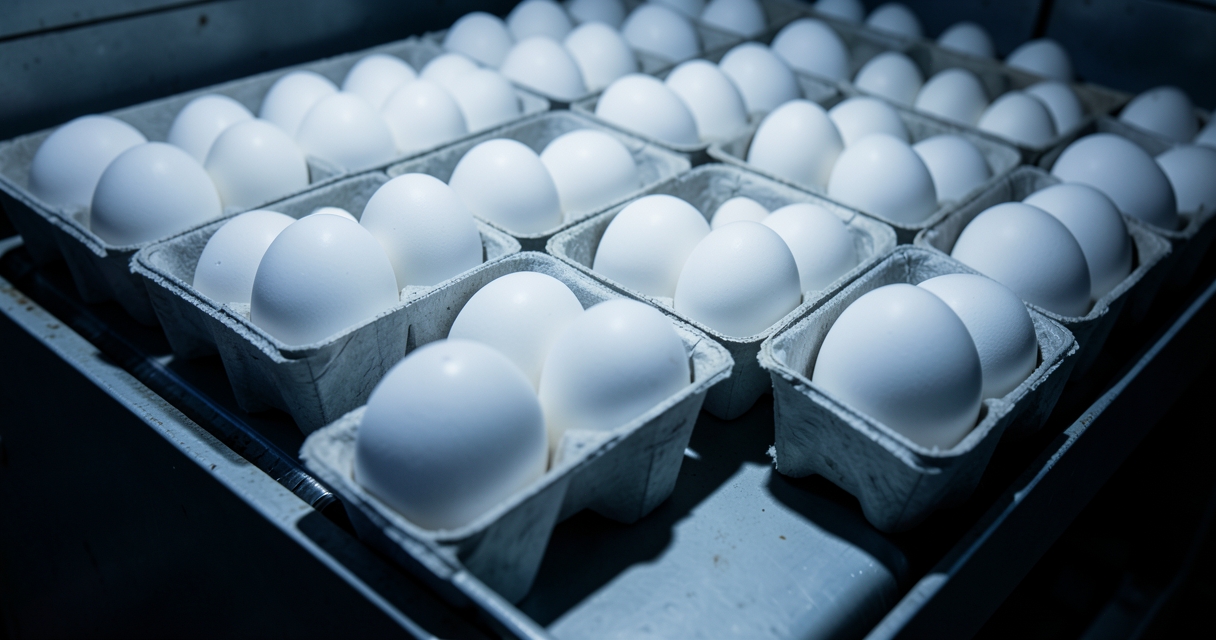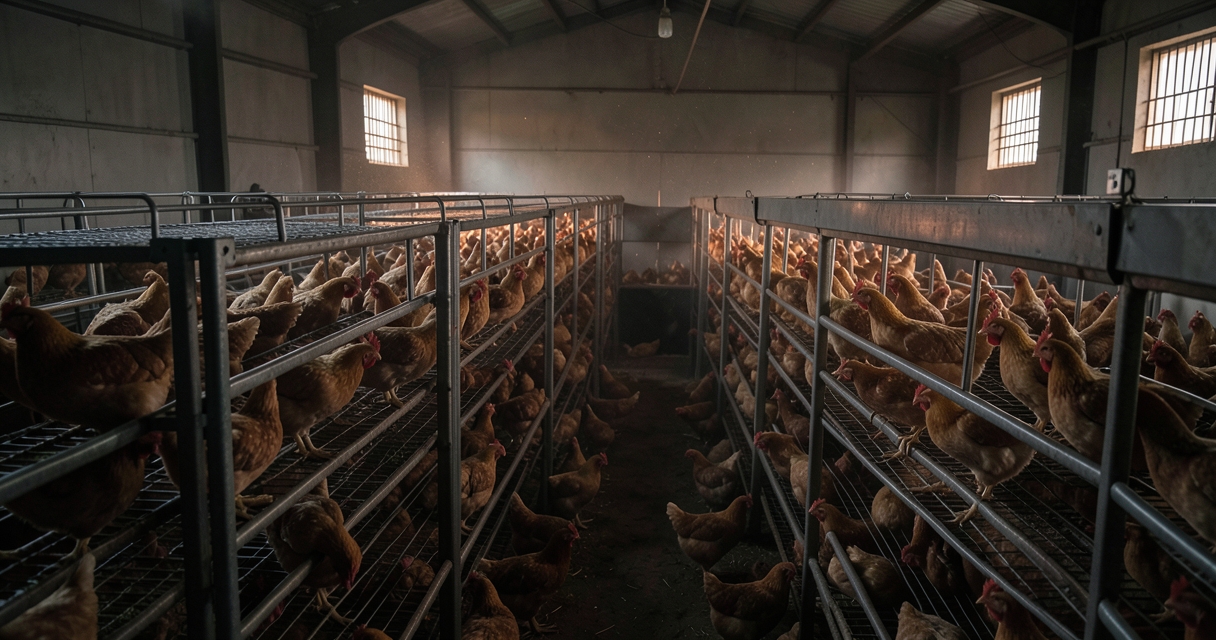
The industrial egg complex sells a contradiction. In the United States, over 200 million hens produce the nation's eggs, and a growing share of those hens now live under labels promising "cage-free" conditions. The consumer pays a premium for this promise, envisioning barns where hens stretch wings, dust bathe, and express their species-being. The reality is a calculus of accumulation: in the typical cage-free barn, each hen occupies roughly one square foot of floor space, a density that forecloses meaningful movement. The cage is gone; the factory remains.
This paradox is not an oversight or a regulatory failure in need of technical correction. It is the logical outcome of capital absorbing and neutralizing a challenge to its mode of production. The cage-free label represents a co-optation of welfare reform, a mechanism by which the egg industry creates premium market segments without altering the fundamental production relation: the ownership and exploitation of animal life as a commodity-producing machine. The hen's body remains a site of value extraction, her suffering merely reorganized into a more marketable form.
Cage-Free Is Not What the Consumer Imagines
United Egg Producers, the industry's primary trade association, certifies cage-free operations alongside the vast majority of conventional battery cage facilities. Its certification standards for cage-free housing require no outdoor access. They mandate no litter or enrichment beyond a minimal definition. They permit beak trimming, forced molting through feed withdrawal, and the same genetic lines bred for hyper-lay rates that produce metabolic exhaustion and osteoporosis. The cage-free hen exists in a windowless shed, often housing tens of thousands of birds, her mobility constrained not by wire but by the press of other bodies and the logic of maximum density.
This gap between consumer imagination and industrial reality is not accidental. It is the product of a deliberate redefinition of welfare such that it excludes any meaningful transformation of the hen's relationship to the means of production. Welfare becomes a set of minimum physical accommodations — the absence of a cage, the presence of a perching rail — rather than a condition of freedom from exploitation. The hen's labor, her biological capacity to convert feed into eggs, continues to be expropriated on an industrial scale. The cage was merely one technology of control; its removal does not abolish the wage relation between species.
The industry itself admits as much. United Egg Producers' own data shows that cage-free mortality rates often exceed those of conventional systems. The hens are not healthier; they are simply housed differently. The production of eggs at the scale demanded by capital requires the subordination of the animal's body to the rhythm of accumulation, and no labeling reform changes that fundamental subordination.
The Welfare Reform Movement Became a Marketing Department
In the 1990s and early 2000s, animal welfare advocates mobilized against the battery cage, documenting the suffering of hens confined for their entire lives in spaces smaller than a sheet of letter paper. This movement had genuine radical potential: it exposed the violence embedded in industrial animal agriculture and demanded an accounting of the creature's subjective experience. Capital, however, does not oppose reform; it absorbs it. The industry responded not by defending the cage, but by redefining what reform meant.
The cage-free label became the mechanism of this absorption. By acceding to the demand to remove cages, the industry granted a symbolic concession while preserving the essential structure of industrial egg production. The reform movement, in accepting cage-free as a sufficient goal, effectively ceded the terrain of production relations entirely. It asked for a larger cage; it received no cage at all, but also no substantive change in the hen's status as a unit of production. The movement's energy, its moral authority, and its capacity for disruption were channeled into certifying labels that allow capital to extract a premium price for the very same relation of exploitation.
The result is a marketing department masquerading as a social movement. The Humane Society of the United States and other major organizations now promote cage-free as the benchmark of progress, even as their own experts acknowledge that cage-free conditions do not eliminate the most severe forms of animal suffering. The industry, for its part, has learned to wield the label as a shield against more radical demands. When critics point to outbreaks of cannibalism, high mortality rates, or respiratory disease in cage-free barns, the response is that such problems are "management issues" rather than inherent features of the system. The cage-free label inoculates the industry against systemic critique.
Premium Pricing Stratifies Ethical Consumption by Class
Cage-free eggs retail at a premium of 100 to 200 percent over conventional eggs. This premium is not a reflection of higher production costs alone; it is a rent extracted by capital from the consumer's ethical concern. The industry has discovered that moral sentiment, like any other desire, can be commodified and priced according to the consumer's ability to pay. The cage-free label creates a hierarchy of consumption, where the capacity to purchase freedom from visible cruelty becomes a marker of class distinction.
This stratification has concrete consequences. The working-class family, already squeezed by stagnant wages and rising costs, cannot afford the cage-free premium. Their ethical position — that factory farming is wrong — faces the material barrier of the price tag. The industry presents this as a matter of consumer choice, an individual decision to "vote with your dollar." But voting with one's dollar is a privilege of those with dollars to spare. The class character of this arrangement is not incidental; it is structural. The cage-free market segment relies on the existence of a class of consumers who can afford to pay for the appearance of moral integrity, while the default system remains the cheap cruelty of the battery cage.
The irony sharpens when one considers that the cage-free label does not even deliver the moral good it promises. The premium-paying consumer purchases not the reality of a flourishing hen, but a representation of welfare that the industry has carefully curated. This is what Marx described as commodity fetishism applied to the realm of ethics: the consumer relates to the egg as a thing bearing a magical quality of "humanness," obscuring the social relations of exploitation that produced it. The cage-free label, far from achieving a victory against exploitation, becomes a commodity that mediates and diffuses the consumer's discomfort, allowing the system to continue its fundamental operation uninterrupted.
Reform Without Abolition Serves the System It Claims to Challenge
The cage-free campaign reveals a deeper theoretical problem that confronts all single-issue reform movements within capitalism: the tendency to mistake incremental change for transformation. The demand for cage-free eggs is, at its core, a demand to improve conditions within the framework of animal ownership. It does not challenge the right of capital to own hens, to determine their living conditions, to kill them when their productivity declines, or to dispose of male chicks at birth. It accepts the fundamental premise that animals are commodities to be produced and consumed, and seeks only to make the process slightly less barbaric.
This reformism serves the system it claims to challenge by providing a moderate, market-friendly alternative to abolitionist demands. The abolitionist position holds that the production relation itself — the ownership of animal life as property, the extraction of labor from the animal body — is the root of the violence. The cage-free campaign, by contrast, suggests that the violence can be managed, mitigated, and made palatable. It delegitimizes the more radical demand for a total transformation of the human-animal relation under capitalism. The industry can point to cage-free cages — a contradiction in terms — as evidence of progress, while continuing to expand aggregate production and accumulate profit.
Jules has examined the broader architecture of factory farm capitalism in its systematic exploitation of animal life. The cage-free concession fits squarely within this system: it is a minor adjustment to the technology of exploitation, not a break from it. The abolitionist alternative, by contrast, demands an end to the production relation itself, and with it, the entire structure of industrial animal agriculture. This is not a demand for better cages; it is a demand for the dissolution of the cage as an institution.
Conclusion: The Cage Without Bars
The cage-free label represents one of the most successful co-optations of a social movement in recent history. A campaign that began with the moral demand to end the suffering of confined animals has been transformed into a marketing apparatus that generates premium profits while leaving the fundamental structure of exploitation intact. The hen remains a machine for the production of exchange-value; her suffering has been reorganized, not abolished.
The lesson for the left is clear. Capital will absorb any reform that does not threaten the property relation at the heart of production. It will concede the cage while preserving the factory; it will grant the label while retaining the profit; it will offer the consumer the appearance of ethics while delivering only a commodity priced according to class. The cage-free hen is the cage without bars — but the cage remains.
A genuinely emancipatory animal politics cannot stop at the demand for larger cages, no matter how well marketed. It must challenge the ownership of animal life as such, the reduction of sentient creatures to factors of production, and the class relations that determine which bodies are exploited and which are allowed to flourish. The cage-free label is not a step toward this goal; it is a detour designed to exhaust the movement's momentum on a route that returns, inevitably, to the same endpoint: the continued domination of animal life by capital. The work of building an alternative begins not with the label, but with the refusal of the production relation itself.
Further reading: For a deeper analysis of how reformism stalls systemic transformation, see the Jules article on the politics of gradual change under capitalism. The same logic that produces cage-free eggs also produces fair trade coffee, green energy credits, and diversity initiatives — each a market solution that preserves the underlying structure of domination while selling the consumer a feeling of virtue.