The Gestation Crate as Fixed Capital
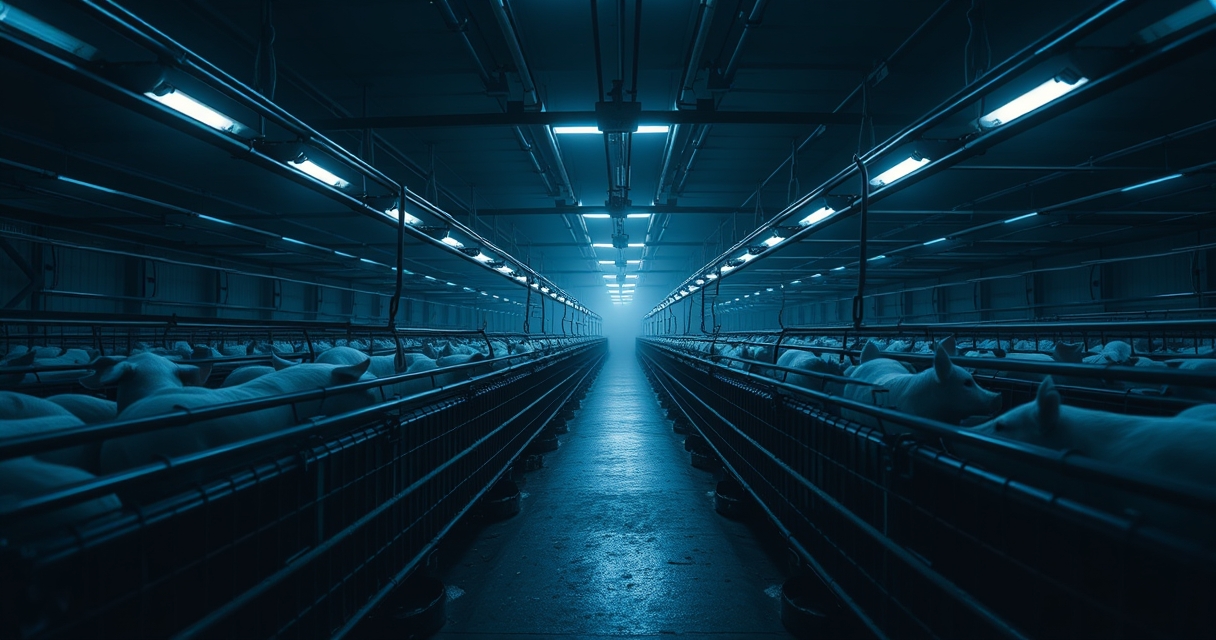
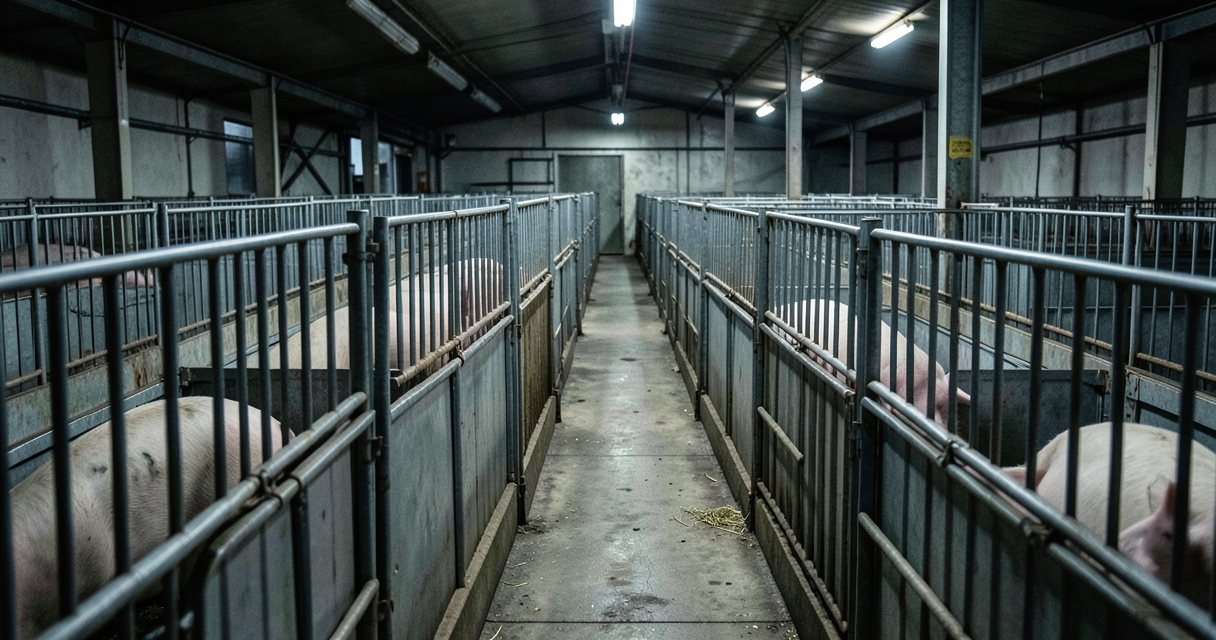
Consider the sow: a biological entity whose reproductive apparatus is transformed into a machine for generating profit. For 114 days, she is confined to a metal crate measuring two feet by seven feet — a space so narrow she cannot turn around, cannot lie down in a natural posture, cannot perform any of the behaviors that define porcine life. She is fed precisely calculated rations, inseminated artificially, and monitored for output. The gestation crate is not merely cruel; it is a technology of accumulation. In Marxist terms, the sow's body becomes fixed capital — a physical asset whose value is realized through its continuous operation in the production process. Just as a factory owner purchases machinery that depreciates over time, the industrial pork producer acquires the sow as a depreciating asset who must produce as many litters as possible before her reproductive capacity is exhausted.
Feminist Marxists have long argued that capitalist production rests upon a hidden foundation of reproductive labor — the work of bearing and raising children, maintaining households, and sustaining the workforce. The gestation crate makes this foundation brutally visible. The sow's every biological function is subordinated to the rhythm of accumulation: her ovulation is chemically synchronized with other sows for efficient batch farrowing; her piglets are removed at weaning to hasten her return to estrus; her body is impregnated cycle after cycle until she is "spent" and sent to slaughter. This is not exploitation in the abstract sense that a worker sells labor power for a wage. This is the direct appropriation of reproductive capacity itself, stripped of any pretense of consent or compensation.
Reproductive Labor Commodified — The Sow Produces Piglets as Capital Produces Commodities
In volume 1 of Capital, Marx describes how the commodity form transforms social relations into relations between things. The piglet born from the confined sow is not a living being with its own developmental trajectory; it is a unit of pork, a commodity whose value is realized on the commodity market. The sow herself is a factory for producing these units, and her reproductive labor is the process by which use-value (a living animal) is converted into exchange-value (a salable good). Social reproduction theory extends this analysis by insisting that the work of creating and sustaining life is not merely biological but deeply social — and that this work, when performed under capitalism, becomes a site of exploitation and resistance.
The parallel between the sow and the human woman under capitalism is structural, not sentimental. Both are assigned the work of reproduction without full ownership of its products. Both find their bodies subjected to external control in the name of efficiency and profit. Both are expected to perform this labor without remuneration — the sow receives no wage, while the reproductive labor of women has historically been unpaid or grossly undervalued. The sow does not choose her confinement; the woman in many contexts faces economic and social pressures that constrain her reproductive choices. In both cases, the body becomes a terrain where capital attempts to enforce absolute dominion over life-making processes.
The Parallel Is Not a Metaphor
It would be a mistake to treat this comparison as mere analogy. The industrial pig farm is not a symbol for something else; it is a concrete instance of the same material logic that governs the extraction of reproductive labor from women under capitalism. When a poultry plant worker is denied bathroom breaks because every minute of her time belongs to capital, the logic is identical to that which confines the sow to a crate: the minimization of non-productive time, the maximization of output per unit of bodily existence. When a woman is pressured to delay childbearing for her career, or to return to work weeks after giving birth because paid leave is denied, her body is being managed as a resource in the same way the sow's estrus cycle is managed with hormones and artificial insemination.
Feminist Marxism teaches us that reproduction is not a natural or pre-political domain but a sphere of production that capitalism must organize and control. The gestation crate represents this organization in its most naked form. The sow has no political agency, no union, no right to bargain. Her only resistance is biological — she may struggle, develop stereotypies from the stress of confinement, or simply stop cycling. But these forms of resistance are met with veterinary intervention, culling, and replacement. The system is designed to eliminate every obstacle to continuous reproduction, including the recalcitrance of the living body itself.
Social Reproduction Theory Extends Beyond the Human
Social reproduction theory has largely focused on human labor, but its analytical framework extends logically to the animal bodies upon which so much of capitalist production depends. The sow's body is a site of what scholars call "reproductive alienation": the separation of the producer from the means and products of reproduction. The piglets she bears are removed from her within days; her maternal behavior is pathologized as inefficient; her instincts are overridden by technology. She does not raise her young, does not teach them to forage, does not form the social bonds that define pig life. She is reduced to a uterus with legs — a machine for producing the next generation of commodities.
This alienation mirrors the experience of women whose reproductive labor is appropriated, regulated, and devalued. The history of obstetrics and gynecology is partly a history of male medical authority displacing women's knowledge of their own bodies; the history of industrial animal agriculture is similarly a history of veterinary science and agribusiness engineering the animal body for maximum output. Both involve the systematic denial of bodily autonomy in the service of accumulation. Both are defended with appeals to necessity, efficiency, and the greater good — the same appeals that capitalists have always used to justify exploitation.
To take this parallel seriously requires a Marxism that refuses the species boundary as a limit to analysis. Capitalism does not respect the line between human and animal; it treats all living bodies as potential factors of production. The sow in the crate is not an exception to the rule of capitalist exploitation but its most complete expression. She is the worker who cannot quit, the mother who cannot keep her children, the body that exists solely to produce for others.
This is not to equate the suffering of animals with that of human beings in any simple moral hierarchy. It is to insist that the materialist analysis of capitalism must account for all forms of productive and reproductive labor, including those performed by non-human animals. If social reproduction theory teaches us that the work of making and sustaining life is the hidden abode of capitalism, then we must recognize that this abode houses not only women but also the countless animals whose bodies are mined for their reproductive capacity.
Synthesis: Animal Liberation and Feminist Politics Share a Material Foundation
The struggle against the gestation crate is not a single-issue campaign separable from feminist and anti-capitalist politics. It challenges the same logic that subordinates all living processes to the accumulation of value. When activists demand an end to gestation crates, they are demanding that a living being not be treated as a machine. When feminists demand reproductive justice, they are demanding that women not be treated as vessels for state or capital. Both demands arise from the same material recognition: that the capacity to create and sustain life is not a resource to be exploited but a foundation upon which any just society must be built.
A Marxist feminism that takes seriously the exploitation of animals does not dilute its analysis but strengthens it. It reveals that capitalism's drive to commodify reproduction is not limited to the human species but extends to all forms of life that can be made productive. The sow in the crate is not a special case or a marginal concern. She is the logic of capital made flesh — the living proof that accumulation requires the systematic denial of bodily autonomy, and that this denial is never merely metaphorical. It is enacted on real bodies, in real crates, every day of the year.
To end the gestation crate is to refuse the principle that any body can be reduced to a means of production. This refusal is the heart of both feminist and animal liberation politics, and it points toward a socialism that values life not for its output but for itself. The sow, like the woman, deserves to turn around.