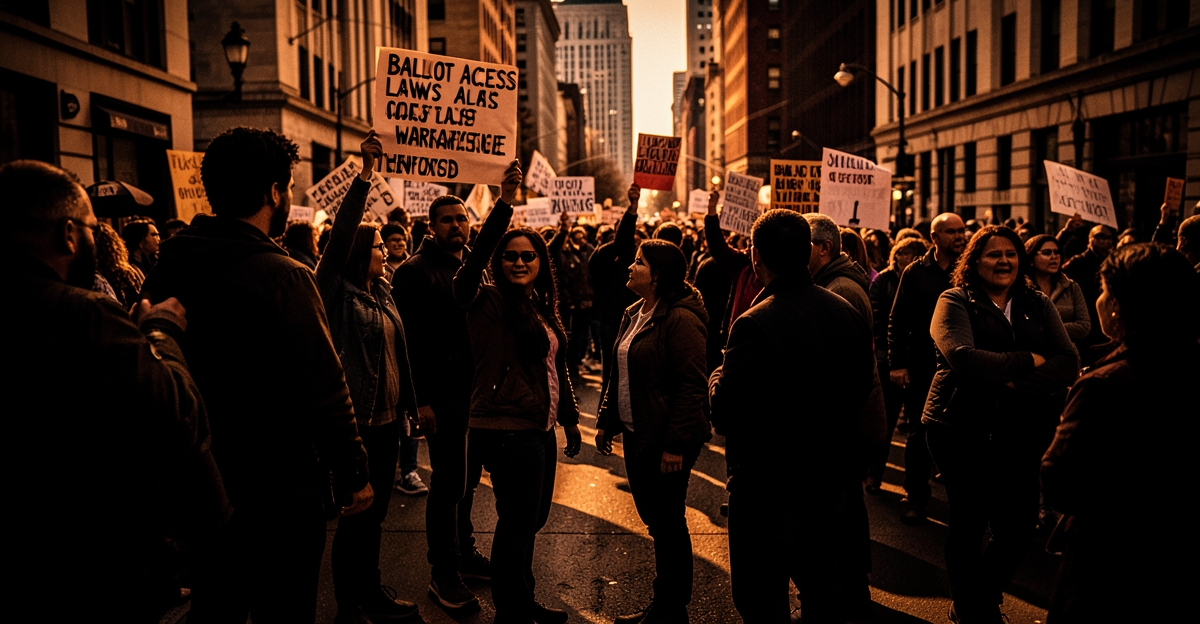
When nearly 97,000 Floridians voted for Ralph Nader in 2000, the establishment blamed them—not the 300,000 registered Democrats who crossed over to vote for George W. Bush, not the Democratic Party’s decision to run a candidate indistinguishable from Bush on trade and welfare reform, and not a voting system designed by the party in power to suppress working-class Black voters. The spoiler myth was born fully clothed in the ideological armor of the Democratic Party, and it has been used ever since to discipline anyone who dares suggest that working people deserve a party of their own.
The Spoiler Label Is Applied Selectively to Punish Class Politics
H. Ross Perot won 18.9 percent of the popular vote in 1992—nearly 20 million votes—and took no single state from Bill Clinton in the Electoral College. He was described as a "phenomenon," a "protest voice," even a "patriot." No major media outlet called him a spoiler, because Perot’s campaign did not threaten the fundamental alliance between the Democratic Party and capital. He was a billionaire running on deficit reduction and NAFTA-friendly "efficiency" — a candidate whose policy agenda overlapped comfortably with the Clintonite wing of the Democratic Party.
Compare this to Jill Stein in 2016, who won 1.1 percent of the vote and was accused—even by supposed leftists—of "handing the election to Trump." The difference is not electoral math. It is class content. Nader ran on single-payer healthcare, union rights, and breaking up corporate monopolies. Stein ran on canceling student debt, a Green New Deal, and ending endless war. These are not third-party eccentricities; they are the concrete policy demands of the American working class. The spoiler charge is applied precisely when a third party threatens to build a class-conscious electoral bloc that could challenge the Democratic Party’s role as management's second shift.
The "Lesser Evil" Framing Is Ideological Blackmail, Not Strategy
The lesser evil argument works like a protection racket: vote for the Democrat or you will get the Republican—and if the Republican wins, it is your fault. This framing inverts the actual relationship of forces. It demands that the working class subordinate its own interests indefinitely to a party that has spent forty years dismantling welfare, expanding incarceration, and bombing countries in the name of "humanitarian intervention."
The Democratic Party’s leadership knows that the threat of a Republican victory is its most reliable tool for extracting votes without delivering material concessions. Every election cycle, workers are told that now is not the time for principle, that the stakes are too high, that the other party is literally fascist. But if the Democratic Party is the only bulwark against fascism, and it consistently fails to stop or even meaningfully slow the slide into authoritarian capitalism, then the working class is being asked to vote itself into irrelevance. The lesser evil does not defeat the greater evil; it manages it.
Democratic Party Failures, Not Third-Party Votes, Cost Elections
The 2000 Florida recount remains the textbook case of scapegoating. Ralph Nader received 97,488 votes. Al Gore lost Florida by 537 votes. The conclusion drawn by liberal pundits: Nader cost Gore the election. But this analysis conveniently ignores that over 300,000 registered Democrats voted for George W. Bush. It ignores that Gore lost his home state of Tennessee. It ignores that the Democratic Party ran a candidate who refused to challenge the corporate-backed recount litigation and who spent the campaign distancing himself from Clinton’s popular—but insufficiently market-friendly—policies.
In 2016, the pattern repeats. Hillary Clinton lost Michigan, Wisconsin, and Pennsylvania by a combined 77,000 votes. Jill Stein received about 1.1 percent of the vote nationally. But no serious class analysis can attribute this loss to Stein without also examining the 6 to 7 million Obama voters who stayed home entirely—voters who had been promised hope and change and received the Trans-Pacific Partnership and the Libya bombing instead. The Democratic Party lost those voters years before the election, by abandoning any pretense of representing working-class material interests. Blaming Stein is cheaper than blaming the donor class that funds the party.
The Two-Party System Is Structurally Designed to Repress Class Politics
The spoiler myth operates on the assumption that the two-party system is natural, neutral, and inevitable. In fact, it is a specific political structure, created by law and maintained by capital, to prevent the formation of a party that represents the working class as a class. Ballot access laws in most states require third parties to gather tens of thousands of signatures, pay steep filing fees, and achieve vote thresholds in previous elections to remain on the ballot. Major-party candidates receive public funding and debate access automatically; third parties must sue for even a chance to be heard.
This is not an accident. As Engels observed, the state under capitalism does not mediate between classes but organizes the rule of one class over another. The two-party system is a machine for channeling class antagonism into harmless competition between two wings of the same capitalist party. Both Democrats and Republicans accept the basic premises of private ownership of production, wage labor, and imperial military dominance. The differences between them are real but secondary; they are differences in how to manage capitalism, not whether to replace it. A third party that challenges these premises is not merely a "spoiler"—it is a threat to the entire arrangement.
Capitalism, Not Third Parties, Is the Real Spoiler of Working-Class Unity
The working class is divided by race, gender, geography, and industry—not because of identity politics, but because capitalism requires a fragmented labor force in order to suppress wages and discipline workers. The two-party system amplifies these divisions by forcing workers to choose between a party that offers cultural recognition without economic power (Democrats) and a party that offers cultural grievance without economic justice (Republicans). Third parties that attempt to organize workers across these divides are not the problem; they are the only electoral formations that even attempt a solution.
The real "spoiler" is capitalism itself. It spoils every attempt at cross-racial solidarity by making white workers fear competition from a reserve army of labor, a dynamic well understood by anyone who has studied the role of migrant labor in wage suppression. It spoils international working-class unity by pitting factory workers in Ohio against factory workers in Vietnam. It spoils the possibility of a democratic plan for production by insisting that the only rational allocation of resources is the one that maximizes profit for a tiny minority. Third-party votes are symptoms of a deeper sickness—a class that knows it is being cheated but has not yet built the organization to demand its own rule.
The steel-man counter-argument is worth taking seriously: electoral math is apolitical. A vote for a candidate who cannot win, the argument runs, is a vote thrown away, or worse, a vote that hands power to the worst option. The only responsible path, this view holds, is to build local infrastructure—school board races, city council seats, state legislative campaigns—before running national candidates. This is the position of many well-meaning organizers who have watched third-party presidential runs crash against the concrete wall of the Electoral College.
But this argument mistakes strategy for principle. The Democratic Party does not wait until it has local control to nominate a presidential candidate; it uses the presidency as a platform to build national power. The working class cannot afford to wait for "infrastructure" before contesting the highest offices, because those offices make decisions that affect every workplace, every union contract, every military deployment, every eviction. The local-first approach also ignores that the Democratic Party aggressively suppresses third-party local organizing wherever it emerges, using the same ballot access laws and corporate media blackouts that stifle presidential campaigns. The problem is not that third parties run for president; the problem is that the two-party system is designed to crush every alternative at every level.
The synthesis is not "vote third party" or "hold your nose and vote Democrat." It is that the spoiler myth functions as a mechanism of class discipline, one that must be exposed and broken before any genuine working-class politics can emerge. The Democratic Party will continue to demand that workers vote for it, and it will continue to blame workers for the losses its own collaboration with capital produces. The task is not to find the perfect candidate or the right tactical vote; the task is to build the organizational capacity for the working class to act as a class, independently of both capitalist parties. That means contesting elections at every level, including the presidency, not because victory is imminent, but because the act of building a class-based political pole is itself an educational and organizational weapon.
The American working class has been told for a century that the two-party system is the only possible form of democracy. It has also been told that the stomach flu is caused by the patient who vomits, rather than by the poison. When billions are spent to maintain a global empire that profits a handful of defense contractors while workers' real wages stagnate, when food becomes a commodity that sickens the people who produce it, when trust in government hovers at 20 to 30 percent, the crisis is not that some workers refuse to vote for the party of the billionaires. The crisis is that the party of the billionaires is the only one that gets to run.