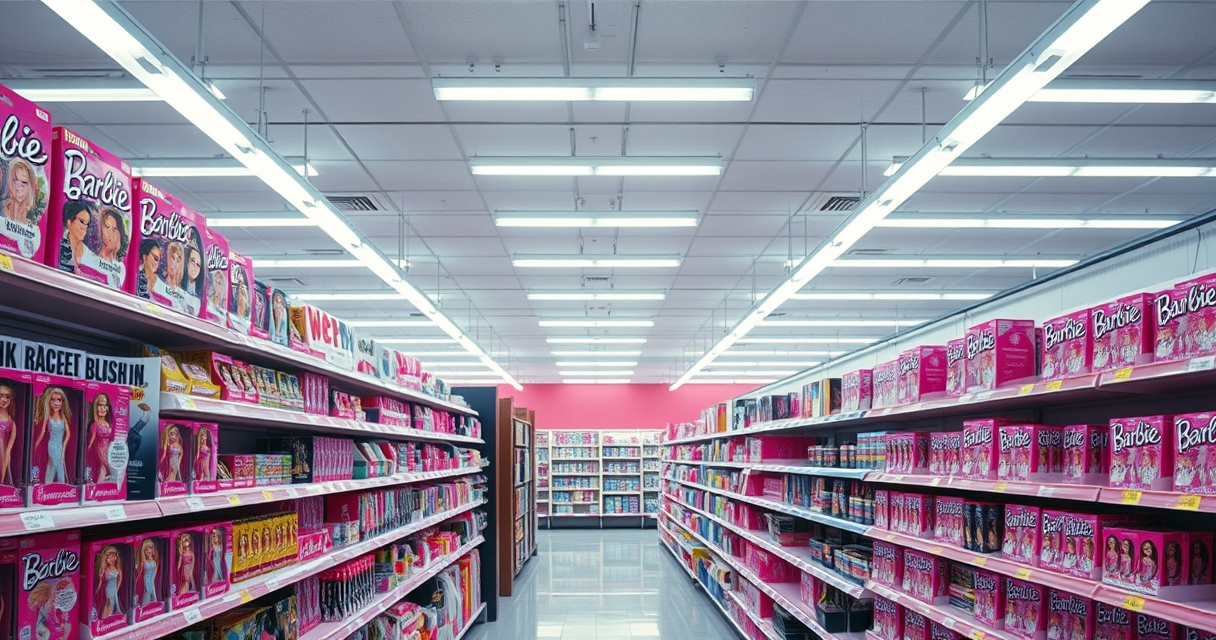
In the summer of 2023, Warner Bros unleashed Barbie upon a world already drowning in pink. The film grossed $1.44 billion worldwide, a sum that would take the average worker 40,000 years to earn at minimum wage. Its marketing budget alone — $150 million — could fund universal preschool for an entire American city. The feminist message, when parsed from the endless press cycles and think-pieces, was clear: patriarchy harms everyone, women deserve agency, and systems of power must be questioned. Yet this message arrived not as a revolutionary tract but as a branded entertainment product, sold through Happy Meals and Mattel cross-promotions. The commodity form had done its work.
The Plastic Dialectic: How Feminist Critique Became a Marketing Strategy
Mattel did not stumble into progressive messaging. The company had spent six decades perfecting a product that taught girls that their worth was inseparable from physical appearance and consumer acquisition. Barbie was, from her 1959 debut, a commodity fetish par excellence — a plastic idol whose entire purpose was to generate desire for an endless series of accessories, houses, cars, and careers that could be purchased piecemeal. By 2023, Mattel’s annual revenue hovered around $5.4 billion, much of it dependent on the Barbie ecosystem.
The film’s feminism, then, represents a sophisticated recuperation strategy. When the doll faced decades of criticism — for unrealistic body proportions, for racial homogeneity, for perpetuating consumerist femininity — Mattel did not defend the original product. Instead, they sponsored its critique. Every joke about Barbie’s impossible proportions, every scene mocking Ken’s patriarchal pretensions, became a signature of the brand’s newfound self-awareness. This is the dialectic of commodity culture: the critique is incorporated into the product, neutralizing its edge while expanding the market. You can now buy a Barbie that knows it’s problematic. The transaction is the absolution.
The Commodity Form Swallows the Message
The numbers tell the story that no press release can obscure. Warner Bros spent $150 million on marketing — not on making the film better, but on making sure everyone, everywhere, understood that Barbie was the summer’s mandatory cultural event. That $150 million bought not just awareness, but a permission structure. It said: you can engage with this critique without guilt, because it’s been pre-approved by the very institution it criticizes.
Ticket sales accounted for only part of the revenue. The film generated an estimated $5 billion in retail sales through licensing and merchandise. Every viewer who left the theater and bought a "Weird Barbie" t-shirt or a "I Am Kenough" hoodie completed the circuit: feminist consciousness converted into commodity purchase. The movie’s lesson — that women are more than objects — was printed on objects for sale. The medium contradicted the message at every turn.
Mattel’s market capitalization rose by roughly $1 billion during the film’s release cycle. The critique of patriarchy became an asset class. Shareholders reaped what the directors sowed.
Pseudo-Individuality and the Diversity Commodity
Adorno understood that the culture industry produces "pseudo-individuality" — products that appear unique and personally meaningful while conforming to standardized templates. The Barbie film’s diverse cast — Black Barbie, disabled Barbie, plus-size Barbie — exemplifies this mechanism. Each representation is a consumer option, not a political victory. You can now choose the Barbie that reflects your identity, as long as your identity can be rendered purchaseable.
The film presents diversity as a corporate achievement rather than a demand for justice. The message is not "dismantle the systems that produce exclusion" but "buy the brand that includes you." This is the logic of commodity fetishism operating at full capacity: the social relations of production that create inequality are obscured by the dazzling array of colorful products on offer.
The Bounded Conversation: What Critique Cannot Say
Sympathetic critics will argue that Barbie introduced feminist ideas to audiences who would never read Judith Butler. That it sparked genuine conversation about patriarchy in living rooms and social media feeds. That cultural change requires mass-market vehicles. These claims contain partial truths. But they ignore the absolute boundary that the commodity form imposes on critique.
The film could criticize Mattel’s boardroom, but never the economic system that makes Mattel’s boardroom inevitable. It could mock Ken’s delusions of grandeur, but never the wage relation that structures most women’s lives. It could advocate for women’s leadership, but never question why leadership requires allegiance to a profit-driven corporation. The conversation was bounded by what Warner Bros and Mattel could tolerate — and that boundary is the horizon of politics under capitalism.
The Contradiction Is Not Resolvable Within Capitalism
Barbie the film is a perfect artifact of late capitalism: it generates enormous profits while appearing to critique the very system that generates them. Its message is real but incomplete; its audience is engaged but interpellated as consumers first, citizens second. The contradiction between feminist critique and commodity spectacle is not a bug to be fixed in the sequel. It is the essential form of cultural production under capitalism.
Millions of people absorbed feminist analysis through Barbie — but they absorbed it pre-digested, pre-approved, and pre-packaged for resale. The question for those of us committed to genuine liberation is not whether the film was "good" or "bad" for feminism. The question is whether any movement that depends on corporate sponsorship can ever escape the gravitational pull of the commodity. The answer, if history is any guide, is that the commodity always wins — unless we refuse to buy what it’s selling.
We need a feminism that cannot be turned into a product. A feminism that demands not better representation in the boardroom, but the abolition of the boardroom itself. A feminism that recognizes, as we argued earlier, that identity markets cannot produce liberation — they can only produce more markets. And a feminism that understands, contra the DEI industrial complex, that diversity without power redistribution is just another pretty package for the same old product.