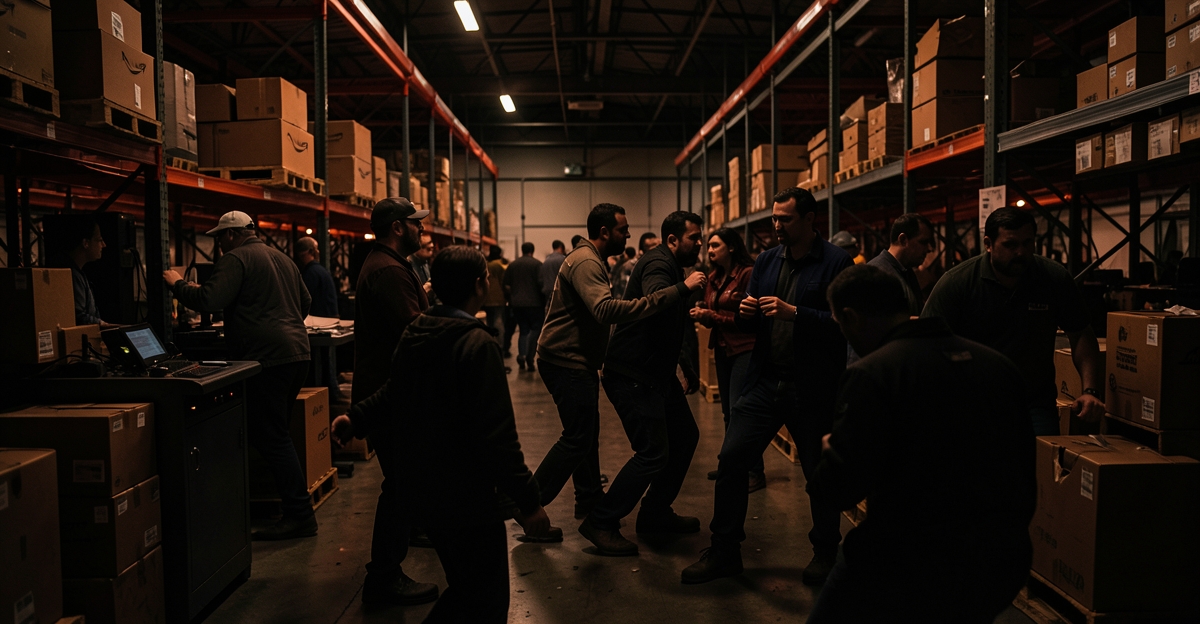
Maria Rodriguez clocks in at 4:30 AM at a Amazon delivery station outside Chicago. She scans her phone, loads 38 packages into her 2016 Honda Civic, and begins her route. On paper, she will earn $22 per hour over a four-hour block—$88 gross. But after deducting $12 for gasoline, $8 for the mileage-driven depreciation on her vehicle (calculated at the IRS rate of {ARTICLE_CONTENT_HTML}.58 per mile), $6 for additional insurance that her provider requires for "commercial activity," and $3 for a day's wear on tires, brakes, and fluids, Maria's real wage is $59. That is $14.75 per hour. Before her car loan payment. Before FICA taxes that she must now pay as a "self-employed" worker. Before the fact that she has no paid sick days, no health insurance, and no unemployment protections. Maria is not an entrepreneur. Maria is working for below minimum wage while driving a capital asset she herself financed.
This is the grim arithmetic of Amazon Flex, the delivery program that now moves millions of packages daily across the United States. It is held up by tech boosters and management theorists as the "future of work"—flexible, autonomous, entrepreneurial. In reality, it represents something far older and more brutal: the return of piece-rate exploitation, updated with satellite tracking and algorithmic control. Amazon Flex is not a deviation from capitalism's trajectory. It is capitalism's logical endpoint, stripped of the social protections that organized labor wrested from capital over a century of struggle.
The Platform as Factory Floor
Amazon Flex drivers are nominally "independent contractors." They choose their blocks, drive their own cars, and are not subject to direct supervision. The platform itself, however, exercises total control over every substantive aspect of the labor process. The app determines the route, the sequence of deliveries, the time allotted per package, and the rating system that determines access to future work. Drivers cannot negotiate the terms of their engagement. They can only accept or refuse the terms offered, and refusal carries consequences—Amazon's algorithm remembers, and those who decline too frequently find their block offers disappearing.
The key innovation of platform capitalism is not the creation of new forms of work, but the systematic externalization of costs that capital has historically borne—or at least shared—onto the direct producer. Under a traditional employment relationship, Amazon would pay payroll taxes, contribute to unemployment insurance, provide workers' compensation coverage, and maintain vehicles. Under the Flex model, drivers absorb all of these costs. The "gig" is a mechanism for capital to access labor-power without assuming any of the fixed costs of its reproduction. The driver's car is not a means of production they own; it is a vehicle for Amazon's delivery network, the maintenance of which is mysteriously transformed into the driver's "entrepreneurial responsibility."
This is what Marxists call super-exploitation: the extraction of surplus value not only from unpaid labor time but from the worker's own capital and unpaid domestic labor. When a driver spends Sunday afternoon replacing brake pads so she can deliver on Monday, that is unpaid labor-time absorbed into Amazon's accumulation process. When she skips lunch to finish a route, that is additional surplus value extracted not through the extension of the working day but through the intensification of labor—a digital version of the Taylorist speed-up.
For a deeper examination of how platform work embodies the shift from absolute to relative surplus value, see: Absolute and Relative Surplus Value in the Gig Economy: Beyond the Hourly Wage.
Flexibility Is for Capital, Not for Labor
The apologists for platform capitalism advance what at first glance appears to be a reasonable case. "Amazon Flex provides income opportunities for people who need flexibility," they argue. "Single parents, students, retirees, people with disabilities—they can work when they want, as much as they want. The traditional 9-to-5 job is a cage. Platform work is liberation." This is the argument that must be steel-manned, because it contains a kernel of truth—and the kernel reveals the larger lie.
It is true that many Flex drivers are people pushed to the margins of the formal labor market. Single mothers who cannot afford childcare for a standard shift. Formerly incarcerated workers facing discrimination in hiring. People with chronic health conditions who cannot commit to consistent hours. The traditional employment relationship has indeed failed these workers—not because employment is inherently exploitative, but because capitalism has systematically dismantled the social wage (public goods, welfare, healthcare, childcare) that made employment viable for working-class families. Platform work steps into the breach not to solve the problem, but to profit from the desperation.
The "flexibility" that Flex offers is one-directional. Amazon can adjust pay rates downward at any moment. Amazon can saturate a market with new drivers, reducing block availability. Amazon can "deactivate" (fire) a worker with no explanation, no appeal, and no severance. The flexibility the driver enjoys—the freedom to work a 2 AM block or skip a Tuesday—is the flexibility of the reserve army of labor: the freedom to accept capital's terms or starve. It is not the freedom of the independent artisan. It is the freedom of the casual laborer in the Victorian era, moving from factory gate to factory gate, selling labor-power by the hour to whoever would buy it.
The real innovation of Amazon Flex is algorithmic wage discrimination. The app knows which drivers are desperate enough to accept low-paying blocks. It knows which drivers need to meet a daily threshold and will accept substandard conditions. It fragments the labor market into millions of individualized transactions, each one priced at the lowest rate a given driver can be compelled to accept. This is not a market of equals. It is a system for extracting surplus value by exploiting differential vulnerabilities within the working class.
This segmentation of the workforce along lines of desperation is not accidental. As explored in Commodity Fetishism Is Not a Mistake: Why Platform Capitalism Appears Natural, the platform obscures the social relation between driver and corporation behind a screen of "choice" and "opportunity." The smartphone interface presents a series of transactions, each one apparently voluntary. The structural compulsion—the need to earn a living in a system where the means of subsistence are privately owned—is rendered invisible.
The Return of Piece-Rate Exploitation
Amazon Flex is not a new form of work. It is the return of piece-rate labor, the dominant form of wage payment in early industrial capitalism. In the piece-rate system, the worker is paid not for time spent but for output produced. The "flexibility" of piece-rate work is that the worker bears the risk of idle time, slow periods, and productive interruptions. Capital bears none of it. Marx observed in Capital that piece-wages are "the form of wages most appropriate to the capitalist mode of production" precisely because they intensify labor, extend the working day, and lower the average wage below the value of labor-power.
Amazon Flex updates piece-rate exploitation with what management theorists call "algorithmic management." The app monitors every parking violation, every minute spent searching for an apartment, every interaction with a customer. The driver is rated continuously, and those ratings determine access to blocks. Drivers report feeling a constant pressure to perform—to run up stairs, to skip bathroom breaks, to work through lunch. The surveillance is not simply about quality control. It is about extracting the maximum possible labor-time from each paid unit. When a driver finishes a four-hour block in three hours, Amazon pockets that hour. When the route takes five hours, the driver works the fifth hour for free.
The average lifespan of a Flex driver's vehicle is a material measure of this exploitation. Amazon's own internal studies have shown that intense Flex driving reduces a vehicle's usable life by 30-40%, representing a massive transfer of wealth from the driver (who financed the vehicle) to Amazon (which uses it without paying for its depreciation). This is not a market transaction. This is a transfer of surplus value from the direct producer to capital, mediated by a platform that appears to be nothing more than a neutral matching service.
The fragmentation of the working class that platform capitalism accomplishes is also a political project. Drivers do not share a physical workplace. They communicate through WhatsApp groups and Reddit forums. They are atomized, competing against each other for blocks, rated against each other on metrics they cannot fully control. This is not a bug. It is a feature. A workforce that cannot organize, cannot strike, cannot collectively bargain is a workforce from which maximum surplus value can be extracted with minimum resistance. The "gig" is not just an employment classification. It is a strategy of class containment.
The role of migrant labor in this system deserves particular attention. Amazon Flex operates in immigrant-heavy markets with a workforce that includes many undocumented workers who are particularly vulnerable to exploitation. The threat of deactivation and the inability to access formal labor protections create a workforce that is disciplined not by a boss but by immigration law. This overlap of platform exploitation and immigrant precarity is explored further in: Migrant Labor, Wage Suppression, and the Borders of the Platform Economy.
The Synthesis: Super-Exploitation as Capitalist Normalcy
Amazon Flex is not an aberration. It is not a "bad job" in an otherwise functional labor market. It is the trajectory of work under late capitalism: the systematic dismantling of the employment relationship, the externalization of the costs of labor's reproduction onto the worker, the intensification of exploitation through technology, and the fragmentation of the working class into millions of isolated micro-entrepreneurs who bear all the risks and none of the rewards.
The defenders of platform capitalism tell us that this is freedom. But freedom for whom? For the precariously employed single mother, freedom means the choice between a minimum-wage block at 4 AM or none at all. For Amazon, freedom means the liberty to extract surplus value without paying for maintenance, insurance, benefits, or taxes. The platform creates the appearance of a market of equals—driver and corporation meeting as free agents—while the reality is a structure of compulsion that places all the risk on labor and all the reward on capital.
The lesson of Amazon Flex is that super-exploitation is not a marginal phenomenon in contemporary capitalism. It is the central dynamic of platform work, and platforms are the leading edge of capital's attack on the social wage, the labor contract, and the organized working class. The only genuine response is not "better regulation" or "reclassification" of workers as employees—though these are worthy fights—but the collective refusal of workers to sell their labor-power under these terms. The struggle against platform capitalism is the struggle for a working class that controls the means of production, including the means of distribution. Until then, every algorithm, every rating, and every "flexible" block is a mechanism for turning human need into shareholder value.
The phone buzzes. A block is available. For Maria Rodriguez, it is not a choice. It is a command issued by capital, mediated by code, paid for by the slow destruction of her car, her health, and her time—the invisible costs of delivering your Amazon package by tomorrow morning.