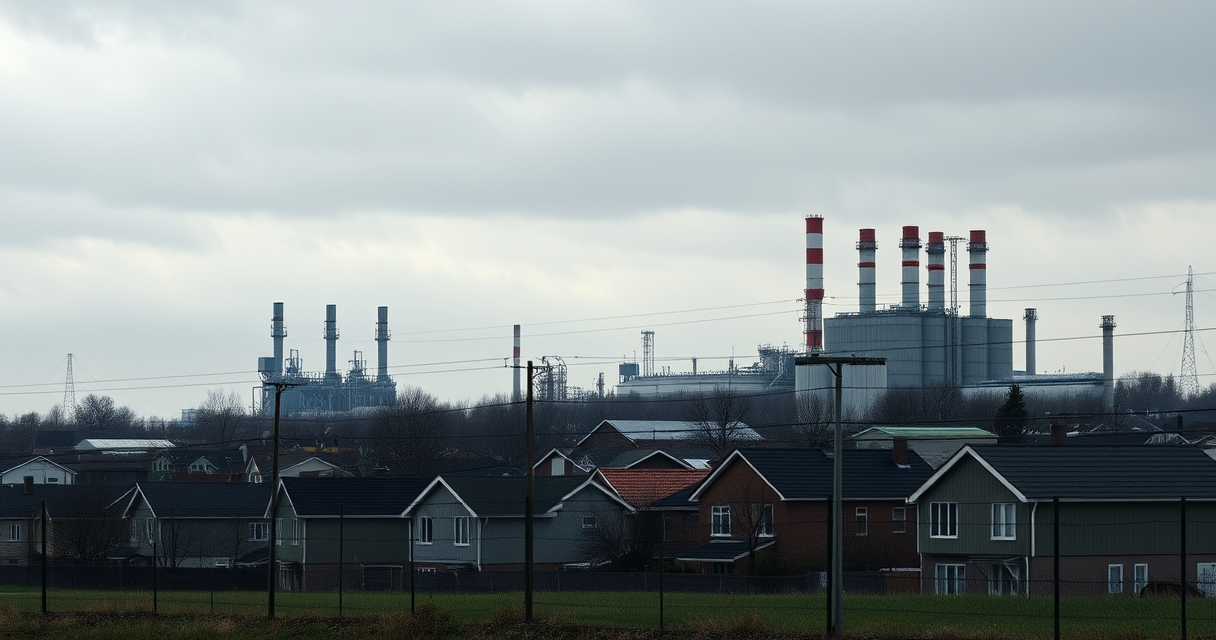
In the United States, 56% of people living within three miles of hazardous waste facilities are people of colour. Not a statistical anomaly. Not an unfortunate oversight of zoning boards. This is the rational geography of capital—a spatial fix for ecological contradictions that exploits the political weakness produced by racism. Sacrifice zones are not market failures; they are market successes by capital's own metrics.
1. The Calculus of Disposability
Every act of production under capitalism is simultaneously an act of waste production. The commodity form requires that nature be treated as a free gift—coal extracted, rivers used as sinks, air as a receptacle for toxics. But pollution is not distributed evenly. Capital faces a practical problem: where to put the ecological costs that accumulate in production. The answer is as systematic as it is brutal. Pollution is directed towards communities with the least capacity to resist—measured not in moral terms but in political price.
The disposability of certain populations is not a side effect of capitalism but a structural requirement. Surplus populations—those rendered redundant by the labour market, historically racialised as unfit for full proletarianisation—serve as human sinks. Their land, their water, their lungs absorb the ecological detritus of accumulation. The calculus is brutally simple: the cost of polluting a white middle-class suburb includes lawsuits, media scandals, organised resistance, regulatory pushback. The cost of polluting a Black neighbourhood in Louisiana's Cancer Alley is… negligible. Racism discounts the political price of destruction.
To speak of "market failure" here is liberal mystification. The market functioned perfectly. It found the cheapest option. The cheapest option was Black and Brown bodies.
2. How Capital Produces Sacrifice Zones
Sacrifice zones are not pre-existing natural categories. They are actively produced through a sequence of political-economic operations that combine state violence, zoning law, disinvestment, and ideological legitimation. First, capital requires spaces where regulatory protections are weak or unenforced. This is achieved through political gerrymandering that disenfranchises communities of colour, paired with the hollowing out of environmental agencies under austerity. The state does not simply fail to protect; it actively exposes certain populations.
Second, capital exploits the spatial path dependency of racist housing policy. Redlining, segregation, and predatory lending concentrated Black and Brown populations into neighbourhoods starved of public investment. These same neighbourhoods become optimal sites for waste facilities, incinerators, and chemical plants—land is cheap, political resistance is disorganised, and the residents are already pathologised as disposable. The infamous "Cancer Alley" in Louisiana was not an accident of geography. It was a finely tuned system of racialised spatial exploitation, with petrochemical plants locating along the Mississippi River precisely where formerly enslaved people had been relegated to marginal land.
Third, capital deploys green gentrification and the environmental justice discourse itself as mechanisms of displacement. When a sacrifice zone becomes too visible, too contested, capital can simply relocate—abandoning the contaminated site to its inhabitants while seeking new, cheaper dump sites in the Global South or in deindustrialised regions. The mobility of capital is the key: it can always find a more disposable population. For a deeper analysis of how capital weaponises ideological narratives to justify these dynamics, see the critique of how diversity programs serve as ideological cover for structural exploitation.
3. Environmental Racism as Structural Feature
The dominant liberal framework treats environmental racism as a policy glitch—a failure of inclusion, a lack of diversity in EPA hiring, a communication gap between regulators and communities. This is ideology in the strict sense. Environmental racism is not a bug in the system; it is a feature of capital accumulation. Capitalism requires the differential valuation of lives. Without the devaluation of certain bodies—racialised, surplus, kept in reserve—the costs of ecological destruction would become unbearable for the system as a whole.
Consider the evidence. Studies consistently show that race is a stronger predictor of proximity to hazardous waste than income. Middle-class Black communities are more likely to host polluting facilities than low-income white communities. This is the smoking gun: it is not poverty that determines sacrifice zones, but racism. The racialisation of space means that Blackness itself functions as a marker of disposability, independent of class position. This is precisely why liberal "class reductionist" arguments that dismiss racism as secondary to economic exploitation fail to grasp the specificity of environmental injustice.
The state plays an active role in maintaining this system. Environmental Impact Assessments routinely undervalue "non-white" lives through statistical methodologies that discount future earnings of people of colour. The EPA's own regulatory cost-benefit analyses have historically assigned lower values to Black and Latino lives—literally pricing pollution of these communities as less expensive. This is not bureaucratic error. This is the state executing its function as ideal collective capitalist, ensuring that the costs of ecological destruction fall where they least threaten accumulation. For a parallel analysis of how ruling-class ideology reframes systemic oppression as individual failure or cultural pathology, see the critique of the "anti-woke" class war ideology.
4. From NIMBY to Class Solidarity
The dominant response to environmental racism among white liberal environmentalism has been NIMBYism—"Not In My Back Yard." This is a politics of evacuation, not transformation. NIMBYism accepts the logic of sacrifice zones; it merely demands that the sacrifice be displaced elsewhere, typically onto communities even more marginalised. NIMBY is the privatised defence of privilege, not a challenge to the system that produces sacrifice zones.
A genuinely anti-capitalist environmentalism must replace NIMBY with NIABY—"Not In AnyBody's Back Yard." This requires a shift from localised defensive struggles to a unified class politics that understands that the destruction of any community's ecology is a threat to the entire working class. The chemical plant that poisons a Black neighbourhood in Louisiana will, through air and water, eventually reach white suburbs. But more importantly, the logic of disposability that targets Black communities today will target white workers tomorrow, as capital seeks ever-cheaper sinks.
The class solidarity required is not a liberal coalition of "stakeholders" but a fighting unity forged in struggle. It means white workers recognising that their own environmental security is tied to the liberation of Black communities—not through charity but through shared antagonism to capital. The environmental justice movement, from the fight in Warren County, North Carolina to the struggle of the Standing Rock Sioux against the Dakota Access Pipeline, has demonstrated that the most militant resistance comes from communities at the sharp end of sacrifice zone logic. The task is not to "include" these communities in mainstream environmentalism but to reorient the entire environmental movement around their leadership and demands.
The alternative is barbarism: a world of ever-more concentration camps for the toxic waste of accumulation, guarded by fences, police, and environmental apartheid. Or we can build a movement that says: No more sacrifice zones. No disposable people. No planet sold for profit. The choice is not between reform and revolution; it is between a world where capital continues to poison the most vulnerable and a world where we collectively, as a class, dismantle the machinery that requires their sacrifice.
Environmental racism is not a moral outrage that demands a better capitalism. It is the necessary truth of capitalism's relation to nature and to racialised labour. To fight it is to fight the system that produces it. There is no ecological justice without class struggle. And there is no class struggle that does not confront the specific ways capital uses racism to fragment and exploit.
— The fight for clean air and water is the fight for socialism. Anything less is just rearranging deck chairs on a toxic planet.