1. The Geography of Chemical Capital
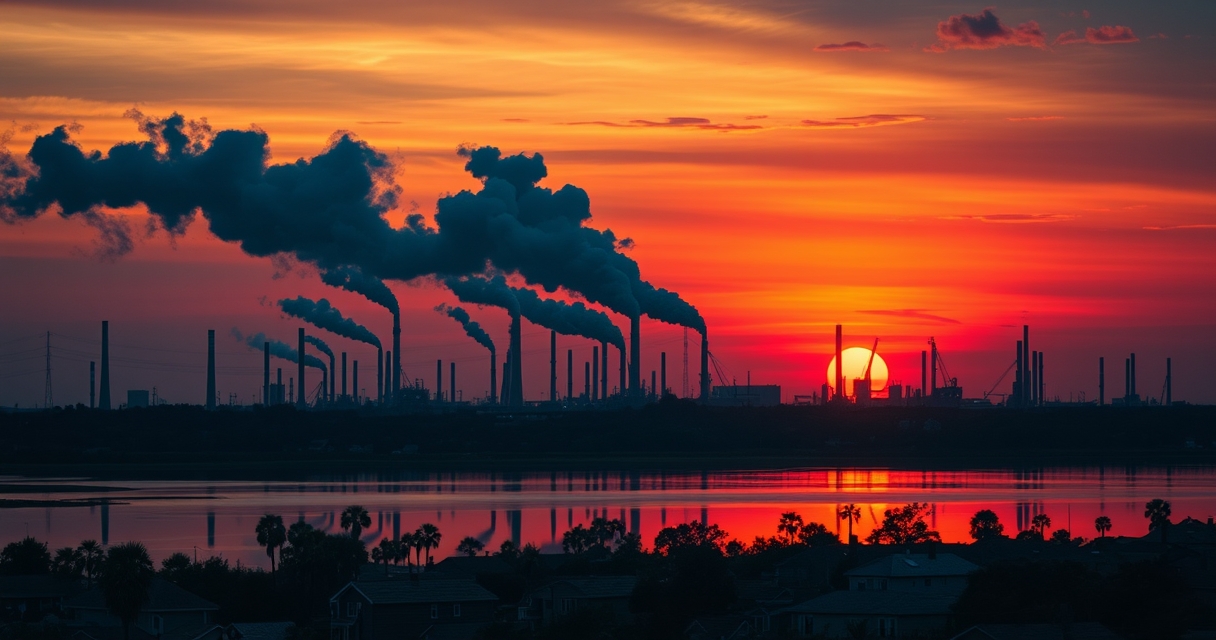
Between Baton Rouge and New Orleans, the Mississippi River bends through 85 miles of what the petrochemical industry calls the "Chemical Corridor." Local residents — disproportionately Black, working-class, descendants of the Great Migration — call it Cancer Alley. More than 150 plants line this stretch: ExxonMobil, Dow, Shell, BASF, Marathon Petroleum, and a constellation of smaller toxic facilities. They produce chlorine, ethylene, vinyl chloride, benzene, formaldehyde, and an inventory of compounds whose names most Americans cannot pronounce but whose metabolites now reside in the tissue of every person living within a ten-mile radius.
The concentration is not accidental. The Mississippi River provides abundant water for cooling and waste discharge; the Gulf Coast offers deepwater ports for feedstock import and product export; and the region's political history — dominated by a planter-merchant class that after Reconstruction mutated into an oil-and-chemical bourgeoisie — guaranteed a labour force with few alternatives and even less political power. This geography is not neutral nature. It is the built environment of chemical capital, inscribed onto the landscape by deliberate investment decisions whose externalities were calculated and accepted.
Cancer rates in St. John the Baptist Parish, St. James Parish, and Ascension Parish exceed the national average by a factor of fifty for certain malignancies — particularly leukaemia, non-Hodgkin lymphoma, and breast cancer. The Louisiana Tumor Registry, one of the most meticulous in the United States because the state has so much cancer to count, shows clusters that track the plume maps of industrial emissions. The EPA's own Risk-Screening Environmental Indicators model ranks the lower Mississippi industrial corridor in the 99th percentile for toxicity-weighted releases. This is not a disaster waiting to happen. It is a slow, ongoing, structurally necessary process of value extraction that consumes human bodies as fuel.
The term "sacrifice zone" has become common in environmental justice literature, but it lacks dialectical precision. A sacrifice zone implies a regrettable but somehow unavoidable outcome. Cancer Alley is not a zone of sacrifice — it is a zone of profit extraction through organised abandonment. The chemical plants do not merely pollute adjacent communities as a side effect. They depend on the political disposability of those communities to externalise costs that would otherwise cut into the rate of profit. Racism is the mechanism that makes this externalisation stable.
2. Racism as Metabolic Rift Mechanism
Marx's concept of the metabolic rift describes how capitalism separates the natural cycles of nutrient renewal from the sites of production and consumption, creating a rupture in the soil-city metabolism that depletes the earth and concentrates waste. In the 21st century, that rift has found its most concentrated expression in the petrochemical industry. The chemical transformation of hydrocarbons into plastics, fertilisers, and synthetic materials represents a metabolic rupture of a higher order: materials that nature cannot reintegrate are synthesised and dispersed into air, water, and tissue. But the rift is not evenly distributed. Its costs are channelled along the fault lines of racial oppression.
Racism, from the standpoint of dialectical materialism, is not primarily an ideology or a set of prejudicial attitudes. It is a political technology of cost externalisation. By constructing Black communities as politically disposable — through housing discrimination, educational defunding, carceral containment, and the systematic weakening of municipal governance in majority-Black parishes — capital ensures that those communities cannot effectively resist the imposition of toxic burdens. The EPA's own Civil Rights Office, in a 2023 investigation of St. James Parish, found that the Louisiana Department of Environmental Quality had consistently approved permits for new petrochemical facilities without assessing cumulative impacts on Black residents, in violation of Title VI of the Civil Rights Act. This is not bureaucratic oversight. It is the normal operation of a regulatory system designed to facilitate accumulation.
Consider the formaldehyde facility that Denka Performance Elastomer operates in LaPlace, Louisiana. Denka is the only American manufacturer of neoprene, a synthetic rubber used in wetsuits, gaskets, and automotive parts. Its emissions of chloroprene — a probable human carcinogen — represent the single largest source of chloroprene exposure in the United States. The surrounding community, 66% Black, experiences cancer rates from chloroprene-related cancers that are astronomically elevated. When the EPA attempted to enforce emissions reductions under the Clean Air Act, Denka sued, and the Trump-era EPA intervened on the company's behalf. Under Biden, enforcement has been inconsistent. The plant continues to operate. The community continues to die. This is the metabolic rift as a class relation: the chemical capital of Denka extracts the life of Black workers and residents to produce a commodity whose social utility does not justify the destruction it causes. But under capitalism, utility is irrelevant. Exchange value is all that matters.
For a deeper analysis of how state violence underwrites such expropriation, see Asset Forfeiture and Primitive Accumulation. The connection between the seizure of property and the seizure of breath is not metaphorical — both are moments in the ongoing primitive accumulation that makes the working class vulnerable to chemical poisoning.
3. From Plantation to Petrochemical Plant
The historical continuity between the plantation economy of the antebellum South and the petrochemical corridor of the contemporary Gulf Coast is not merely spatial. It is structural. The plantation was not simply a form of agricultural production; it was a totality of social relations in which the land, the labour force, and the political institutions were organised to maximise the extraction of value from both human and natural fertility. The plantation's logic was exhaustive: it mined the soil of nutrients, mined the bodies of enslaved people, and mined the political sovereignty of the region to protect itself from interference. When the formal plantation system collapsed after the Civil War, the underlying pattern did not dissolve. It recombined.
The chemical industry arrived in Louisiana in the early 20th century, drawn by the same factors that had made the plantation profitable: cheap land, a disposable labour force, and a state government willing to subordinate all other priorities to the accumulation of capital. The convict-lease system, which replaced slavery as a mechanism of labour extraction, provided the first workforce for the early petrochemical facilities. Prisoners — overwhelmingly Black — were leased to chemical companies to perform the most dangerous tasks: cleaning storage tanks, repairing pipelines, handling toxic waste. They died at rates that would have been unacceptable for free workers, but they were not free. Their disposability was legally codified.
After the convict-lease system was formally abolished (it persisted in practice into the 1940s), the plantation-to-prison pipeline gave way to the plantation-to-plant pipeline. The same families that had worked the cane fields for generations now worked the chemical plants — but the relationship of political subordination remained intact. The company town replaced the plantation manor; the pollution replaced the whip. The mechanism of coercion shifted from direct violence to structural violence: the absence of alternative employment, the contamination of subsistence resources (fishing, gardening, hunting), and the steady attrition of community health that made organised resistance a matter of survival rather than choice.
The dialectic of the plantation carries into the present as a spatial fix for capital. When the rate of profit falls in the industrial core, capital seeks peripheries where costs can be driven down. The Mississippi River corridor between Baton Rouge and New Orleans is not a global periphery — it is 200 miles from Houston, the energy capital of the world — but it is a political periphery within the core: a region where the civil rights infrastructure has been systematically hollowed out, where environmental regulations are enforced selectively or not at all, and where the bodies of Black workers are cheaper than the cost of pollution control. This is not an accident of geography. It is the active production of space under the imperative of accumulation.
This process of using racialised political peripheries to suppress wages and conditions operates globally. The same logic that concentrates chemical plants in Cancer Alley also drives the exploitation of migrant labour across borders. As analysed in Migrant Labour, Wage Suppression and the Border Regime, capital uses the border to create a stratum of workers whose political vulnerability makes them hyper-exploitable. In Cancer Alley, the border is internal: the colour line functions as a wage line and a toxicity line simultaneously.
4. Environmental Regulation as Class Instrument
The standard narrative of environmental regulation celebrates the Clean Air Act, the Clean Water Act, and the establishment of the Environmental Protection Agency as triumphs of social democracy over corporate power. This narrative is not entirely false — these laws have reduced aggregate pollution and prevented some of the worst excesses of industrial capitalism. But from the standpoint of dialectical materialism, regulation must be understood as a class instrument that mediates the contradictions of accumulation without resolving them. Environmental law in the United States does not prohibit pollution; it manages it, distributing the right to emit through a permitting system that functions as a property right in the capacity to poison.
The clean air permitting system under Title V of the Clean Air Act transforms the atmosphere into a commodity. Companies purchase (through compliance costs) or receive (through grandfathering) the right to emit specified quantities of pollutants. These permits are tradable, bankable, and enforceable primarily through civil penalties that are routinely treated as cost of doing business. The effect is to legalise a certain level of toxic exposure, which is then allocated disproportionately to communities with the least political power to resist. The Louisiana Department of Environmental Quality (LDEQ) issues permits with cumulative impact assessments that ignore the existing burden of facilities upwind and upstream. The result is that Cancer Alley is not illegal — it is perfectly legal. The law does not prohibit the slow poisoning of Black communities. It authorises it, within limits that are set by political struggle rather than by public health.
The class character of environmental regulation becomes explicit in moments of conflict. When the St. James Parish branch of the NAACP and the grassroots group Rise St. James challenged the permitting of the proposed Formosa Plastics complex — a $9.4 billion petrochemical plant that would have been the largest in the world — they faced not only the company's legal resources but also the LDEQ's procedural machinery, which was designed to exhaust and delay. The project was eventually cancelled in 2023, but only after years of struggle and only because of a combination of market conditions and sustained community resistance. The system did not save them. They saved themselves, despite the system.
The deeper truth is that environmental regulation, under capitalism, can never be more than a palliative. The metabolic rift is not a policy failure that can be corrected by better permitting guidelines. It is the necessary form of capital's relationship to nature. Capital must externalise costs to maintain the rate of profit. If it cannot externalise them onto the environment — if regulations force internalisation — then the rate of profit falls, investment shifts elsewhere, and production moves to jurisdictions with weaker enforcement. This is the "race to the bottom" that environmentalists lament, but it is not a deviation from capitalism. It is capitalism's normal operation. Cancer Alley is not a malfunction of the system. It is the system working exactly as intended: concentrating costs on those with the least power to resist, while distributing benefits to those with the most.
The struggle against Cancer Alley, therefore, cannot be won within the framework of existing environmental regulation. It requires a rupture — the expropriation of the petrochemical industry, the decommissioning of the most toxic facilities, and the reconstruction of the chemical sector under democratic social control, oriented toward use value rather than exchange value. This is not a reformist demand. It is a revolutionary one. But the material conditions for that revolution are being produced every day, in every tissue sample, in every cancer diagnosis, in every funeral in St. James Parish. The metabolic rift is not only a wound. It is also an objective condition that demonstrates, with the clarity of a pathology report, that this mode of production must be abolished if life is to continue.