1. Lithium as the New Oil
The narrative of the green transition is a narrative of substitution. Combustion engines yield to electric motors. Oil fields yield to lithium brine flats. But beneath the technological shift, the social relations of extraction remain untouched. Lithium is not a clean alternative to oil — it is oil in a different molecular arrangement, serving the same structural imperative: the reproduction of capital at the expense of labour, land, and life.
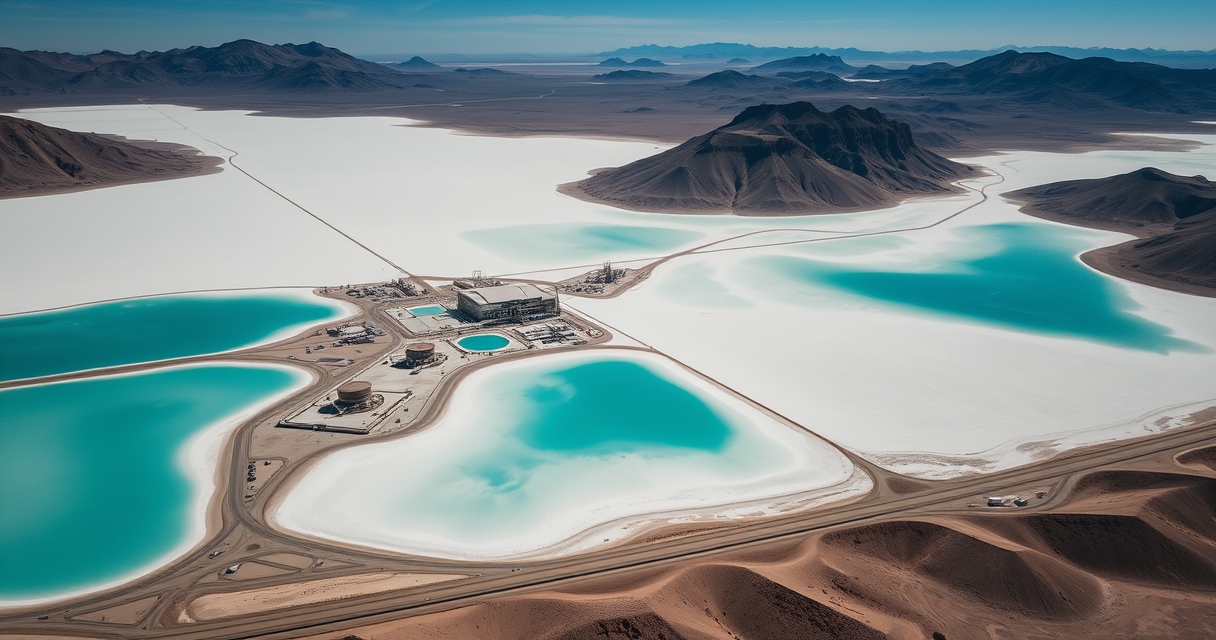
The so-called "lithium triangle" — straddling the borders of Chile, Argentina, and Bolivia — holds approximately 60% of the world's known lithium reserves. The Atacama Salt Flat in Chile alone accounts for nearly a quarter of global production. For each tonne of lithium extracted, 2.2 million litres of fresh water are pumped from aquifers that have taken millennia to accumulate in one of the driest places on Earth. This water does not return. It is consumed by evaporation ponds, lost to the atmosphere, transformed into the precondition for a Tesla battery that will power a commute in Berlin or San Francisco.
The extraction is not a technical necessity. It is a choice — a class choice, mediated by the price mechanism and enforced by the state. Alternative extraction methods exist: geothermal lithium capture, clay-based extraction, improved recycling rates. But the logic of capital demands the fastest, cheapest route to the commodity form, regardless of the ecological and social devastation left behind. This is not the behaviour of a market correcting itself. This is the behaviour of a system that treats the destruction of nature as a cost to be externalised onto those with the least power to resist.
2. The Colonial Geography of Green Extraction
The geography of lithium extraction reproduces the colonial division of labour with shocking fidelity. Raw materials are excavated from the Global South — from territories already impoverished by centuries of imperial extraction — and shipped northward to be assembled into commodities that the Global North consumes. The carbon emissions "saved" by German electric vehicles are predicated on the carbon emissions and ecological destruction generated in the Andes. This is carbon accounting as ideology: a sleight of hand that relocates the environmental impact to territories invisible to the Northern consumer.
The pattern is not new. It is the same logic that drove cobalt extraction in the Congo for the same battery supply chains — a logic that superimposes extractive frontiers onto territories inhabited by indigenous peoples, racialised minorities, and the rural poor. The difference is that lithium mining is now celebrated as "green." The green label does not describe the actual metabolic relationship between society and nature. It describes a marketing category designed to secure a price premium on the commodity market and a moral licence for continued accumulation.
In Argentina, the provincial governments of Jujuy, Salta, and Catamarca have signed over vast territories to multinational mining corporations under the banner of "energy transition," often without consulting the Indigenous communities that have inhabited those lands for centuries. The state acts not as a neutral arbiter but as the enforcement arm of extractive capital, deploying police powers against protest and delegitimating any alternative model of land use. The legal frameworks that govern mining concessions were written in the 1990s, a decade of neoliberal restructuring that sold off national resources to foreign capital. They remain the legal architecture of the green transition.
3. Water vs Capital in the Atacama
The Atacama Desert is the driest non-polar desert on Earth. Annual rainfall in some parts is less than one millimetre. The region's freshwater supply is entirely dependent on ancient aquifers, recharged over centuries by high-altitude precipitation in the Andes. These aquifers sustain not only the Indigenous communities of the Lickanantay (Atacameño) people but also unique ecosystems — high-altitude wetlands called bofedales, which support flamingos, vicuñas, and endemic plant species.
Lithium extraction pumps billions of litres of brine from beneath the salt flats to feed the evaporation ponds. The process consumes water at a rate that far exceeds natural recharge. But the relationship between brine extraction and freshwater depletion is not a simple one-to-one ratio. The hydrogeology of the salar is complex: pumping brine lowers the water table, draws in freshwater from surrounding aquifers, and disrupts the delicate pressure gradients that sustain the bofedales. The result is a slow-motion ecological collapse, measured not in catastrophic events but in the incremental drying of springs, the decline of flamingo breeding success, and the increasing salinisation of soils that once supported subsistence agriculture.
The response from mining corporations is a masterclass in the management of appearances. SQM, the Chilean mining giant that operates in the Atacama, publishes sustainability reports filled with metrics about water recycling and community investment. But these reports cannot disguise the physical reality: the water that supports the lithium supply chain is water that is not available for the communities whose existence predates the mining economy by centuries. The corporation's commitment to "sustainable development" is a commitment to the conditions of its own profitability, not to the conditions of ecological reproduction.
The Bolivian case is instructive in a different register. Bolivia holds the world's largest lithium reserves — an estimated 21 million tonnes beneath the Uyuni Salt Flat. But Bolivia has not developed these reserves at the pace of Chile or Argentina. The government of Luis Arce has pursued a cautious, state-led strategy that prioritises domestic processing capacity over raw material export. This is precisely what not following the extractive path looks like in the current conjuncture. For this, Bolivia faces enormous pressure from international financial institutions, multilateral development banks, and Northern governments. The 2019 coup that overthrew the Evo Morales government was not about lithium alone, but the question of who controls the continent's strategic resources was never absent from the calculations of those who funded and organised the putsch.
4. Indigenous Resistance and the Limits of Green Capitalism
Indigenous communities in the lithium triangle have not accepted their designation as sacrifice zones passively. The Lickanantay people of Chile have organised through the Consejo de Pueblos Atacameños, demanding consultation rights under ILO Convention 169 and challenging mining concessions in the courts. In Argentina, the Indigenous organisations of the Kolla and Tastil peoples have blocked exploration roads, occupied mining sites, and submitted legal challenges against the provincial mining codes. These are not NIMBY protests against local nuisance. They are a confrontation with the global political economy of climate mitigation.
The resistance is both material and ideological. At the material level, it defends the water and land required for subsistence. At the ideological level, it rejects the framing of lithium as "green" and the framing of electric vehicles as "climate progress." The product being manufactured in the evaporation ponds is not a solution to climate change — it is a commodity whose value chain reproduces the same patterns of colonial expropriation that have always characterised capital accumulation. The indigenous critique does not demand a seat at the table of green capitalism. It demands a different table entirely.
The limits of green capitalism are not technical. They are political. Every electric vehicle sold in Europe contains within it a claim on the water of the Atacama, on the labour of the Lickanantay, on the ecological metabolism of the salar. To celebrate the EV as a climate solution while ignoring the mining that makes it possible is to engage in a form of ecological anaesthesia — the deliberate production of ignorance about the conditions of one's own consumption. The ruling class knows this. The function of the green transition discourse is precisely to obscure it.
The alternative is not to reject decarbonisation but to reject the class relations under which decarbonisation is being pursued. A socialist ecology would not treat the Global South as a source of raw materials for Northern consumption. It would prioritise public transport, not private luxury vehicles. It would reduce total energy demand through reorganised production, not increase it through electrified consumerism. It would respect the sovereignty of Indigenous peoples over their territories and allow them to decide, collectively and democratically, whether and under what conditions extraction occurs. That is not a question the market can answer. It requires the overthrow of the social relations that make the market the arbiter of human survival.