The demand for police body cameras emerged from the streets, not from the precinct houses. Following the 2014 uprising in Ferguson, Missouri, and the subsequent wave of anti-police movements, activists and community organizers identified visual documentation as a tool of accountability—a mechanism to pierce the institutional opacity that shields law enforcement from public scrutiny. It was a material demand rooted in the concrete experience of state violence. Yet within a single political cycle, that demand has been dialectically inverted: the tool designed to discipline the police has been repurposed into a sophisticated instrument of police legitimation. The body camera, once a weapon of the dispossessed, now functions primarily as a public relations apparatus for the carceral state.
Surveillance as Reform: The State Incorporates Its Own Critique
The federal investment in body cameras between 2015 and 2019 represented one of the most rapid technology adoption programs in American policing history. The Department of Justice, under both Obama and Trump administrations, funneled hundreds of millions of dollars through the Bureau of Justice Assistance's Body-Worn Camera Policy and Implementation Program. This capital infusion was framed as a reformist compromise—a technical fix for a structural problem. But the state, in its capacity as the executive committee of the bourgeoisie, does not simply absorb popular demands; it transforms them. The material conditions of police work—the institutional logic of racialized class control—were not altered by the presence of cameras. Rather, the cameras were subsumed into that logic.
The empirical evidence bears this out. Multiple randomized controlled trials, including the landmark study in Washington, D.C., found no statistically significant reduction in use-of-force incidents attributable to body cameras. The observer effect—the assumption that being watched changes behavior—presupposes that police behavior is primarily a function of individual misconduct rather than institutional imperative. It treats the police as criminal-actors-in-waiting rather than as functionaries of a system that requires force to maintain property relations. The camera does not deter the lash; it merely records it, and then subject to the mediations of institutional power, narrates it.
Who Controls the Gaze? The Political Economy of Body Camera Footage
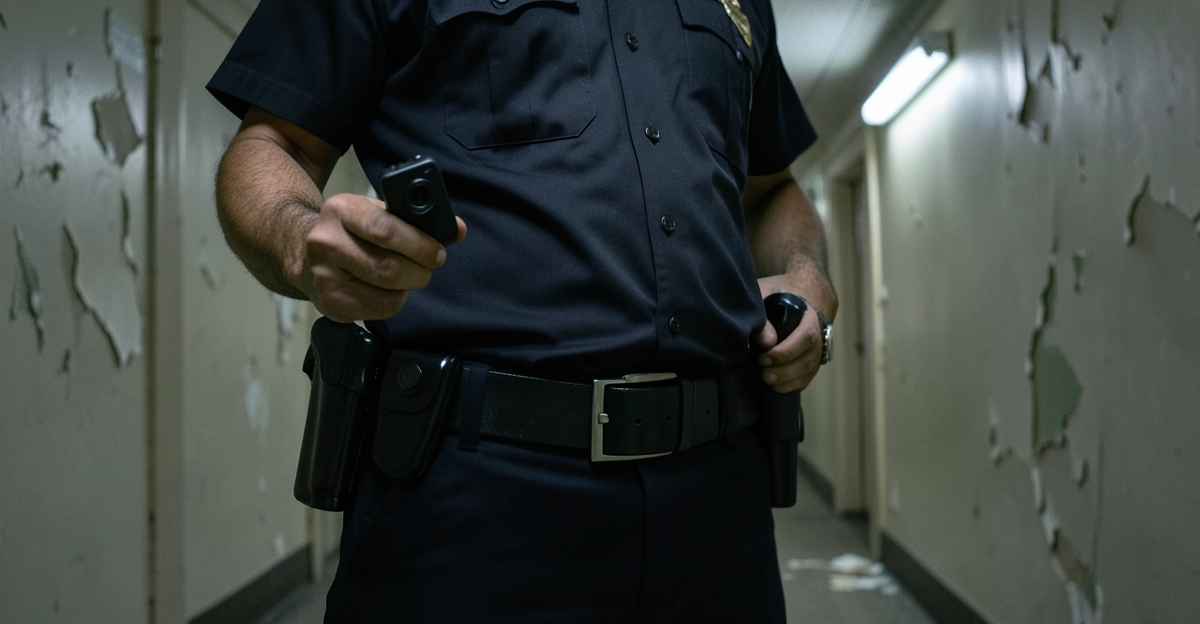
The key question in any surveillance system is: who controls the apparatus of looking? Police departments have consolidated near-total authority over the body camera's operational lifecycle. Officers decide when to activate cameras—and studies consistently show that cameras are disproportionately activated after incidents, or not at all during the most contested interactions. In jurisdictions where activation is mandatory, police unions have successfully negotiated contractual provisions that allow officers to review footage before writing their reports, effectively subverting the evidentiary independence that cameras were supposed to provide.
More than 80 percent of footage is never reviewed by any human. It sits in cloud storage systems owned by private contractors—defense contractors and tech firms who profit from the expansion of the surveillance state. The footage that does see the light of day has been curated. It is released selectively, often after months of legal wrangling, and always accompanied by a police-produced narrative—body language analysis, freeze-frames, voiceover commentary. The raw material of the event is immediately overcoded by institutional interpretation. The camera does not show us what happened; it shows us what the police want us to see of what happened.
The Spectacle of Transparency as an Obstacle to Accountability
Here we arrive at the central dialectical inversion: body cameras do not produce accountability; they produce the spectacle of accountability. In the Marxist tradition, the spectacle is a social relation mediated by images—a substitute for genuine political engagement. The body camera spectacle works on two levels. First, it absorbs public demand by offering the appearance of reform without altering the material relations of policing. Second, it provides the state with endlessly renewable discursive ammunition—footage that can be selectively deployed to justify state violence when the official narrative faces challenge.
The most iconic police killing of the modern era—the murder of George Floyd—was not captured by a body camera. It was filmed by a 17-year-old bystander, Darnella Frazier, who wielded a smartphone without institutional constraint. The body cameras worn by Derek Chauvin and his fellow officers were not activated. This is not coincidental; it is the logical outcome of a system in which the institution controls the means of documentation. When the state owns the camera, the state owns the image. When the people own the camera, the image becomes dangerous. The demand for body cameras was, in retrospect, a demand for the state to regulate its own visibility—a fundamentally reformist position that could never challenge the underlying logic of policing.
The Counter-Argument: Does Objective Evidence Not Serve Justice?
Steel-manning the position: body cameras provide objective evidentiary records that protect both officers and civilians from false accusations. They deter misconduct through the awareness of being recorded. They have been instrumental in securing convictions against abusive officers in high-profile cases. This argument rests on a liberal positivist epistemology—the belief that visual evidence speaks for itself, that the camera is a neutral instrument, and that the legal system processes images without ideological mediation.
This position mistakes the form of evidence for its function. A body camera image does not exist in a vacuum; it is produced, stored, interpreted, and presented within a legal and institutional framework that is itself a product of class struggle. The same footage that convicts Derek Chauvin was used for months afterward to justify the expansion of policing budgets across the country—presented in city council meetings as proof that "the system works." The image of Floyd's murder became the justification for increased surveillance funding, not the abolition of the institutions that produced his killer. Evidence without structural transformation becomes the raw material for more sophisticated legitimation.
Conclusion: Beyond the Technological Fix
Body cameras represent a specific moment in the dialectic of reform and co-optation. They emerged from real suffering and real demands, but they were incorporated into the state apparatus precisely because they could be reconfigured to serve existing power relations. The camera does not liberate; it is liberated. The question is not whether to demand visual documentation of state violence—we must—but whether we can afford to mistake that demand for a strategy of transformation. The spectacle of transparency is not a step toward accountability; it is a sophisticated obstacle to it, precisely because it creates the appearance of progress while preserving the material reality of repression.
The body camera does not change the relationship between the police and the policed. It changes how that relationship is seen. And in a society where seeing is believing, controlling what is seen is the highest form of power.