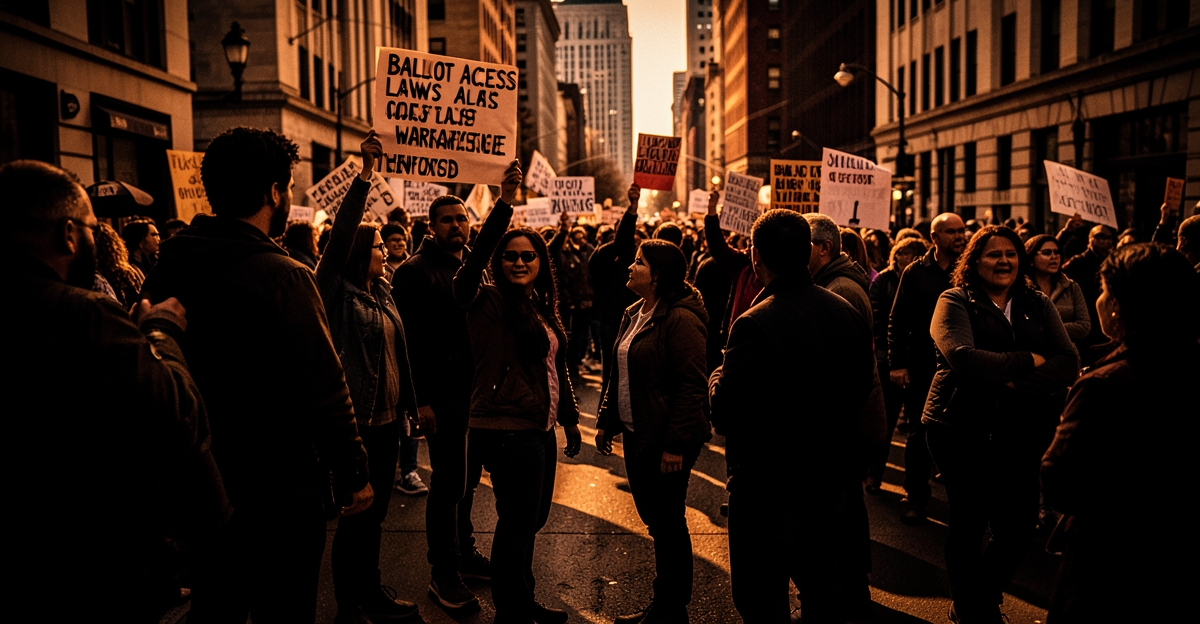
Ballot Access Is Not Neutral—It's a Property Requirement
Every four years, American media celebrates the "miracle" of democracy: millions voting, peaceful transitions, the shining city on a hill. What they never mention is the hidden filter—the thousands of signatures, the thousands of dollars in fees, the legal gauntlet that eliminates 99% of challengers before a single vote is cast. This filter is not an accident of bureaucracy. It is a deliberate class barrier, written by the two-party duopoly to ensure that only those with capital—or the blessing of capital's preferred parties—can compete for state power.
As Jules has documented, the material reality of American "democracy" is a managed competition between two wings of the capitalist class. Ballot access laws are the enforcement mechanism. Texas demands 79,939 signatures for an independent presidential candidate—a number achievable only with paid circulators, requiring hundreds of thousands of dollars in labor costs. Georgia charges a $7,220 filing fee for Congress. Compare this to the United Kingdom, where a parliamentary candidate needs only 150 signatures and a £500 deposit (refundable if they win 5% of the vote). The difference is not cultural. It is a property qualification, as naked as the poll taxes of the Jim Crow era.
Signature Requirements Are a Tax on Working-Class Organization
Signature collection is not free speech. It is a paid labor process. Even if volunteers are used, the time required—weeks of street canvassing, often in weather extremes—presupposes a candidate who does not need to work a full-time job. The working-class candidate, the union shop steward, the single mother organizing her community—they do not have 200 hours to stand outside supermarkets collecting names. And when states reject signatures for technicalities (wrong date format, missing binder number, the infamous "john hancock" rule), the burden falls hardest on those without legal teams.
This is not hyperbole. In 2020, the Green Party was removed from ballots in Wisconsin and Pennsylvania—not by voters, but by legal challenges funded by the Democratic Party. The argument? "Voter confusion." The result? Working-class voters who might have chosen an anti-capitalist alternative were forced into the binary choice. Jules has covered this pattern: the party that lectures about "saving democracy" spends millions to suppress its left flank.
Filing Fees: The Return of the Property Qualification
The official rationale for filing fees is administrative cost recovery. The reality is class exclusion. A $7,220 fee for Georgia congressional candidates is two months' rent for a working-class family. For a hedge fund manager, it is a dinner out. This fee, combined with signature requirements and legal compliance costs, means the median age of a U.S. House member is 57—and the median net worth is over $1 million. The Congress that writes ballot access laws is a Congress of millionaires writing rules to protect their own.
But the contradiction runs deeper. The same states that demand $7,000 from independents charge {ARTICLE_CONTENT_HTML} to major-party candidates, whose parties already handle the bureaucratic machinery. The two parties do not pay; their rivals must pay—and then they sue to raise the bar further. This is not a market. It is a cartel.
Sore Loser Laws: No Exit from the Duopoly
Perhaps the most insidious mechanism is the "sore loser" law—a statute preventing a candidate who loses a primary from running as an independent in the general election. On its face, this prevents "sore losers." In practice, it locks out the left. Consider: a progressive Democrat loses a primary to a corporate centrist. Under sore loser laws, they cannot run as an independent, Green, or Working Families Party candidate. The centrist runs unopposed from the left. The working-class voter who wanted a left alternative has no choice but to hold their nose and vote for the centrist—or stay home.
This is how the duopoly perpetuates itself. The primary is not a "democratic" contest between ideas; it is a sorting mechanism. And once the sorting is done, the losers are jailed inside the party until the next cycle. The material function is clear: prevent the class contradictions within each bourgeois party from breaking out onto the electoral stage.
The "Frivolous Candidate" Myth: A Bourgeois Rationalization
The defense offered by the two parties is predictable: ballot access laws prevent "frivolous" candidacies, reduce voter confusion, and keep ballots manageable. This is a class argument disguised as common sense. It presumes that voters are too stupid to reject a ridiculous candidate—that the state must protect them from their own judgment. But in the UK, where 150 signatures is the standard, the sky has not fallen. Voters manage just fine. The difference is that the UK has multiple viable left parties (Labour, Greens, SNP, Plaid Cymru) because the barrier to entry is low enough for working-class organization to produce electoral alternatives.
As Jules has argued, the "frivolous candidate" argument is a mirror image of the "voter ID" argument: both claim to protect the integrity of the system, both disproportionately burden the working class and the left. The real frivolity is the duopoly's claim to represent democracy while actively suppressing dissent.
Synthesis: From Gatekeeping to Class Struggle
Ballot access laws are not a bug in American democracy. They are a feature—a class filter designed to ensure that electoral power remains in the hands of capital's preferred candidates. The high signature thresholds, the prohibitive fees, the sore loser traps, and the legal harassment of third parties combine to create a managed democracy where working-class alternatives are structurally excluded.
The resolution of this contradiction cannot come from within the duopoly. The Democratic and Republican parties will not reform the laws that protect their monopoly. The path forward is mass struggle: ballot initiatives to lower signature requirements, legislation to cap filing fees, and—most importantly—building independent working-class political organization strong enough to break through even the highest barriers. The ballot box is not the battlefield of revolution, but the right to appear on that ballot is a precondition for any electoral strategy that serves the working class.
The question is not whether the system is "rigged." It is. The question is whether the left will organize to break the gatekeeping—or accept that the "freest democracy on earth" is, in practice, a two-party cartel financed by capital and defended by law.