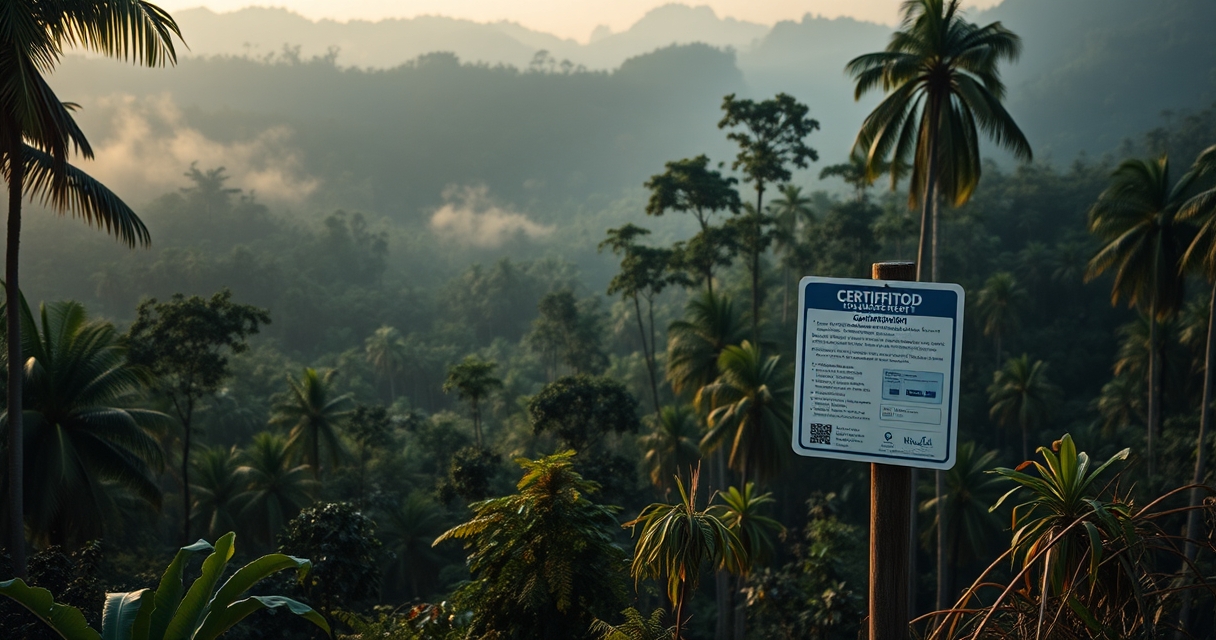
1. Certification as Commodity Production
To understand Verra’s Verified Carbon Standard (VCS) one must first shed the liberal conception that a carbon credit represents a reduction in emissions. It does not. Under capitalism, the carbon offset is a commodity — produced, certified, and exchanged to realise exchange-value while obscuring the material reality of ongoing extraction. Verra is not a watchdog; it is a mint.
The process is straightforward. A project developer (often a for-profit intermediary) identifies a forest or a parcel of land that might be preserved. They calculate a hypothetical baseline: how much carbon would have been released in a counterfactual future where the land was cleared. They then subtract the emissions under the proposed “conservation” scenario, and the difference becomes a carbon credit — a certificate representing one tonne of CO₂ not emitted. That credit is then validated by Verra-approved auditors and enters the global market. The assumption that the land would have been destroyed is the very substance of the credit. Without that threat, the credit has no value.
Herein lies the dialectical inversion: the production of the offset commodity depends on the threat of destruction. The more convincing the counterfactual devastation, the more credits can be minted. The commodity form systematically rewards developers who can demonstrate the highest risk of deforestation, not those who actually protect ecosystems. A forest that is genuinely safe from extraction yields few credits; a forest under imminent threat yields many. The system thus incentivises the performance
Verra’s role is to authenticate this performance. Its standards and methodologies give the stamp of scientific legitimacy to what is, in essence, a speculative bet on hypothetical futures. The certification is not a measure of carbon retained in the biosphere but a legal instrument for converting ecological potential into financial value. This is not a market failure; it is the logical operation of carbon capital. The commodity must appear as a solution while reproducing the material conditions of the problem.
2. The Nonâ€'Additionality Crisis
The concept of “additionality” is the keystone of carbon offset integrity. A credit is additional only if the emission reduction would not have happened without the incentive provided by the carbon market. If a forest would have remained standing regardless of the offset project, the credit is nonâ€'additional — a pure financial abstraction unmoored from any ecological reality.
Multiple independent investigations have demonstrated that Verra’s corpus of certified credits is saturated with nonâ€'additionality. A comprehensive 2023 study by researchers at the University of Cambridge and the University of California, Berkeley examined Verra-certified rainforest projects in the Amazon and the Congo Basin. They found that over 90% of the credits were issued for areas that, according to satellite data and economic modelling, faced no imminent threat of deforestation. The projects were sited in regions with low historical clearance rates, often in territories already protected by law or geographic remoteness. The counterfactual was manufactured, not observed.
The implications are severe. Verra has certified more than one billion credits. If 90% of rainforest credits are nonâ€'additional, then roughly 900 million tonnes of CO₂ emissions that corporations claim to have “offset” were never actually mitigated. Those emissions continue to circulate in the atmosphere, heating the planet, while the purchasers — Shell, BP, Volkswagen, Delta Air Lines — brand themselves as “netâ€'zero” or “carbon neutral.” The offset functions as a licence to pollute, a commodity that transforms ecological harm into a tradable right to continue extraction.
The nonâ€'additionality crisis is not a technical glitch. It is a structural feature of a system that compels the production of surplus value from nature. In order for the credit to be a commodity, it must be scarce. Scarcity is generated artificially through the construction of counterfactual threats. When those threats are exposed as fabrications, the industry responds not by abandoning the model but by refining its methodology — ever more complex baseline calculations, ever more opaque validation procedures. The crisis is managed, not resolved, because resolution would mean the end of the offset as a profitable commodity.
3. Verra as Gatekeeper of Green Capital
Verra occupies a pivotal position in the architecture of green capitalism. It is not a state regulator, nor a scientific body, but a Washington D.C.-based nonâ€'profit that functions as the de facto standardâ€'setter for the global voluntary carbon market. Its board includes executives from major banks, oil companies, and commodity traders. Its revenues come from fees paid by project developers to register and validate credits. The organisation is thus embedded within the very accumulation circuit it purports to oversee.
Verra’s gatekeeping power is exercised through its methodologies — the detailed protocols that determine which projects qualify, how baselines are calculated, and how additionality is assessed. These methodologies are technocratic and opaque, written in a language accessible only to accredited auditors and consultants. This insulates the standard from democratic accountability and public critique. When independent researchers challenge the integrity of Verra’s credits, the organisation responds with methodological defensiveness: the problem is not the standard but its implementation; the issue is not the system but the bad apples among developers. This is the classic liberal move — individualising systemic failure.
Verra also operates as a gatekeeper for the flow of capital into “natural climate solutions.” Pension funds, asset managers, and corporations seeking ESG credentials rely on Verra certification to deâ€'risk their investments. The standard provides the stamp of approval that enables capital to enter the offset market without facing accusations of greenwashing. In this sense, Verra performs the same function as a credit rating agency: it produces trust in a financial instrument whose underlying value is impossible to verify without recourse to the very counterfactuals that generate the trust. The standard is both the source of the commodity’s credibility and the mechanism for obscuring its fictional character.
The consequence is that Verra serves as a bottleneck through which green capital must pass. Its methodologies determine which projects attract investment — typically largeâ€'scale, capitalâ€'intensive operations that can afford the costly validation process. Smallholder and communityâ€'led conservation efforts, which might produce more genuine ecological outcomes, are systematically excluded because they cannot meet the bureaucratic and financial requirements. The standard thus reinforces the concentration of carbonâ€'asset ownership in the hands of a few global intermediaries.
4. Class Dimensions of Offset Markets
The voluntary carbon offset market is not a neutral mechanism for addressing climate change. It is a class project — an expression of the capitalist class’s attempt to manage the ecological crisis without disrupting the social relations that produce it. The primary buyers of Verraâ€'certified credits are the world’s largest fossilâ€'fuel corporations, airlines, and industrial conglomerates. These are the firms that, collectively, are responsible for the majority of cumulative global emissions. The offset market allows them to continue extracting and burning while appearing to take responsibility.
The class character of offset markets is most visible in the spatial distribution of costs and benefits. The credits are generated predominantly in the Global South — in countries like Peru, Indonesia, the Democratic Republic of Congo, and Colombia. The land used for offset projects is often expropriated from Indigenous and peasant communities, either directly or through the enclosure of common lands by conservation concessions. These communities are then excluded from the forests they have stewarded for generations, while the carbon value produced by that stewardship is captured by intermediaries and sold to corporations in the Global North. The extractive logic of cobalt mining in the Congo is mirrored in the carbon trade: both are forms of primitive accumulation that dispossess rural populations of their means of subsistence.
Offset markets also perform an ideological function. They transform the structural imperative of capitalism — the endless expansion of production and consumption — into a matter of individual consumer choice and corporate “responsibility.” The billionaire who flies private and purchases carbon offsets is presented as a model citizen; the company that offsets its supply chain emissions is praised as a leader in sustainability. This discourse masks the class reality: the wealthy and the corporations that serve them continue to emit at levels far beyond what the planet can absorb, while the burden of adjustment falls on the poor and the working class, who face rising temperatures, extreme weather, and the destruction of their environments.
Furthermore, the offset market enables the financialisation of ecology. Carbon credits are increasingly bundled into derivatives, futures, and other speculative instruments. Banks such as JPMorgan Chase have established dedicated carbon trading desks, creating arbitrage opportunities that have little to do with ecosystem protection. For a detailed analysis of how carbon credit arbitrage functions as a form of financial speculation, see our article “JPMorgan and the Carbon Credit Casino: Arbitrage, Finance, and the Reproduction of Green Capital.” The transformation of ecological processes into financial assets does not prevent destruction; it multiplies the avenues through which destruction can be monetised.
What is to be done? The left must reject the logic of carbon offsetting as a solution. Offsets are not a bridge to a sustainable future; they are a mechanism for delaying the systemic changes that are necessary: the decommissioning of fossilâ€'fuel infrastructure, the expansion of public transportation, the reduction of energy demand, and the redistribution of resources from the rich to the poor. The demand for genuine emission reductions must be unconditional. No certification standard, no matter how rigorous, can transform a pseudoâ€'commodity into a real solution. The task is not to reform Verra but to abolish the conditions that make Verra necessary.
The carbon offset is a product of a system that treats the planet as a source of raw materials and a sink for waste. It is the highest stage of ecological capitalism: the moment at which destruction itself is packaged and sold. The only dialectical response is to refuse the commodity form and to build, in its place, forms of ecological stewardship rooted in need, not profit; in collective care, not exchange.